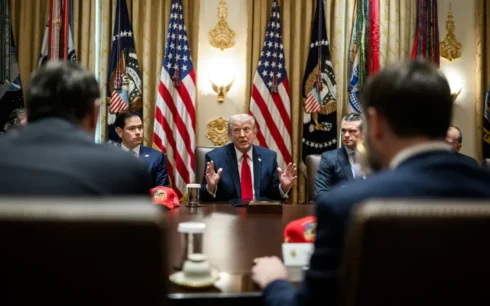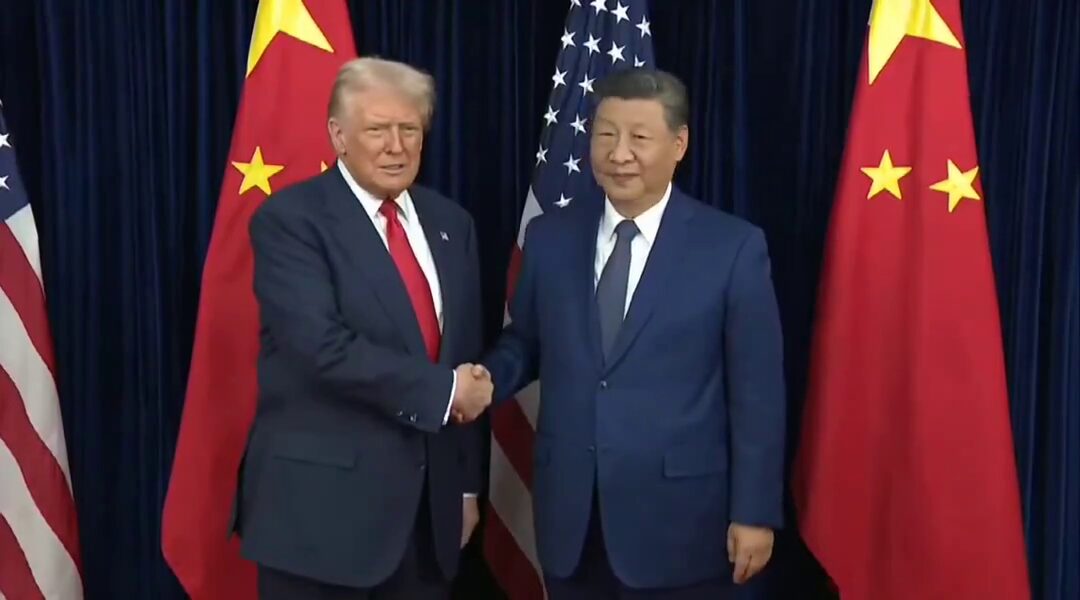
President Trump met with Chinese President Xi Jinping on Thursday at a South Korean military base, where the two leaders discussed a range of contentious issues, including trade, technology, and rare earths. The meeting, which lasted about 90 minutes, came against the backdrop of escalating geopolitical tensions and a surprise announcement from Mr. Trump that the United States would resume nuclear weapons testing after a more than 30-year moratorium.
Speaking to reporters before the bilateral meeting began, Mr. Trump struck a hopeful tone, saying the two leaders had “already agreed to a lot of things.” However, his remarks were quickly overshadowed by his earlier social media post declaring the Pentagon would “begin testing our Nuclear Weapons on an equal basis,” a move he said was in response to recent weapons tests by Russia.
There was no immediate clarification from the White House about whether the testing would involve actual nuclear detonations. The United States has not conducted an explosive nuclear test since 1992, although it regularly tests unarmed missiles and other components of its nuclear arsenal.
A trade truce, for now
Despite the nuclear cloud, the summit yielded some economic progress. Mr. Trump said both sides agreed to pause the ongoing trade dispute for at least a year, describing the talks as “constructive.” The Chinese government had not yet confirmed the deal as of Thursday afternoon.
According to Mr. Trump, Beijing has agreed to temporarily lift restrictions on exports of rare earth minerals—materials critical to the manufacturing of semiconductors, electric vehicles, and military hardware. He also said China pledged to crack down on precursor chemicals used to manufacture fentanyl, a potent synthetic opioid that has fueled a crisis in the United States.
In response, the U.S. will reduce tariffs on certain China-linked chemicals from 20 percent to 10 percent. The White House did not provide further details, and Chinese officials made no immediate statements on the matter.
Nuclear testing announcement
Mr. Trump’s decision to announce the resumption of nuclear testing—on social media and en route to Busan—took both allies and officials by surprise. The announcement follows recent claims by Russian President Vladimir V. Putin that Moscow successfully tested a nuclear-powered cruise missile and a nuclear-capable torpedo.
Arms control experts quickly expressed concern that Mr. Trump’s statement could mark the beginning of a new global nuclear arms race, particularly as Washington has yet to re-engage in arms limitation treaties scrapped during his first term.
“This move undermines decades of bipartisan efforts to prevent the spread and escalation of nuclear weapons,” said a senior arms control analyst at the Brookings Institution. “Without a clear commitment to non-proliferation, we’re entering dangerous territory.”
Mr. Trump greeted Mr. Xi warmly at the base near Busan, though the atmosphere was reportedly tenser than during his meetings with Japanese and South Korean leaders earlier in the week. Mr. Xi, in opening remarks before the closed-door talks, acknowledged ongoing “frictions” but emphasized the need for the United States and China to remain “partners and friends.”
“It is normal for the two leading economies of the world to have frictions now and then,” Mr. Xi said, speaking through a translator. “We are fully able to help each other succeed and prosper together.”
Mr. Trump, in turn, called Mr. Xi “a friend of mine,” adding that they expected to cover a wide range of issues, including computer chips and trade barriers. “It’s an honor to be with a friend,” he said, signaling optimism despite the thorny topics on the agenda.
No mention of nukes in meeting
Neither leader publicly addressed the nuclear testing announcement during or after the summit. The two appeared briefly before reporters following their discussions, shaking hands and exchanging pleasantries. Mr. Trump leaned in to whisper something to Mr. Xi before boarding Air Force One.
Mr. Xi departed shortly thereafter for Gyeongju to attend an economic forum hosted by South Korea.
Trump heads home after Asia tour
Mr. Trump’s visit to Busan marked the final leg of a five-day tour through Malaysia, Japan, and South Korea. He is scheduled to return to Washington Thursday afternoon, where he is expected to attend a Halloween event at the White House.
Despite a whirlwind of policy announcements and high-stakes diplomacy, the outcome of the Trump-Xi meeting remained largely symbolic. While both sides offered modest concessions, questions linger about the durability of any agreements—and the implications of Washington’s renewed nuclear posture.