For years, Afghanistan has sought a direct trade and transit route to China through the Wakhan Corridor, a narrow, mountainous strip of land in the country’s far northeast and its only direct geographical connection to China.
Taliban now say they are making progress toward that goal.
The Taliban-run Ministry of Rural Rehabilitation and Development said on June 16 that construction work on the Wakhan road was 75 percent complete and that the project would soon be finished.
But former officials and economists say the road now under construction is only a preliminary step. Turning Wakhan into a functioning trade and transit corridor, they say, would require hundreds of millions of dollars in additional investment in highways, railways, customs facilities and other infrastructure.
Hamidullah Farooqi, a former Afghan minister of transport and civil aviation, said the current project was insufficient to establish a safe and modern commercial route.
“We need hundreds of millions of dollars,” Farooqi told Amu. He described the current work as a preliminary effort that, on its own, could not resolve Afghanistan’s transit challenges.
A remote corridor with strategic ambitions
The Wakhan Corridor stretches for about 260 kilometers through Badakhshan province and varies in width from roughly 12 to 60 kilometers.
Its administrative center is Khandud, and its population consists primarily of Tajik and Kyrgyz communities.
The corridor was shaped in the 19th century as a buffer zone between the British and Russian empires. Today, it lies between Tajikistan to the north and Pakistan to the south, extending eastward to Afghanistan’s short border with China’s Xinjiang region.
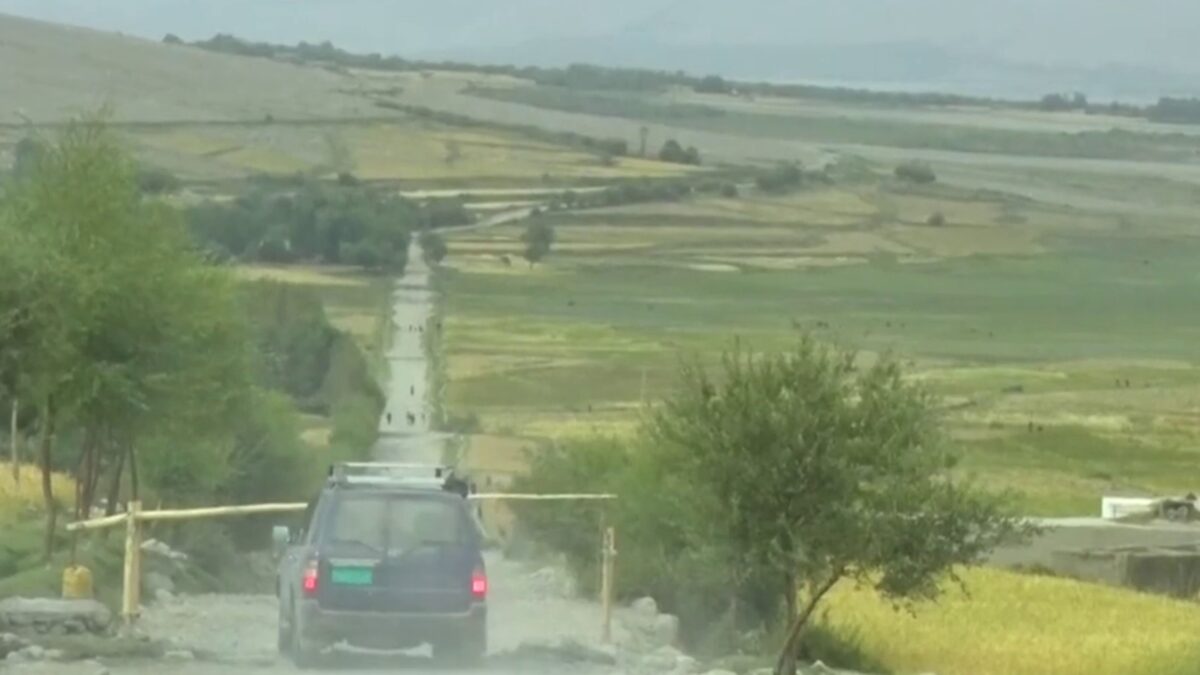
Much of the district sits at elevations ranging from about 3,000 meters to nearly 6,800 meters above sea level. Its difficult terrain, extreme weather and sparse population have made it one of Afghanistan’s most isolated regions.
Yet its geography has also given Wakhan unusual strategic significance. It is the only place where Afghanistan and China share a border, making it a potential route for direct trade between the two countries.
Successive Afghan governments have considered ways to develop the corridor, but its remoteness and the enormous cost of building infrastructure through the high mountains have repeatedly limited those ambitions.
A road project spanning two governments
Work on a road from Bozai Gumbaz toward the Chinese border first began in October 2020, during the former Afghan republic.
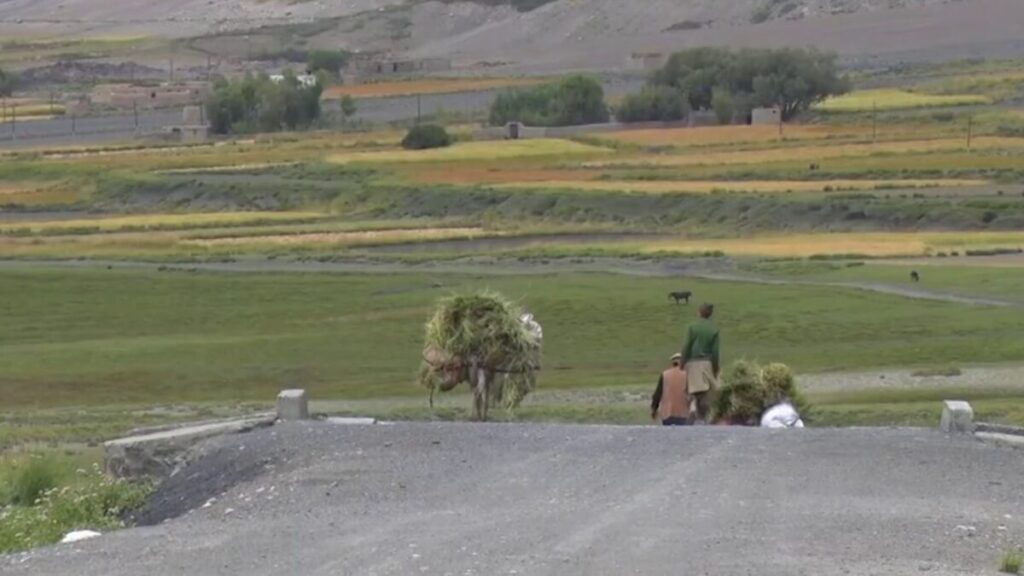
At the time, the Ministry of Public Works was responsible for the project. According to information gathered by Amu, about 15 percent of the work had been completed by the time the former government collapsed in August 2021.
After returning to power, Taliban transferred responsibility for the project to the Ministry of Rural Rehabilitation and Development.
They began work on the first phase of the current project in September 2023.
That phase covers a 50.49-kilometer route from Bozai Gumbaz to the Chinese border and has a reported budget of 183 million afghanis.
Taliban later launched a second phase before the first had been completed.
The second section runs 71 kilometers from the Broghil border area to Bozai Gumbaz. The planned road is eight meters wide and has a reported budget of 143 million afghanis.
Together, the two phases cover roughly 120 kilometers, with the Taliban allocating the equivalent of nearly $5 million for the work.
The Taliban’s economic office previously said more than 60 percent of work on the road had been completed. The Rural Rehabilitation and Development Ministry later said progress had reached 75 percent.
Questions over pace of construction
Questions remain about the extent of the work. The Washington Post reported in February 2025 that satellite imagery showed no visible construction activity along parts of the proposed route between August 2023 and February 2025.
Taliban have continued to report progress on the project, but the full extent and quality of the road construction cannot be independently verified.
Even if the current work is completed, experts say a gravel road through Wakhan would remain far from the infrastructure required for significant international trade.
Farooqi said a viable commercial corridor would require a safe, all-season highway built to modern standards, along with potentially far more expensive railway infrastructure.
For Afghanistan, the central question is not simply whether a road can physically reach the Chinese border, but whether the country can build the infrastructure and secure the political agreements necessary to turn that connection into a functioning trade route.
Afghanistan and China’s Belt and Road network
Afghanistan historically lay along branches of the Silk Road, the network of trade routes that connected Asia, the Middle East and Europe.
But Afghanistan has not become a major route in China’s modern Belt and Road infrastructure network.
China has instead invested heavily in transport projects elsewhere in Central and South Asia, including in countries neighboring Afghanistan.
In nearby Tajikistan, China has moved ahead with work connected to the Dushanbe-Kulma highway. Under an agreement reached last year, China began construction on a 109-kilometer section of the route, which connects Tajikistan with China through the Kulma Pass.
The project underscores the scale of infrastructure investment required to create meaningful cross-border trade routes through the region’s mountainous terrain.
Sayed Massoud, an Afghan economic analyst, said political and regional considerations had also complicated Afghanistan’s efforts to become a major transit route.
He argued that a direct connection through Wakhan could significantly increase Afghanistan’s strategic importance, although realizing such a project would depend on regional cooperation as well as financing.
China’s security concerns
China’s approach to Wakhan is also shaped by security considerations.
Afghanistan’s border at the end of the corridor meets China’s Xinjiang Uyghur Autonomous Region, home to a large population of Uyghurs and other predominantly Muslim ethnic groups.
Beijing regards separatism, terrorism and religious extremism in Xinjiang as major national security concerns and has repeatedly pressed the Taliban to prevent militant groups from using Afghanistan’s territory to threaten China.
Those concerns are likely to remain central to any discussion of opening a major commercial crossing between Afghanistan and China.
Taliban have sought closer political and economic ties with Beijing since returning to power in 2021, presenting Afghanistan’s mineral resources and geographic position as opportunities for Chinese investment.
But large-scale Chinese investment in transport infrastructure through Wakhan has yet to materialize.
A national park
Wakhan’s significance extends beyond trade and geopolitics.
In March 2014, the Afghan government designated the area as the country’s second national park.
The remote region contains distinctive mountain ecosystems and rare wildlife, including Marco Polo sheep and snow leopards. Its environmental importance could add another layer of complexity to any large-scale infrastructure development.
For now, the Taliban’s road project represents a renewed attempt to overcome one of Afghanistan’s most formidable geographic barriers.
But whether a road through the mountains can become a true commercial gateway to China remains uncertain. The current construction may provide a physical route toward the border, but a functioning trade corridor would require far more: sustained investment, modern infrastructure, security arrangements and, crucially, China’s willingness to open the other end.