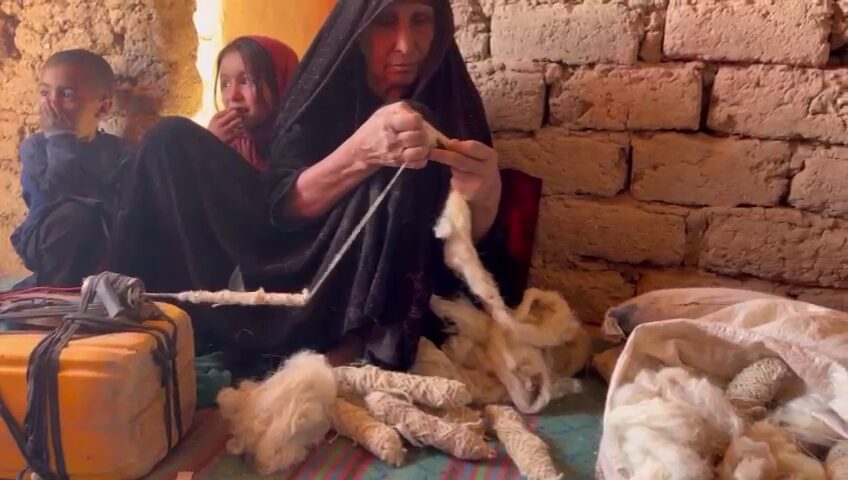
In the remote province of Uruzgan in southern Afghanistan, dozens of women have turned to wool spinning — one of the country’s most traditional yet grueling crafts — as a means of survival amid widespread poverty and unemployment.
The women collect raw wool, clean it by hand and spin it into thread used for carpet weaving, selling each kilogram for about 50 afghanis (less than $1). They say the work is tiring and time-consuming, yet it provides the only steady source of income to sustain their families.
Fifty-five-year-old Hamesha Gul spends most of her day in a dim corner of her house, operating a small hand-made spindle to turn coarse wool into fine strands of thread. “I spin wool so I can buy a small sack of flour,” she told Amu. “People here are poor and desperate. Even men who try to go to Iran for work are turned back. I am a woman, and I just keep working here to survive.”
Hamesha Gul said it can take hours to produce just one kilogram of thread, which she then sells to local carpet weavers. “It’s hard work for very little money,” she said, “but without it, my family would have nothing to eat.”
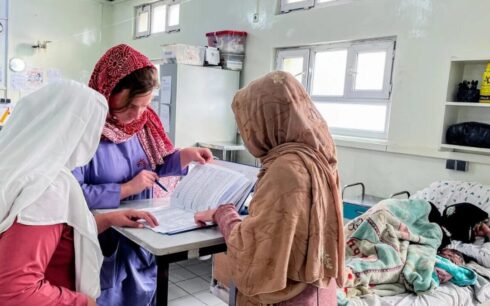
Another woman, 38-year-old Rana, said the modest income she earns from spinning barely covers the cost of food and medicine for her children. “For two or three years now, the clinics in our area have been closed,” she said. “Our children get sick and we don’t know what to do. I work here to pay for their treatment and food, but jobs are hard to find.”
Carpet weaving and thread spinning have long been a part of Afghanistan’s rural economy, with women making up the backbone of the workforce. However, the collapse of the Afghan economy and the Taliban’s restrictions on women’s employment have pushed even more women into informal, home-based labor.
Local traders say that despite the high global demand for Afghan carpets, many women like Hamesha Gul and Rana earn only a fraction of the final value of their products. Rising inflation and limited access to markets have further reduced their earnings.
Still, the women of Uruzgan say they will continue spinning wool — not as a choice, but as a necessity. “It’s the only work left for us,” said Hamesha Gul. “We can’t leave home to find other jobs. So we spin, we work, and we keep our families alive.”