The Taliban’s commerce minister, Nooruddin Azizi, said on Monday that at least 12,000 Afghan cargo containers are stranded in Pakistan ports, including Karachi, a move he said has inflicted severe financial losses on Afghan traders.
Addressing the opening ceremony of the Imam Abu Hanifa National and International Trade Exhibition in Kabul, Azizi said their decision to restrict trade with Pakistan was not taken, but was driven by necessity in response to worsening border tensions between the two sides.
“This decision was unavoidable,” Azizi said. “But Afghanistan’s doors remain open for trade with other regional countries.”
His remarks come amid a deepening diplomatic standoff between the Taliban and the Pakistani government, following a series of border clashes and rising friction over militant activity, particularly the issue of Tehrik-e-Taliban Pakistan (TTP). The border closures at Torkham and Chaman, two of the most critical trade arteries between the countries, have brought the once $2-billion bilateral trade relationship to a near halt.
While containers remain stuck at Pakistani ports, Afghan traders say perishable goods are being lost and supply chains disrupted—impacting businesses on both sides of the border.
Despite these setbacks, Azizi struck an optimistic tone, saying Afghanistan continues to pursue economic partnerships beyond its immediate neighbors.
“Today, we have active trade relations with over 80 countries,” he said, citing ties with Central Asian nations, Iran, and China. “We face challenges, but our officials are committed and will never stop working to strengthen our economy.”
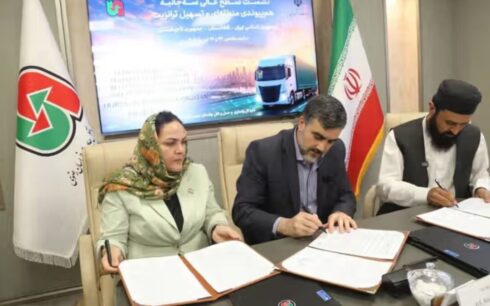
The comments were echoed by Alireza Bigdeli, Iran’s charge d’affaires in Kabul, who also attended the exhibition. He reaffirmed Tehran’s support for Afghanistan’s economic recovery and trade ambitions.
“Iran’s transit infrastructure—including Chabahar and Bandar Abbas ports, and rail networks—is fully available to serve the people of Afghanistan,” Bigdeli said.
He added that Tehran views Afghan exports—including dried fruits, agricultural products, and minerals—as having strong potential for growth in Iranian and regional markets.
The Imam Abu Hanifa Exhibition, now in its fourth iteration, is part of efforts to showcase Afghanistan’s self-reliance and industrial capacity, according to Taliban’s commerce ministry.
The exhibition features a range of Afghan goods and services, with participation from business delegations across the region. Iranian officials said at least 90 Iranian traders and company representatives attended the event.
According to the Taliban’s commerce ministry, the exhibition is aimed at boosting domestic production, attracting foreign investment, and creating new economic opportunities, particularly as relations with Pakistan deteriorate.