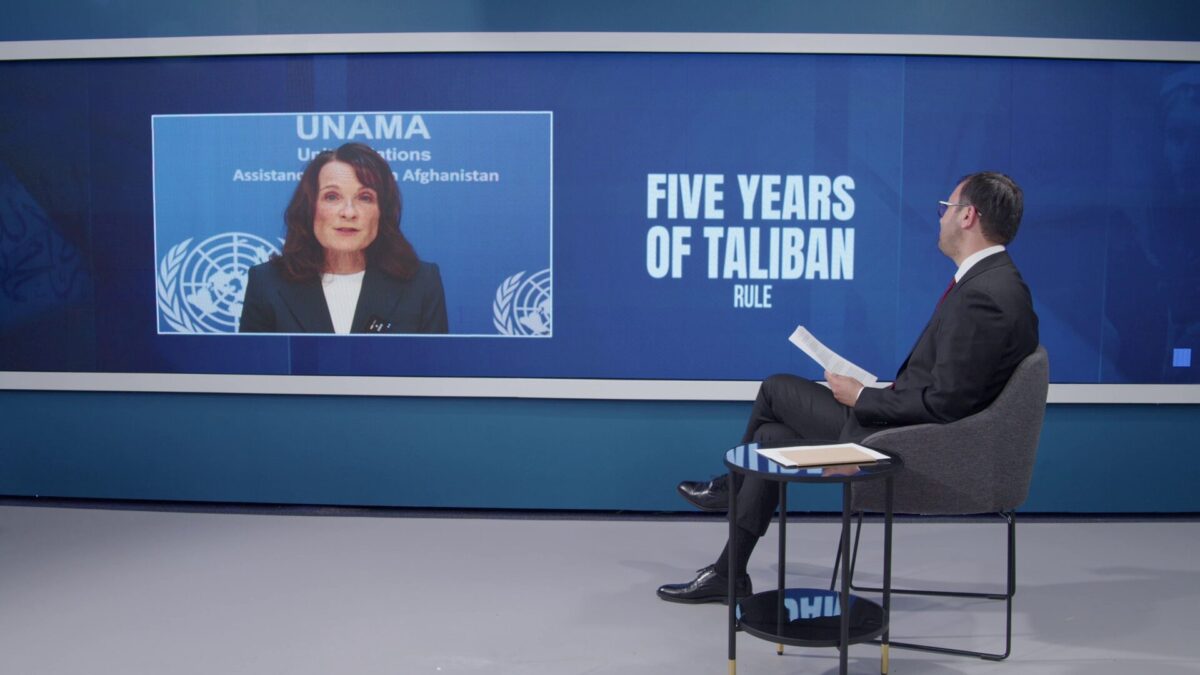
In this program, Amu TV’s Lotfullah Najafizada speaks with Georgette Gagnon, Acting Head of the UN Assistance Mission in Afghanistan (UNAMA), to discuss the country’s political future, human rights, humanitarian crisis and the international community’s engagement with the Taliban.
Here is full transcript of the interview:
Najafizada:
Ms. Georgette Gagnon, the acting head of UNAMA, thank you for your time.
Gagnon:
Thank you for having me.
Najafizada:
Five years into the Taliban rule as a woman, as someone who led UNAMA’s human rights division back in the days when I was also in Kabul, what makes you get up every morning and move?
Gagnon:
It’s the Afghan people and particularly Afghan women and girls. And this is what keeps me getting up as you said every day and working with the UN people across Afghanistan who are supporting Afghan people in what is of course a very challenging time for them now.
Najafizada:
And you just got a new mandate. What does that mean for the UN political mission in Afghanistan?
Gagnon:
The positive thing about the mandate is that it shows full UN Security Council support for the Afghan people and that the country and the people remain a very important part of the international agenda. And what they’ve asked us to do as UNAMA is to continue to work on our three key priorities for the benefit of Afghans across the country. These are political engagement and good offices, human rights of course, and coordination of basic human needs and humanitarian assistance. And in each of these areas, these are very critical also for Afghanistan’s reintegration into the international system and also for the country’s future, for Afghan’s future.
Najafizada:
And how important is a political mission from the UN and Afghanistan?
Gagnon:
Very important. As I said, the security council members, all 15 of them and many of the international and regional member states and donors and international partners view the political mission as imperative because it permits a lot of the other actors to work in the country, to stay in the country, to come to the country because we are on the ground. We are supporting Afghan people across the country. We are the eyes and the ears. And it is us, UNAMA, the political mission, together with the UN agencies, funds and programs, of course, that are the main international entity that is engaging daily with Afghan people, with the de facto authorities here, with many others, as I said, to take forward what the Security Council has highlighted it would like to see in Afghanistan. A country reintegrated into the international system at peace with itself and its neighbours meeting international obligations and providing a place where all Afghans, men, women, children, everyone can find a future and a place where economic development moves ahead.
Najafizada:
You are referring to the 2023 UN Security Council Resolution and the Independent Assessment, which was conducted earlier that year. Where are we with that? Those were very ambitious end state objectives.
Gagnon:
The Security Council mandated, as you said, that independent assessment. And it was aimed at improving or starting structured coordinated engagement with the de facto authorities here for the benefit of the Afghan people in a number of areas. And it recommended a number of steps, actions. Some of them have been taken forward in quite a constructive way. For example, there are two working groups now where Afghans, different member states, UN agencies, and the de facto authorities are coming together to address counter-narcotics and also to enable the private sector. So these are elements of the independent assessment that have moved. Others have not. And this mainly due to the very challenging discussion around these particular issues. For example, diplomatic recognition of the de facto authorities, counter-terrorism, international obligations, inclusive governance. In these areas, there has been not as much forward movement because the issues are very challenging and the de facto authorities in particular need to engage more with the international community in finding ways to resolve these hard issues.
Najafizada:
And why they don’t do that? What is the challenge there, the main challenge there? You talk to them, you deal with them on daily basis.
Gagnon:
The challenges are, as we have assessed and many others who are interacting with the de facto authorities, is that at this point in time they prefer bilateral engagement. That is how they are mainly conducting their foreign policy with different member states. While the process to address some of these very difficult issues requires a multilateral approach where a whole number of member states come together with them to address these issues. And at this point in time, they are not engaging as well as we would like them to be engaging in this multilateral effort.
Najafizada:
And by engaging, you mean they don’t even talk about it or they’re not putting meaningful steps forward?
Gagnon:
There is lots of discussion with the de facto authorities on all these issues, whether it be human rights and international obligations. For example, release of the frozen assets, counter-terrorism. There’s lots of discussion, but I think you put your finger on it, not a lot of action on their part. Very little action at this point. While they might say to us on some of the issues, we’re considering we’re doing a few things. Overall, the action isn’t enough to take forward this whole multilateral approach to address these issues.
Najafizada:
And when member states and the Afghan people ask you about your own assessment on why they don’t move forward, how do you respond to them?
Gagnon:
They need to do more. And if they do more, they will get more support from the international community. This was a message that was highlighted recently by the visit here of the two high level officials on the UN agency side. We had last week here the visit of the UN High Commissioner for Refugees and also the administrator for UNDP. And the message was very clear, help us help you. If you move ahead with some of these international obligations, you can see the country will see progress. It will see deeper cooperation and engagement.
Najafizada:
Right. I mean, they let UNHCR and the head of UNDP, the money people basically, but not Richard Bennett, the UN special rapporteur. How do you explain this paradox?
Gagnon:
Well, I think that’s a very good question. I’m not sure whether it’s a paradox. I think there’s many countries who, and Afghanistan is one in particular who are not very pleased to have highest level human rights officials come into the country and assess the human rights situation. Now it would be a very good move if Richard Bennett, the special rapporteur on human rights for Afghanistan was permitted to come in and visit the country. That would be a positive step. Also highlighting that of course UNAMA has a human rights team on the ground here. We are working across the country monitoring, documenting and reporting on human rights very regularly. And this is a key priority of course for the UN system, not only in the country but globally. So the more human rights presence here, the better. And that of course supports Afghan people.
Najafizada:
Understood. And we will come back to that. But on Bennett’s lack of access to the country, that is not justified, right? I mean, you must be telling them that this has to be resolved. They can’t cherry-pick who can come and who cannot come to the country.
Gagnon:
As I understand, there have been several requests for his entry into the country. And as I said, as the UN system, we would certainly support such requests. But ultimately of course it’s the de facto authorities that would make that decision. The requests can continue of course. And the special rapporteur is continuing to report on the human rights situation here to the Human Rights Council very regularly every few months.
Najafizada:
That is also what we see and I think that is also very brave of him to continue such reporting despite all the limitations. But on the political process, the last Doha main track happened I think two years ago. There are subtracts happening on counter-narcotics and private sector, but why not Doha Four? What is stopping it? And what is the main impediment here?
Gagnon:
Well, we are, as I said, continuing discussions among the member states in the DOHA process with de facto line ministries within these working groups and then also on some of these other issues. But it’s very clear from the member states of the DOHA process that to move ahead with a DOHA four, for example, there would need to be more progress on some of these issues that I have previously highlighted. And that is why at this point in time, there hasn’t been a DOHA Four. We would all like to see that happen, but there needs to be more action and more movement, particularly on the part of the de facto authorities.
Najafizada:
If you can highlight three maybe main deliverables on the Taliban front before DOHA four, what would they be? Letting girls go to school, cutting ties with terrorist groups. What are some of these main tasks that are a challenge before another meeting?
Gagnon:
Well, a few have been proposed by the member states that are in this DOHA process. It would certainly include some actions on international obligations, particularly around girls’ education. It would also require some further action on counter-terrorism. These are just a number of examples, perhaps some other action around enabling more women to work in the private sector. It is an area where women have some space to work, but more space for them in that area would be a good step.
Najafizada:
Indeed. And what is your current level of engagement with the Taliban government? You deal with the ministers in Kabul as we see, or you also have access to the Kandahar leadership. You said that they are not a big fan of engaging with multilateral organizations. So I’m curious how you deal with them.
Gagnon:
We have our colleagues, our UN colleagues in field offices across the country in the main urban centres and in some other locations. And in each of those locations, not only here in Kabul, our colleagues are meeting with the provincial governors, the deputy provincial governors, other officials of the de facto authorities at that more local or sub-national district level. They of course also meet very regularly with Afghans who are working in different sectors, many, many discussions and engagements with Afghan women, with Afghan business people, with Afghans who are running NGOs, for example, on alternative livelihoods for counter narcotics, those who are providing different kinds of treatment and health support to all range of Afghans. And of course we’re meeting very regularly with Afghans and de facto officials who are supporting the return of the millions of Afghans who have returned to Afghanistan over the last few years. So there’s a very regular, deep engagement with many Afghans across the country.
Najafizada:
But what about the Taliban leadership as UNAMA’s number one? What is your level of access to the Taliban? Who is the highest Taliban official you meet?
Gagnon:
We have met with the Prime Minister and the different ministers of the de facto authorities that are present in Kabul. And as I said, at the provincial level, we meet with the governors and deputy governors and other officials regarding the Taliban leader based in Kandahar. As we understand, no international people, no foreigners are meeting with him.
Najafizada:
Yes. I think there were reports that the Qatari Prime Minister managed to see him a couple of years ago and no other meeting since then. You’re right. That’ my understanding at least. But he is in charge of the country. He’ making all these decisions. So it must be very important to talk to him.
Gagnon:
Yes, that is what we understand. Now the de facto officials that we are meeting regularly, it’s our understanding that they are in regular touch and consistent touch with the Taliban leader in Kandahar and that our discussions, our requests, what we have been seeking from the de facto authorities, what we’re concerned about, what support that the UN has been providing to Afghans across the country, our amplification of concerns and issues we’re seeing that is taken to Kandahar. It’s the same situation as we understand it with many of the member states who meet regularly with the de facto officials here in Kabul and also with the governors and others in Kandahar and other parts of the country. The messages are getting through to the leadership as we are informed.
Najafizada:
We touched upon the question of human rights a little bit. Your own staff, your female colleagues, your Afghan sisters and staff cannot come to their offices for months now, I guess, if not over a year. How are you dealing with that? Is that being managed or resolved?
Gagnon:
Yeah, this is a very, very challenging issue for us. And we have continued to highlight with the de facto officials and including from the highest level of the UN, the Secretary General, the Security Council, how important, how critical it is for our Afghan female personnel to return to our premises so that they can continue to support Afghan women, Afghan people across the country in the best way possible and that we can more effectively, of course, deliver our mandate, what we are required to do, what we are asked to do by the security council. So you will have seen in our last two mandates of the security council was very clearly demanded of the de facto authorities by the security council that they permit our Afghan female personnel to return to our offices and also of course reverse the very restrictive policies that the de facto officials have put in place preventing women and girls from education at higher levels, from participating in public life, from all manner of what they should be able to do in this country. This continues to be of the highest priority for the United Nations, for the member states. And again, I refer to the visit we had here of these two high level UN officials who again said, “We can’t continue to deliver humanitarian support, basic human needs support in this context. You must allow our national female personnel to return to their places of work.”
Najafizada:
Is that a red line for you? And is that red line crossed? And how much more time do you have?
Gagnon:
We will continue to push. We have been in constant dialogue with the de facto officials here on it. We have discussed with them various ways that our female staff could return to our places of work and we will continue. That is our best way to address this challenging issue.
Najafizada:
I understand. But what are you hearing back from them? Are they saying that this is work in progress or it’s like talking to the wall basically?
Gagnon:
What they are saying to us is that we are working on this. We’re considering it. And many of them will say here in Kabul particularly that they certainly appreciate all the effort and work that the UN agencies and UNAMA are doing in support of the Afghan people. And they are, as I said, they’re working on it and we will get back to you. Of course, that is not a good enough answer and we will continue to push and advocate and see what else we can do to have this restriction lifted. Of course, it’s also a violation of the UN Charter.
Najafizada:
You’ve said their response to preventing female colleagues, your female colleagues, your Afghan sisters to come to their offices not good enough. How good enough is their response to continued, I would say, push by you and others on letting Afghan girls go to school above grade six?
Gagnon:
Well, it’s not good enough. And this is impacting not only Afghan women and girls, but all of the country, all Afghans. Afghanistan remains again the only country that does not allow girls past grade six to go to school, certainly the public schools.
Najafizada:
You said Afghanistan is the only country that’s not allowing girls to go to school above grade six. Is it politically correct to say that it’s the Taliban leader, Hibatullah Akhundzada, who is not allowing girls to go to school above grade six? Can we at least name him?
Gagnon:
Well, the fact is that girls are not going to public schools past grade six. And that is a very serious issue that needs to be addressed as we all know. And as I said, is holding back the entire country from moving forward to reintegration, which would see progress for all. And our view is that argument continues to be made to the Taliban leader by all those who have any influence over him.
Najafizada:
I see more references to extra judicial killings in your recent human rights reports, which is interesting. Just two days ago, Abdullah Rahimi, a former deputy NDS director in Ghor, was killed after attending evening prayers. Who is killing these people, these former security officials?
Gagnon:
UNAMA, as you know, is documenting with our human rights team these sorts of incidents. Because of course, what we understand the de facto authorities had done initially on the return to power is indicate that they would not be doing these types of things and that former Republic government people and security officials could return. There was a general amnesty, as you may know, that was passed. However, what we’ve seen that there are these incidents, there continue to be these incidents. And we in the human rights team are, as I said, documenting and reporting on them and there should be action taken to account for that.
Najafizada:
So there is no amnesty.
Gagnon:
The continuing incidents of this could certainly indicate that in some cases, this amnesty may not be implemented. And this is a point that has been made to the de facto authorities. You’ve put in place this general amnesty. You need to implement it fully.
Najafizada:
Let’s talk about poverty. You said the country is poor in your reports. Two third of Afghans don’t know if their next meal is coming. How is the world responding?
Gagnon:
Since 2021 up to now, the official figures show that the international community, the international donors have provided Afghans with around 16 billion US dollars for both humanitarian and basic human needs assistance out of an ask overall of about 18 billion. And this shows how important supporting Afghans, supporting Afghans through humanitarian and basic human needs assistance is for the international community. And there’s many other types of support that are being provided through, for example, a new plan to address the needs and all the support needed for returnees and refugees who have returned to the country. You’re well aware that some six million Afghans have come back to Afghanistan since 2023. They are continuing to come and the international community are providing much, much, much support to them to try and take forward reintegration livelihoods. But the needs are very large. And of course there needs to be more international support, more international engagement.
Najafizada:
But the appetite in the world is changing. There is a reduction in aid. There are talks about downsizing your own office, UNAMA, and why the world should invest in Afghanistan when let’s say the Taliban are not allowing girls to deliver aid, stopping other agencies delivering aid. And there are so many competing priorities in the world. What’s your pitch to the world? How do you convince donors that Afghanistan should be supported?
Gagnon:
What we say is that the Afghan people continue to need international support and that while Afghanistan may not be at the top of the list of priorities for international support by the big international donors, it is among one of the top places where such support is still needed. And that to take forward stability in the country, to continue to try and stabilize the country, to support its reintegration and reduce risks of increased instability, out migration, concerns about insecurity, you must continue to support the country, the people and not abandon or isolate the situation here because that will not result in why What everyone wants for Afghanistan, everyone. There is also a very young population here. You may have seen that a statistic just came out recently that 63% of Afghanistan the population is now under 24. The issue is really livelihoods also. What are all these young people going to do here?
Gagnon:
What is their future here? And that I think is a concern shared, as I said, by many, many Afghans. We want our young people, we want our families to be able to stay in the country, to be able to work, to be able to be educated, and that this is a place where they can find a future. And given the challenges here, given the situation coming out of a long period of conflict, international support and engagement is needed. Abandoning the country, leaving the country will not result in that future or that future that every Afghan wants will be very much at risk.
Najafizada:
Right. As my last couple of questions in closing, this year is also the 25th anniversary of nine eleven. I think in a new mandate, you have been tasked to also keep an eye on terrorism by facilitating the activities and the efforts of the sanctions committee. Speaking from Kabul, how are you assessing the situation of terrorism? Can you tell that Afghanistan is a safer place and the world should not be worried when it comes to Al-Qaeda and TTP and other terrorist groups?
Gagnon:
In the new mandate, the Security Council did highlight again, concerns around terrorism, the presence of terrorists inside the country. This was also highlighted by the sanctions monitoring team. So the aimed at ensuring that that issue remains on the international agenda was in our view, why it was included in the new mandate. Of course, many countries in the region as well are concerned about this issue. So that’s why it still is a part of the work that the international community is doing and is concerned about.
Najafizada:
And that concern is legitimate.
Gagnon:
Well, as I said, the Security Council has highlighted in its mandate, as has reporting from the sanctions monitoring team, their concerns about the presence of the issue of terrorism here in the country.
Najafizada:
And five years in, you think there’s a stalemate in Afghanistan. The country is stuck or moving to the right direction or wrong direction. If a friend called you from your home country, Canada, how would you explain the situation in Afghanistan in nutshell in simple terms?
Gagnon:
There has been some good things that have happened over the last few years. We have seen what some might call relative stability in the country. There’s also been good efforts to eradicate poppy and some other effort to reintegrate and address, for example, climate change, disaster response. But overall, there are still immense challenges here on the political process, of course, on human rights. And these issues, if they’re not addressed and taken seriously in a more serious way with increased engagement, particularly by the de facto authorities, then the concern, the risks of increasing instability here, the country not moving but staying at status quo will continue or certainly could continue. And that is a concern.
Najafizada:
What will happen, ma’am, if the status quo remains for another three to five years?
Gagnon:
I think if the status quo on, for example, the situation of human rights on the situation of women and girls continues there will be or there could be decreased or wanting international engagement in the country because the investments that are being made are not yielding or leading to this end state of reintegration into the international system meeting international obligations. And as I said, the concern is that a status quo now without some forward movement on these issues, there’s a risk. The country will not see greater prosperity, greater peace, greater stability with Afghans having a future that they are really engaged in and where they want to stay in the country and where others want to return.
Najafizada:
Right. And my last question, you will be joined by another woman leading the UN mission together with you in Afghanistan very soon, two women leading the UN mission in Afghanistan. What kind of message does it send to the Taliban?
Gagnon:
The message is clear that women are at the exact same level as any man and should be fully participating in every aspect of political life, of public life. And there are a whole range of women leaders internationally inside this country, outside this country who should be enabled to participate fully in Afghanistan’s future. And that the international community in particular, the UN will take forward in every way this message, including by having as its top leadership here in the country, two women.
Najafizada:
Georgette Gagnon, the top UN official in Afghanistan. Thank you for joining us from Kabul and have a good evening.
Gagnon:
Thank you.