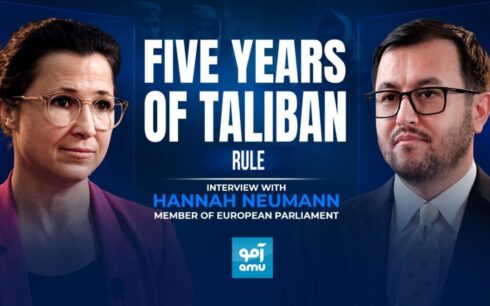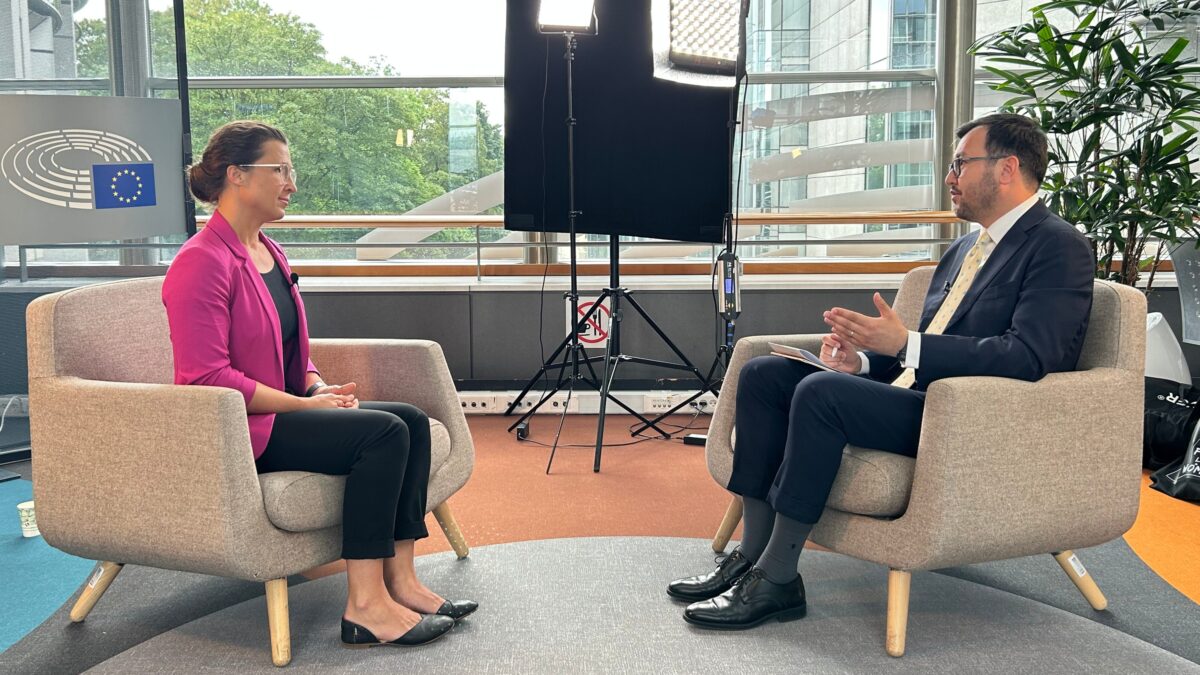
In this interview, Hannah Neumann, member of the European Parliament, sits with Amu TV’s Lotfullah Najafizada to discuss the EU’s planned talks with the Taliban in Brussels, deportations of Afghans, women’s rights and the future of international engagement with Afghanistan.
Here is the full transcript of the interview.
Najafizada:
Hannah Newman, member of the European Parliament, it’s a pleasure to talk to you.
Neumann:
Thank you for having me.
Najafizada:
You said that inviting the Taliban to Brussels is not technical and how is that pushback going?
Neumann:
If you have to discuss things with the Taliban on deportation, you can do that in Kabul, right? And there have been technical teams from Brussels that went to Kabul to discuss with the Taliban. Why is it that the Taliban now want to have these very same discussions in Brussels? Well, because they want to be invited to the capital of Europe because they want to have the pictures, they want to have the handshakes so everything that looks like they are back at the table, that they are being normalised. And I think for no reason we should give it to them. I just want to remind everyone and I continue to remind people here in Europe about it. In 2021, all EU member states came together. They said there need to be clear benchmarks for engagement with the Taliban. It was five benchmarks. One was to let international personal leave Afghanistan. Okay, gone. The other one was Taliban upholding human rights. Well, on that one, we saw a backlash far worse than anyone expected. They said humanitarian access for everyone. Well, that’s not working. They said the Taliban need to combat terrorism. They are becoming a safe haven for terrorism. And they said an inclusive governance and we are so far away from inclusive governance. So why now start an engagement when they just move back on everything?
Najafizada:
Why now?
Neumann:
Germany set a very bad precedent because we saw in Germany, the German government, because they wanted to deport Afghans for, I would say, very shortsighted populist reasons. They started this talking to the Taliban and the Taliban basically blackmailed them. So the Taliban first said, “So we need to be invited for talks.” That’s what we had in Germany about two years ago. Next thing the Taliban said, “But we need to take over the consulates again.” That’s what then the Germans gave to them. So the Taliban said, and then we would take back a few Afghans. So where are we in Germany right now? About 50 Afghans were sent back to Afghanistan.
Najafizada:
In two years.
Neumann:
In two years. In return, two Taliban representatives are now in the consulates in Berlin and Born having a lot of terrible potential for European security, for Afghan security. I’m pretty sure we can talk about that later. And now there were a number of other EU member states that they actually thought that would be a good idea. I don’t know how come. And now they ask the European Commission to basically do it for them. So there were a number of members that said, “Dear European Commission, can you please invite the Taliban for technical talks?” What they call technical talks.
Najafizada:
I heard there are about like 20 member states.
Neumann:
Well, the number I have is 17. So apparently 17 said, “We want to have what the Germans have. ” They’d asked the European Commission to do that. And then the European Commission was stupid enough to take that task and now to do it. And I’m afraid they might run into the very same situation with Germany where now there was one of these deportation planes scheduled I think two days ago. And the Taliban said, “Well, but we’re going to refuse it until we have more personal and more consulates.” So we clearly see that they just used this for their very egoistic blackmailing and I think we really need to stop the European Union for getting engaged in the same game.
Najafizada:
And what is your strategy for 17 members of Europe, of the EU to have sort of a smart way of addressing the migration issue?
Neumann:
Well, I mean, first of all, we are making quite a mess here right now to stop these technical talks from happening. So we are trying to engage with the European Commission, but especially with the European Union External Action Service from a foreign policy perspective to make everyone understand how dangerous it is to fall for Taliban blackmail because Taliban will just ask for more and more of these weird regimes will ask for the same thing. So we will just end up in a very terrible situation. We’re trying to figure out with the Belgian government, they have to give the visa to the Taliban eventually that they don’t do that. So we’re putting public pressure on them. So we are trying to make all of that very complicated. On the other hand, you are right. We also need to see with the member states how to deal with this issue.
I mean, there is no way one could send back Afghans in general in line with the Geneva Convention and all the rules we have because Afghanistan is not safe. It’s not safe for women, but frankly said it’s also not safe for most of the men that seek refuge here because the Taliban are power and they’re just very cruel. We are only discussing about a very limited number of people that have either become criminal. Here in the European Union we are talking especially about sex offences or people where there might be a danger that they might engage in terrorist activities, for example. I actually don’t think it’s smart to just send them back to Afghanistan because those that are sexual offenders, for example, they should be in prisons and not rooming around freely in Afghanistan and those where we are afraid that they might commit terror acts, well, I’d rather have them under supervision here than just being back in Afghanistan, I have no clue what they are doing, how they might come back to Europe and what they stage there.
So also from a security perspective, and I think that’s the discussion we are having and the discussion I’m having with the German government, but also with the other governments, it simply doesn’t make sense. So rather than falling for this populist right wing shortsighted claims, I think we should have a proper discussion of what helps our security.
Najafizada:
And would that help sort of to stop the flow of migrants coming to Europe from countries like Afghanistan?
Neumann:
Well, what would help to stop the flow from Afghans to come to Europe is to stop Taliban rule in Afghanistan so people can just go back and rebuild their lives. And what we are doing with this is just stabilising the Taliban, kind of giving them some aura of legitimacy and giving them the idea that whatever horrible they do, they would get away with it. And I rather saying we should be very clear that with these kind of governments, we are not going to engage. We don’t want to legitimise them. We’re not going to talk to them. We are not going to hand over consulates to them. So we bring down these kind of governments rather than making it easier for them. This is what would in the media and long term really stop migration. And frankly said, I just find it super cynical that there are so many people in Afghanistan where we promised them that we would support them, that we would protect them, that they would get visa and asylum.
So those that worked for our institutions, for example, those that supported us or that we worked hand in hand with to confront the Taliban and now they are stuck in a terrible security situation inside Afghanistan-
Najafizada:
Or in Pakistan.
Neumann:
Or in Pakistan or in Tajikistan or in Turkey or in Iran, while we start giving visas to the Taliban. I mean, how cynical and absurd is that? And then we have another group of people, the Afghans that were able to flee the Taliban, that they had asylum here right now, that they are clearly opposed to the Taliban. This is why they came here. Most of the Afghans are here because they were opposed to the Taliban. And now when we give the Taliban access to the consulates, we give them access to the addresses of all these people. I mean, we see with the Iranian regime how bad transnational oppression is. And I’m just afraid the Taliban will learn from them.
Najafizada:
I remember you visited Afghanistan under the Taliban. I did.
Neumann:
I did.
Najafizada:
In 2022.
Neumann:
I think I did twice even.
Najafizada:
Twice, yes.
Neumann:
I think 22 and 23, but yes.
Najafizada:
I remember you met once with the Minister of Education and there was this picture of you talking to the Minister of Education of the Taliban and talking about girls’ education. We are three years, four years after that visit. Do you see any progress or any change since then?
Neumann:
Back then they said, “You know, we just need a little bit more time to work out the curricular. We need a little bit more time to work out the dress code.” And since then they just walked backwards. So back then it was just higher education being a problem for girls, but there was still university for women and there was still like the normal kind of education. Since then, well, the girls haven’t been allowed to go to school. Then the women have been banned from university. Now, even for the primary education, it is very, very difficult for girls and now it also becomes difficult for boys to get the kind of education that they need to be ready for the job market because they’re also trying to push them more and more towards madrasas. So much, much, much, much, much, much, much has gone back. But there is actually, if you allow me a bit of a funny story, around the picture that you mentioned, because for me it was always the question, what do I do with the veiling?
Najafizada:
Yes.
Neumann:
Because I mean, it’s not in my religion, it’s not in my culture. So I wouldn’t put a veal usually. When people ask me, for example, when I visited schools or hospitals to veal so they don’t get in trouble with Taliban, then I would do it because I don’t want to make people’s life difficult. But then when I had the meeting with the Taliban, I was like, “I’m not going to proactively wear. I just had the scarf around my neck.” So it looked as if it just had fallen down and I was waiting for them to ask me to put it on and then I might have a discussion because they come in their cultural clothes when they come here. So I guess I can come in my cultural clothes when I go there, but they never ever asked me. But the funny thing is the Minister of Education all the time either talked to the men next to me or he basically talked to my uterus because he couldn’t look into my face and I also had shoes like this so he couldn’t also look at my ankles and they came with official pictures, but they never actually published the pictures.
So the only picture that exists is the one members of my team took. But this whole meeting, it was also a bit part of like my very own personal resistance to giving into their logic and somehow I got away with it and he felt quite uncomfortable and I think that’s how it should be.
Najafizada:
But you did as sort of probably the only member of the European Parliament who travelled to Afghanistan.
Neumann:
I think I was about the only one, you’re right.
Najafizada:
Yes. So you did try, you did go and talk to them, you wanted to go to the country on your own and push for the rights of the Afghan people.
Neumann:
Well, I mean, I didn’t go there to meet the Taliban. I went there to meet with the different women, women’s organisations, women journalists, all those that were still trying to put up some kind of resistance to uphold the work they do and to just hear how they are doing, how we can support them, well what their wishes are, how they assess the situation. So for me, that was key. And then of course I also had to somehow meet the Taliban and it was my pleasure to tell him into his face that we think that this policy is quite dangerous for the country because you’re not just losing half of the workforce. I mean, there will be no midwives. There will be no female doctors who’s going to treat the women. I mean, this whole thing doesn’t make any sense.
Najafizada:
That’s right.
Neumann:
And that was the kind of discussion I wanted to have with them, but also to bring the women’s voices that they are no longer meeting. I mean, they are no longer meeting their own women in their own country. So I wanted to at least use my presence to bring these voices to them, but I have been trying for the last two years to go back again to Afghanistan.
Najafizada:
And you’re not welcome.
Neumann:
Well, the problem is I always got the visa from the Republic ambassadors, but they consider this visas as not valid anymore and I haven’t found a Taliban yet who was willing to give me a visa.
Najafizada:
But you want to go if you’re…
Neumann:
I think if I get the visa and if there is an opportunity to have substantial talks with the kind of people that are resisting the Taliban, then I would indeed go. If I would put these people into big danger and they would refrain from meeting with me and then I would end up only with the Taliban, then I mean, why should I go?
Najafizada:
If you want to go meet with a Taliban in Afghanistan, why they can’t come to Brussels to meet you here?
Neumann:
I’m not saying we should not talk to the Taliban, but inviting them here, so giving them visas while we don’t give visa to the people that fought with us against the Taliban, giving them these super nice photo options here with shaking hands and being in the capital of Europe with the European flags, they just want this to show that they are back at the table, that they are being normalised, that they become part of the normal international affairs that we shouldn’t give to them. So for me, it’s something very different whether I sit with them in Taliban to have the tough discussions we need to have or whether I invite them here and give them the platform that they seek so desperately.
Najafizada:
And it’s not only you who is finding it difficult to go back to Afghanistan. Richard Bennett can’t go back to Afghanistan, the UN special rapporteur, journalists like Lyse Doucet have been saying publicly that they are trying to secure visas to go back, but in the same time you see an entire entourage of Western YouTubers, the so-called Talib bros are going.
Neumann:
Well, yes, that’s propaganda.
Najafizada:
So they do cherry pick who can have access to the country.
Neumann:
No, clearly they do cherry pick and they use that as a propaganda tool and I’m set for everyone who falls for that.
Najafizada:
The EU is right now is the largest donor for Afghanistan in the absence of reduction of American aid. Should aid be conditional? Should aid be given to the Afghan people regardless of how the Taliban rule the country?
Neumann:
I think we should never give the Taliban any budget support. That is very clear. So nothing that goes straight to the Taliban or that it’s channels to organisations from which the Taliban benefit. I think that’s a very hard line. And I think on the very basic aid, like for example, preventing children from starvation, we need to do everything we can to push for, for example, that we can set the conditions on how we do that. So we pay for it, we set the conditions and that’s the hard fight we’re having. I want women to be able to deliver this. I want women to be the main beneficiaries of this. The Taliban are trying to interfere. There are regions where we can deliver better. That is where we are doing more. There are regions where it is more complicated there. It is indeed complicated and it’s a constant battle that we are having.
And I’m afraid the battle’s not going to get away, but I think we should continue fighting it, fighting it, fighting it, and ensure that we can deliver in the best way possible for the most vulnerable without the Taliban benefiting from it. And where the balance goes the wrong way, we have to stop.
Najafizada:
Ma’am, you are one of the very rare and strong voices, not only on Afghanistan, but also on Iran. Why is that? Why are you advocating for people of that region?
Neumann:
I mean, first of all, it’s just about humans and I don’t care about the nationality and it’s just that they both suffer from regimes that are very brutal and very ignorant of the needs of their people and where women are suffering a lot. So I think it’s just a lot of, if I would have to live there, if I were them, what would that do to me? And I just don’t want Europeans to just close their eyes on this. So I try to use some of my work in the European Parliament. I also work on defence and trade agreements, but some of my work to just bring these stories and these voices and these needs also to the parliament.
Najafizada:
And do you think they … I mean, we’re at a very critical moment in case of Iran, for instance, with the US, Iran negotiations going on. Are you hopeful that this deal would make the life of Iranian people better?
Neumann:
Before there was the war, we had brought sanctions on the revolutionary guards and on the regime. Everybody understood how brutal this regime was, especially after the massacres that we saw in January. There was a lot of appetite inside the country to bring down this regime, just people didn’t know how and the tools. Khamenei was about to die anyways anytime soon. Now we are three months into this war and sadly, I see a terrible economic situation with a lot of people starving in the country. I see the revolutionary guards, which is the most ideological part of this government stronger than ever. I see this regime all of a sudden being back in all the international fora at all the negotiation tables, we are all of a sudden discussing sanctions really, allowing them to sell their oil. They figured out that the Strait of Hormuz is even better than any nuclear bomb. They still have the enriched nuclear. They know how to make the Gulf countries very vulnerable. They have a choke point for all the economy. It’s just like the situation is so much worse than before for Iranians and that makes me feel very, very sad. But somehow, well, we are in a situation now where it’s difficult to see a good way out.
Najafizada:
And it’s also a lesson that probably sort of a regime change can’t be done from afar.
Neumann:
Well, I mean, that’s a lesson Afghans. We had to learn very painfully in Afghanistan. We had to learn very painfully in Iraq where, I mean, there has been a regime change but the country is not very stable and now we have to kind of redo it in Iran. I just hope we could learn it for good that I truly believe regime change needs to come from the inside. It’s nothing that can be enforced by violence or from the outside. I mean, there can be support from the outside, but it needs to come from the inside and maybe we need to just be a bit more modest in the idea of what if only we wanted like the Germans or the Europeans or the Americans, what we can do if only we wanted. I think our parish and our means are limited and if we overestimate it, we actually make things worse.
Najafizada:
How about the Afghan or the Iranian diaspora in the West in particular? What they can do differently?
Neumann:
The diaspora needs to find ways and means, but I think that’s there to link with the people inside the country. And if they understand themselves as supporting the struggle of those inside the country because they are under far worse conditions and kind of being their voice here when they can’t speak such as the Iranians right now because they are under the internet blackout, then I think the two coming together could be very strong. When there starts to be infighting and I mean these regimes, the Taliban as well as the revolutionary guards, they love to sow division. If there’s a growing division between the diaspora and those inside the country, then sometimes it gets more complicated. Yes.
Najafizada:
Why fighting for democracy in places like Afghanistan or Iran should be important for your country, Germany, for your parliament, the European parliament or the Europe as a whole?
Neumann:
For me, it’s a very basic thing. We are all human beings and I think every human being has a right to live a dignified life. And I mean, there’s also this discourse and it often comes from the autocrats and all the authoritarian regimes. They say like human rights know that’s a Western value, but no matter which country I go in the world, if I ask a father, “Do you want your daughter to be tortured because she didn’t wear the right clothes? Do you want your son to be killed because he speaks his mind at the age of 16, 18, 20?” They say, “No, we don’t want that.” So I don’t think it’s like a Western concept. It’s just about human dignity. Do you want your baby to die from malnutrition because there’s not enough food? Nobody wants that. And these autocrats and dictators and also some of the right wing forces here, they want us to lose this very basic understanding of we are all human beings and we all have this right to dignified life. And I think we should just never lose that. I mean, one of the speeches I think I gave that has most resonance in Afghanistan but also in the European Union was when I said, “Imagine your mother in Afghanistan with a newborn child, and what is the vision for that one?” And that’s what I mean, like a mother with a newborn in Afghanistan to me is no different than one in my constituency here in Germany and I really think we need to adopt this perspective and then just ask from there, so what is a good political decision and what is a bad political decision? That’s why I’m saying, so there are very few Afghan men that have been held accountable for sexual offences, for example, the European Union that we should have in prison here. How can we think sending back to Afghanistan, having them run free does any good? Is an Afghan woman’s life, is it okay for an Afghan woman to be harassed so a German one isn’t?
Najafizada:
Yes.
Neumann:
What the hell is this? I don’t even want us to go down the road of thinking that way.
Najafizada:
On that note, if you have two messages, one let’s say for the Taliban leader and one for that Afghan woman with a newborn baby who might survive, who might not survive, what would be those two messages for two different audiences?
Neumann:
Wow. I mean, my first reaction to the Taliban would just be “f— off”. Sorry. I mean just like, “What the hell are you doing?” But they are there. So I’m just like, can you think of these women like human beings? Imagine if you have a problem with women, think of them as men, okay? I don’t even know how to talk to them, to address them. I mean, I spoke to some Taliban and some, but they are … No, I find it very difficult. I’m sorry to address the Taliban. I just think either they change or it’s going to be very difficult. And for these women, don’t lose hope, bundle together. I would say we stand by your side. What makes me sometimes a bit sad is that I remember five years ago, everybody in this parliament was saying, “We stand by your side. We are not going to turn our back on you. ” And I know that some did, but I still think it is worth fighting for this international solidarity and even though Iran doesn’t look super rosy right now, but there we see how this continuous civil resistance, it also makes life very difficult for very brutal rulers. And I think eventually all these regimes are coming down because they don’t … I mean, they are not in power because they deliver to the people. They are in power because they are repressive and they are punishing and they only survive if they get worse and worse and worse and worse and at some point there’s an end to it and often freedom comes surprisingly, just never give up hope.
Najafizada:
Hannah Newman, member of the European Parliament and a rock solid supporter and advocate-
Neumann:
I’m trying my best.
Najafizada:
… for Afghanistan. Thank you so much.
Neumann: (24:35):
Thank you for having me.