Pakistan is one of those countries emerged from the post colonial era, and the country has long presented itself as a fiercely sovereign state and proud of its nuclear system, but when one starts following the actual decision-making in Islamabad and Rawalpindi, a different reality emerges that shows in contrary, a state that is deeply reliant on others and lost if not for its dependency. For decades, Pakistan’s political order has been built around the needs of outside powers. Externally, first Washington and its allies, then Beijing, and now the Gulf countries, and internally, around the interests of a military establishment that trades geopolitical services abroad for undisputed supremacy inside Pakistan. The result is a system in which elected politicians are weak and often play a role already scripted by others.
During the Cold War, Pakistan joined US-led alliances and turned itself into a frontline state in the Afghanistan jihad in the 1980s, and then again in the US-led war on terror after 9/11. Each time, billions of dollars of aid, weapons, and diplomatic support flowed into the country, and almost every time, it happened under the control of the army with no involvement of the Pakistani civilian government. When relations became cooled with the US, the country pivoted toward China’s Belt and Road, allowing the China-Pakistan Economic Corridor to facilitate Beijing’s strategic presence on the Arabian Sea, and on the other hand, Saudi Arabia and other Gulf countries have repeatedly bailed out Pakistan’s balance of payments. These are not ordinary diplomatic relationships; these behaviors have become normal deals in which Pakistan’s strategic location, army, and nuclear status are constantly exchanged for loans, diplomatic backing and regime survival.
Inside the country, this external dependency has been matched by a domestic order where civilians are expected to obey the military generals. No prime minister in Pakistan’s history has ever completed a full five year term, and even in nominally democratic periods, key decisions on security, foreign policy, and sometimes economic direction are taken by the military in Rawalpindi. Politicians have to obey a system that Pakistan’s own defence minister has described as “hybrid,” a model of governing that allows politicians to govern so long as they never challenge the army’s veto power. A system that makes the subservience in the country two-layered, first, the generals who manage the expectations of powerful countries, then, the politicians, who submit to the military generals.
Imran Khan’s removal from power and his imprisonment made this structure far more visible. Khan’s narrative of a foreign-backed regime change plot, which was built around the now famous cipher from Washington, which he waved at a PTI rally in 2022, was always more political than legal. What matters for our argument is not whether every part of his story is true, but why so many Pakistanis found it believable when he spoke of people in the Pakistan government allegedly working with foreign envoys to engineer his removal. This shows that the public in Pakistan is awakened and has realized that when the military routinely intervenes in politics and engages in talks with foreign countries, it is not irrational to see domestic power struggles and external agendas as two faces of the same coin.
The 2024 general election deepened this distrust. On election day, mobile networks were shut down “for security reasons,” and the reporting of results stretched far beyond legal deadlines, and in many constituencies, unofficial tallies showed independent candidates backed by Khan’s PTI far ahead. Later, after long unexplained delays, results suddenly favoured candidates who belonged to military aligned parties. More shockingly, a senior Pakistan commissioner in Rawalpindi even publicly admitted to manipulating results before resigning, which triggered large protests.
For people of Pakistan, even more worrying is that this trend is getting stronger. Rather than easing off, the military’s control over the country has even tightened. In May 2025, General Asim Munir was promoted to field marshal after an escalation with India, an extremely rare honour in Pakistan’s history. Moreover, the current administration of Pakistan approved a constitutional amendment to expand the powers of the army chief, and grants him lifelong legal immunity once the chief of the army leaves office. At the same time, the Supreme Court’s jurisdiction over constitutional questions was stripped and transferred to a new Federal Constitutional Court, whose judges will be appointed by the executive, a move many have labeled a grave assault on Pakistan’s judicial independence and a constitutional surrender to the military.
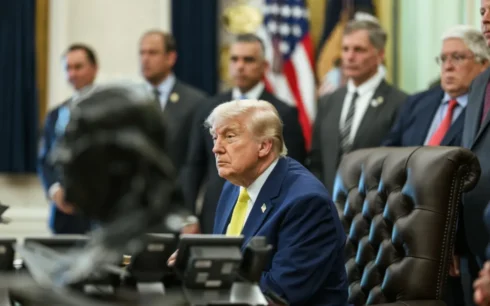
All of this has unfolded against an external backdrop that underlines Pakistan’s subservience not just to the West, but to multiple competing centres of power. In 2025 alone, the army Chief, Asim Munir, visited the United States at least twice, with one trip following Washington’s decision to officially designate the Balochistan Liberation Army as a foreign terrorist organisation, a demand that the Pakistan security establishment had for a long time. For the second time, in September, Shehbaz Sharif travelled to the White House, accompanied by Munir, to meet President Trump. There, Pakistan asked for investment and political backing; the United States, in turn, signalled that it now sees Pakistan as a useful partner again. Once more, it was the army chief, not parliament, who appeared as Washington’s principal interlocutor.
Among all this, one cannot ignore the Bagram Air Base. In September, in a press conference, Trump declared that the United States wanted to reclaim the Bagram air base in Afghanistan because of its proximity to China’s nuclear facilities. Afghanistan’s neighbouring states from Iran to China, publicly opposed the idea, and the Taliban, for their own reasons, though for public show, insisted that they would not talk about Bagram with the US, though later multiple reports suggested that the Taliban did hold Talks with the US, for that matter. In this climate, every photo-op between Trump and Munir, and statements for close cooperation in the region, feed a suspicion that Rawalpindi might once again be positioning itself as the broker of Afghanistan airspace and territory on behalf of great powers. One thing to remind is, as I recently wrote somewhere else, whether or not such a deal is actually on the table, it is crucial to state that the future of Bagram is not a commodity for Pakistani, American, Chinese or Saudi officials to haggle over; it is an Afghan question, and only Afghanistan’s Bagram indigenous people themselves have the right to discuss it with any external power, even if it is with the US.
What we are witnessing, then, is not a normal foreign policy but a system of layered subservience. At the top, Pakistan’s security establishment offers its services to global and regional powers, from the United States and China to Saudi Arabia, in exchange for money, weapons, diplomatic cover and forgiveness of domestic abuses. Beneath that, civilian politicians compete for the favour of that same establishment, accepting constitutional arrangements that elevate one unelected individual to a position above the courts and above future governments. At the very bottom of this pyramid, the ordinary voter is asked to believe that their ballot matters, even as election results are heavily questioned. This is why the country is divided more than it has ever been, and the public lacks trust in its government. People can see that major decisions about any important aspect of their life, including war and peace, about relations with India, Afghanistan and China, and even about the country’s economy, are taken in places where they have no representation.
But one thing that brings hope is that Pakistanis still have choices. Lawyers are already challenging the new constitutional change; journalists, despite heavy repression, continue to challenge the government; and people of Pakistan have shown repeatedly that they are willing to protest when their votes are stolen. Yet time is not on their side. Each year under this dependency on foreign powers and the Pakistan military makes it harder to imagine a country where important matters are argued openly by elected representatives, instead of being whispered in back rooms by military generals.
Natiq Malikzada is a journalist and human rights advocate. He holds an MA in International Relations and an LLM in International Human Rights Law from the University of Essex.
This op-ed reflects the views of the author, not necessarily those of Amu TV.