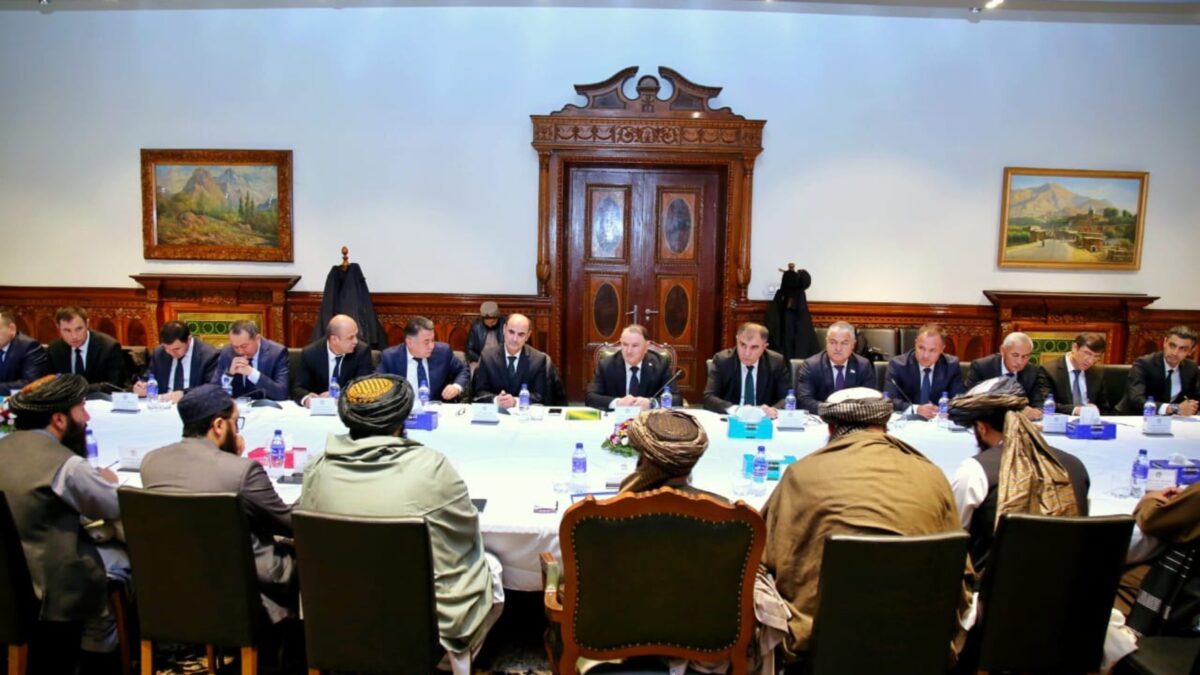
The recent visit of a Tajik delegation to Afghanistan—a trip that included representatives from Tajikistan’s security agencies—raises questions that have received little attention. This marks the first time in four years that Dushanbe has officially decided to send a 14-member delegation to Kabul. This seemingly simple act sparks a series of important questions.
The first question is: Why, after four years of political, security, and border tensions, has Tajikistan now concluded that it should engage in talks with the Taliban? Has the country’s security concern increased? Or has pressure from Moscow pushed Dushanbe in this direction? Or perhaps Tajikistan, through a quiet and gradual shift, has decided to engage with the Taliban in a limited manner to at least ease its security concerns along borders under Taliban control?
Unofficial information suggests that the Tajik delegation’s discussions with Taliban officials focused specifically on counterterrorism, cross-border infiltration, drug control, and intelligence cooperation. These concerns are not new; however, their intensity has changed. Tajikistan’s security services face a combination of threats: remnants of ISIS-Khorasan, local radical groups with internal sympathizers, and criminal networks linked to heroin and other drug trafficking. These concerns are compounded by the Taliban’s inability—due to a lack of capability and fundamental will—to fully control northern Afghanistan. Even during these high-level meetings, Tajikistan did not recognize the Taliban. Reports indicate that the Taliban requested three concessions from the Tajik delegation: formal recognition, the transfer of the Afghan embassy in Dushanbe to Taliban-appointed diplomats, and increased political cooperation. Tajikistan made no explicit commitment on any of these three points.
For the past four years, it has been clear that recognizing the Taliban could anger segments of Tajik society and damage the country’s credibility among Afghan Tajiks—who see Tajikistan as their closest foreign ally. However, completely avoiding engagement also risks diplomatic isolation, greater dependence on Moscow, and a lack of insight into developments in the surrounding environment.
Perhaps the most sensitive aspect of Tajikistan’s new strategy concerns Taliban opposition groups located near its borders. Since 2021, Tajikistan has hosted political figures, activists, journalists, and some members of the National Resistance Front. These groups have operated for years with implicit support, while Tajikistan openly condemned the Taliban government.
Now, increased security cooperation may place subtle pressure on Tajikistan to limit the activities of opposition groups. Even without direct requests, information-sharing frameworks inherently reduce safe spaces for opposition members. Surveillance is likely to increase, meetings may face more restrictions, and cross-border communications may be more closely monitored.
Tajikistan is likely the only neighboring country of Afghanistan that has completely avoided official relations with the Taliban since their return to power in 2021. It has also become a de facto host for Taliban armed opposition groups.
President Emomali Rahmon of Tajikistan has consistently supported the formation of an inclusive government in Afghanistan with the participation of all political factions, viewing democratic governance as the solution to the Afghan crisis. However, Tajikistan itself lacks a modern democratic system, and Rahmon’s nearly three decades in power is a clear sign of a closed government reminiscent of the “Russian model.”
Most Central Asian countries, after enduring decades of Soviet dictatorship, fell into the grip of local autocrats upon gaining independence. Kazakhstan is a clear example, having faced internal uprisings and bloody crackdowns long after the Soviet collapse. Tajikistan is no exception; hence, statements from its officials about the need for democracy in Afghanistan do not find a wide audience.
Beyond political positions, Dushanbe also has another reason to be sensitive toward Afghanistan: linguistic, ethnic, and historical ties with Afghan Tajiks. Tajikistan’s close relationship with Afghanistan’s Jamiat-e-Islami party and its charismatic leaders—Burhanuddin Rabbani and Ahmad Shah Massoud—has played a key role in shaping this sensitivity. Even during the Islamic Republic era in Afghanistan, when Tajikistan’s formal relations with the Karzai and Ghani governments were relatively warm, Dushanbe maintained a special relationship with Jamiat leaders.
Nevertheless, it is unlikely that such concerns were raised during the recent Tajik delegation’s meeting with the Taliban. The Taliban are aware that Tajikistan is not indifferent to the situation of Afghan Tajiks, but this sensitivity is neither intimidating nor a source of pressure for them—much like how Turkic countries view Afghanistan’s Uzbek population.
Any analysis of Tajikistan’s foreign policy must begin with Russia. Tajikistan hosts Russia’s largest military base outside its borders and relies on Moscow for military support, intelligence coordination, and economic aid. It is also a member of the Collective Security Treaty Organization (CSTO), a Russian-led security bloc that influences its regional doctrine.
The diplomatic landscape shifted dramatically in July 2025 when Russia recognized the Taliban. By removing the group from its terrorist list and establishing official relations, Moscow signaled a strategic shift from “resistance” to “engagement.” This move reflects Russia’s attempt to secure its southern borders, counter Western influence in Central Asia, and establish trade routes to circumvent sanctions.
Russia’s role in the dispatch of the Tajik delegation cannot be overlooked. It is the only country to formally recognize the Taliban and now faces the consequences—costs that may, in some cases, outweigh the benefits. Some Russian political analysts argue that today’s confrontation between Moscow and the West has roots in the humiliating treatment Russia received from the U.S. after the Soviet collapse—an era when Russia saw itself as a Washington ally, only to be sidelined, ultimately paving the way for a more aggressive Kremlin.
From this perspective, it is likely that Russia—with its considerable political and military influence in Tajikistan—advised Dushanbe to reconsider its stance on the Taliban. Even without formal consultation, Tajikistan is well aware that, amid the Ukraine war and strained ties with the West, Russia does not want to see tension or fragmentation in its traditional sphere of influence. Moscow has always favored unity and uniformity over political pluralism.
For Tajikistan, resisting Moscow’s wishes has never been a practical option. Although Russia avoids overt pressure, the political message is clear: the CSTO’s new strategy on Afghanistan requires a pragmatic, engagement-based approach. The Tajik delegation’s visit to Kabul should be seen, at least in part, as an alignment with Moscow’s evolving policy.
Still, Tajikistan maintains its independence despite Russian influence. To safeguard internal stability, Dushanbe seeks guarantees in any cooperation with the Taliban. In this light, Russia’s recognition of the Taliban presents both an opportunity and a threat: an opportunity to align regional security frameworks and a threat of being drawn into policies that may not align with Tajikistan’s long-term interests.
Despite these factors, Dushanbe’s core concern remains the security of its borders with Afghanistan. The escalating tensions between the Taliban and Pakistan—including border skirmishes, the expulsion of refugees, and the relocation of Tehrik-i-Taliban Pakistan (TTP) fighters and their families to northern Afghanistan—have raised alarms for regional players, particularly Tajikistan and Iran.
Tajikistan is undoubtedly aware of the presence of Tajik extremist groups in Afghanistan. Reports have also emerged of TTP families being moved to Badakhshan, a province bordering Tajikistan—a development that could be deeply troubling.
In addition, drug trafficking remains a critical issue for Dushanbe. Tajikistan has long served as a transit route for Afghan narcotics headed to Russia and Europe, and it is unlikely that its leaders ignored this issue during their meeting with the Taliban.
Alongside Tajikistan, Iran’s concerns must also be acknowledged. These have intensified amid Taliban-Pakistan tensions and include fears over the increased activity of Salafi groups in eastern and northeastern Afghanistan.
When Taliban-Pakistan tensions escalate, waves of militants may head westward toward Iran’s borders. Like Dushanbe, Tehran is alarmed by the threat of ISIS-Khorasan, the activity of Pakistani networks, and instability in Badakhshan and Takhar. In this light, the regional climate has brought Iranian and Tajik concerns closer than ever.
It appears Tajikistan has now adopted a policy of “pragmatic minimum engagement”—establishing minimal contact with the Taliban to ensure northern Afghanistan does not become a launchpad for direct threats. The Taliban, in turn, seek their own interests: formal recognition and possibly the transfer of the Afghan embassy in Dushanbe, which remains under the control of representatives from the previous government.
Ultimately, the visit of the Tajik delegation does not represent a fundamental policy shift, but rather a recalibration of security calculations—a move that places Dushanbe in a position where it must soften its tone and keep a limited channel of dialogue open with the Taliban. Perhaps Tajikistan now believes that complete disengagement not only fails to enhance its security but may in fact prove more costly.
Mohammad Afzali holds a Ph.D. from Delhi University and previously taught at Herat University. He served for two decades with Afghanistan’s Ministry of Foreign Affairs, including as head of the ministry’s Herat office and as deputy ambassador in India. He is the author and translator of several books on literature and history.
The views expressed in this opinion piece are those of the author and do not reflect the editorial stance of Amu.