This article seeks, with a critical approach, to analyze the ideological, ethnic, and religious nature of the Taliban. Drawing on the concepts of totalitarian systems, ethnic hegemony, and the conflict between the Taliban’s interpretation of religion and modern rights-based structures, it examines both the internal and external dimensions of this political-military project. The article concludes by offering several solutions for confronting this authoritarian order.
Introduction
The Taliban’s return to power in 2021 opened a new chapter in Afghanistan’s political, social, and civilizational crisis. What rules Afghanistan today is not merely an insurgent group, but the representative of a systematic external project that, by exploiting the elements of religion and ethnicity, has managed to impose a totalitarian structure on the Afghan people. This article, by examining the ideological, historical, and geopolitical roots of Taliban rule, analyzes the structure of power in present-day Afghanistan.
The Identity and Nature of the Taliban
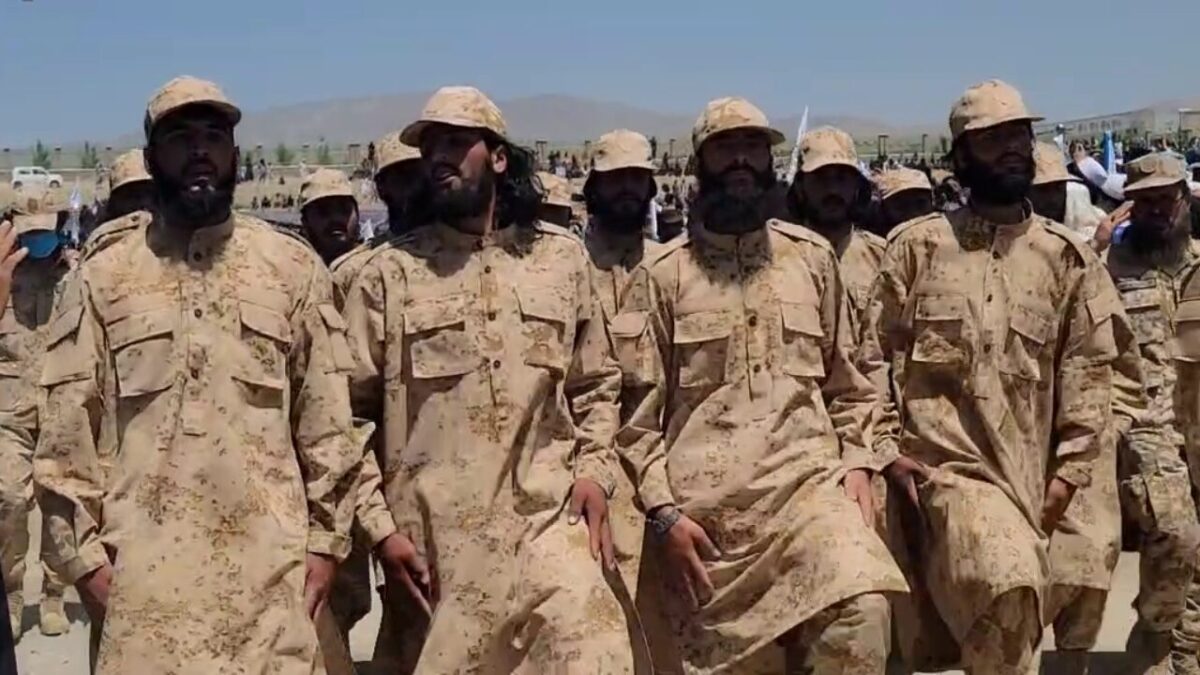
Contrary to popular belief, the Taliban were not a spontaneous, indigenous movement. From their inception, the group benefited from the support of Pakistan’s government, certain Gulf Arab states, and, at times, the meaningful silence of Western powers (Rashid, 2010). The Taliban’s re-emergence in 2021, in the shadow of the U.S. withdrawal and the collapse of the republic, was the result of a pre-designed plan that operated through the dual elements of religion and ethnicity. These two elements, which have repeatedly served as tools of domination in Afghanistan’s modern history, have enabled the Taliban to secure the backing of part of the Pashtun population while silencing other ethnic groups with the sword of religion.
The Taliban’s interpretation of religion is obligation-centered and authoritarian, incompatible with modern rights-based structures (Roy, 2004). Ethnicity, especially Pashtun-centrism, forms the backbone of Taliban power. Although Pashtuns are not an absolute majority in Afghanistan’s population, they have historically played a dominant role in political power (Barfield, 2010). The wider presence of this ethnic group in Pakistan has created a deep link between ethnic politics and geopolitics. In the Taliban’s interpretation, religion is neither salvific nor spiritual; it has become an instrument for blind obedience and suppression. Religion is not a source of liberation but a means of subjugation, while ethnicity—particularly political Pashtunism—serves as the spinal column of Taliban authority.
The Taliban represent a classic totalitarian system, in which no aspect of private or public life lies beyond the control of the official ideology. As Hannah Arendt (1951) writes, totalitarian systems seek to dominate every facet of individual and social life. In the Taliban’s system, not only women but also men, minorities, and even dissenting Pashtuns are eliminated. This is a textbook example of religious totalitarianism—where the individual, freedom, choice, and rights are all sacrificed to “religious governance,” which in practice is nothing more than the dominance of a specific ethnic group.
The Taliban regime stands in fundamental opposition to the structures of the modern nation-state, citizenship, gender equality, freedom of expression, and religious and ethnic pluralism. The group is alien to human rights not only in practice but in theory. As Ghamari-Tabrizi (2007) argues, fundamentalist religious systems often bypass modern concepts such as “rights,” replacing them with “obligation” and “obedience.” Imposing the Taliban’s interpretation of religion on a diverse society—home to many ethnicities, languages, religions, and cultures—is not only incompatible but disastrous. In the Taliban’s view, there is no such thing as a citizen; only a Taliban-accepting Muslim is permitted to live.
Factors and Consequences
At the macro level, the Taliban can be seen as part of the Third World’s return to archaic and ideological structures. In global politics, the conflict between realism and idealism has, at least for underdeveloped countries, tilted toward a return to dictatorship, religious nationalism, and anti-modern ideologies. Systems like the Taliban’s are understandable in this global context, where legitimacy stems not from the people but from religion, ethnicity, and authority.
Although the Taliban govern under religious slogans, their survival depends on the geopolitical calculations of regional and international powers. Pakistan, Iran, China, and Russia have each, in different ways, accommodated the current order in Afghanistan. The West, too, after its withdrawal, has largely accepted the Taliban as a political reality, whether through silence or limited engagement (Rubin, 2022).
The elimination of girls’ education, the ban on women’s work, the removal of the Persian language from official documents, religious discrimination against Hazaras and Shiites, and the marginalization of Tajiks and Uzbeks are all parts of the Taliban’s apartheid order. As Butler (2021) notes, the exclusion of women from public life constitutes a form of “social invisibilization” that leads to political death.
The Afghan people, contrary to the assumptions of many observers, do not remain passive out of sympathy for the Taliban, but due to despair and disbelief. The experience of the Arab Spring shows that popular uprisings without strong political structures end in disaster. Moreover, resistance is costly, and its benefits often accrue to foreign actors.
Solutions: What is to be done?
a) Producing indigenous knowledge and awareness through media, art, and social networks.
b) Forming multiethnic political coalitions that transcend identity boundaries.
c) Strengthening civil society in exile and applying targeted pressure on international institutions.
d) Empowering women, minorities, and the new generation outside the country.
e) Supporting civil and creative resistance inside Afghanistan.
Conclusion
Taliban rule in Afghanistan is not a local phenomenon, but the product of the convergence of ideological, ethnic, and geopolitical projects. What threatens Afghan society is not only religious despotism but a return to political primitivism under the guise of religion and tradition. Hope will remain alive only when resistance is tied to awareness and struggle is linked to structure. The end of this dark night is possible only with light from within.
References
Arendt, H. (1951). The Origins of Totalitarianism. Harcourt.
Barfield, T. (2010). Afghanistan: A Cultural and Political History. Princeton University Press.
Butler, J. (2021). The Force of Nonviolence. Verso.
Ghamari-Tabrizi, B. (2007). Islam and Dissent in Postrevolutionary Iran. I.B. Tauris.
Rashid, A. (2010). Taliban: Militant Islam, Oil and Fundamentalism in Central Asia. Yale University Press.
Roy, O. (2004). Globalized Islam: The Search for a New Ummah. Columbia University Press.
Rubin, B. R. (2022). “Afghanistan after the US Withdrawal: Regional Stakes and Global Responses.” Foreign Affairs.
Mohammad Afzali received his Ph.D. from Delhi University and previously taught at Herat University. He has also served for 20 years within Afghanistan’s Ministry of Foreign Affairs, both at home and abroad — from heading the ministry’s office in Herat to serving as Minister-Counselor in India. He has authored books on literature and history and translated several books from English into Persian.
The views expressed in the opinion section of Amu’s website are solely those of the authors.