The Taliban’s public health minister, Noorjalal Jalali, claimed on Sunday that Afghanistan’s healthcare system has undergone significant reform, citing the development of dozens of new legal and regulatory frameworks over the past year.
Speaking at an annual performance briefing in Kabul, Jalali said the ministry had produced six legislative drafts, two procedural manuals, 200 institutional charters, 15 bylaws and 70 health guidelines. “We have restructured the health system,” he declared, describing the past year’s work as a milestone in governance.
The remarks come amid mounting international criticism of Taliban policies that have sharply restricted the rights of women and girls, including access to education and employment in the health sector. Jalali himself had previously enforced a ban—at the direction of Taliban leader Hibatullah Akhundzada—on women and girls studying at medical institutes, warning that institutions defying the order could lose their licenses.
Despite these restrictions, the minister highlighted infrastructure initiatives including approved budgets for hospital construction in 318 districts and the launch of 20 additional hospital projects supported by the U.N. High Commissioner for Refugees.
Jalali said 12 of 174 previously incomplete projects had been completed, and 202 health centers were upgraded. He also claimed that 6,367 professional and support staff had been hired through “transparent and competitive” processes. However, he did not provide a breakdown of the new hires, particularly with regard to female staff—a notable omission given the Taliban’s policies limiting women’s participation in public life and the healthcare sector.
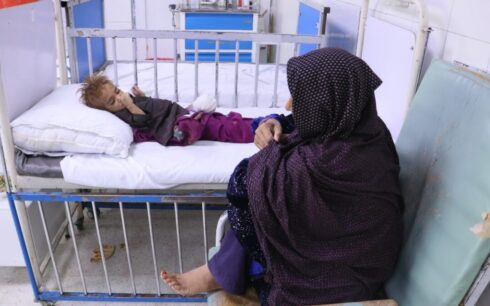
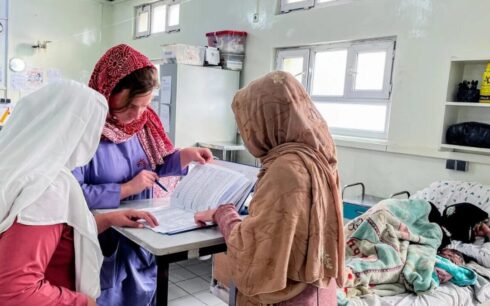
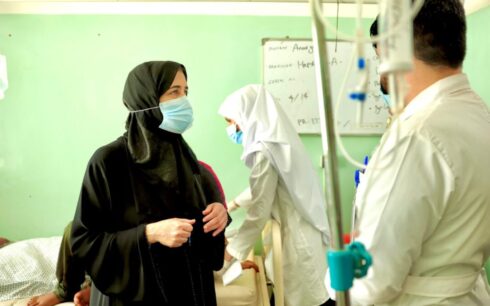
Global health organizations, including the World Health Organization, have warned that the exclusion of women from the health workforce poses a grave risk to the country’s already fragile medical system, which relies heavily on female workers to treat women and children.
Jalali also reported that a database has been created to assess training needs for 33,000 health employees, with more than 27,000 staff receiving professional training over the past year.
According to the minister, 377 contracts worth 1.2 billion Afghanis were signed for procurement and development projects, and medical supplies, food, and fuel worth 2.6 billion Afghanis were purchased for 22 central hospitals. The ministry inspected more than 71,000 medical and nutritional items, rejecting over 4,000 and destroying 1,077 tons of expired or substandard products.
Taliban officials added that 3,526 private health centers were registered nationwide last year, and 382 were granted operating licenses.
While the Taliban continue to present these developments as progress, human rights groups and medical professionals remain deeply skeptical. Analysts note that the lack of transparency, particularly around gender inclusion, continues to undercut any claims of meaningful reform.