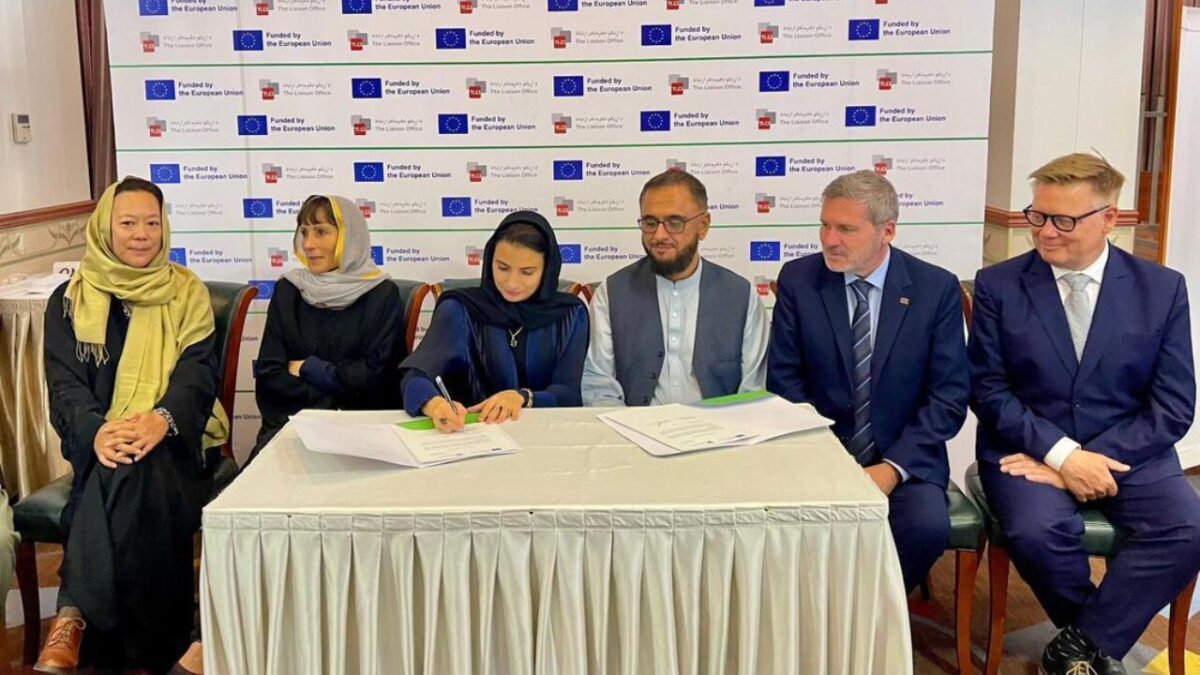
The European Union has signed a €1.5 million (about $1.6 million) agreement with The Liaison Office (TLO), an Afghan civil society organization, to support climate- and socially resilient livelihoods in Afghanistan, the E.U. office in Kabul announced Wednesday.
The funding complements an existing $8 million contribution from the Swiss Agency for Development and Cooperation (SDC) and will expand the Climate and Socially Resilient Livelihoods Support (CSRLS) project. The program, which runs through January 2028, targets the poorest households across 16 districts in the provinces of Loya Paktia and Daikundi.
The CSRLS initiative is part of TLO’s broader 12-year strategy and is designed to help Afghan communities adapt to climate change and sustain their livelihoods. It focuses on four areas: improving natural resource management, diversifying climate-resilient livelihoods, strengthening social cohesion, and linking local communities with authorities for joint climate action.
“By partnering with TLO, the E.U. is investing in stronger Afghan communities that can withstand the impacts of climate change and protect their livelihoods,” said Veronika Boskovic-Pohar, the E.U.’s chargé d’affaires in Afghanistan. “The massive return of Afghans to their home country puts additional strain on local communities already struggling with increasingly scarce natural resources and livelihoods.”
Masood Karukhail, director of TLO, said the E.U.’s support would allow the organization to expand its reach. “The E.U.’s support enables TLO to extend the reach of the CSRLS program and work with Afghan communities to restore resources, adapt to change, and build resilient livelihoods,” he said.
Afghanistan is among the world’s most climate-vulnerable countries, with more than 76 percent of its population dependent on agriculture, according to U.N. data. The CSRLS project, launched in February 2024, builds on TLO’s two decades of work in Afghanistan. The E.U. said its new contribution strengthens co-financing efforts aimed at breaking the cycle of environmental degradation, poverty and vulnerability while fostering social cohesion.