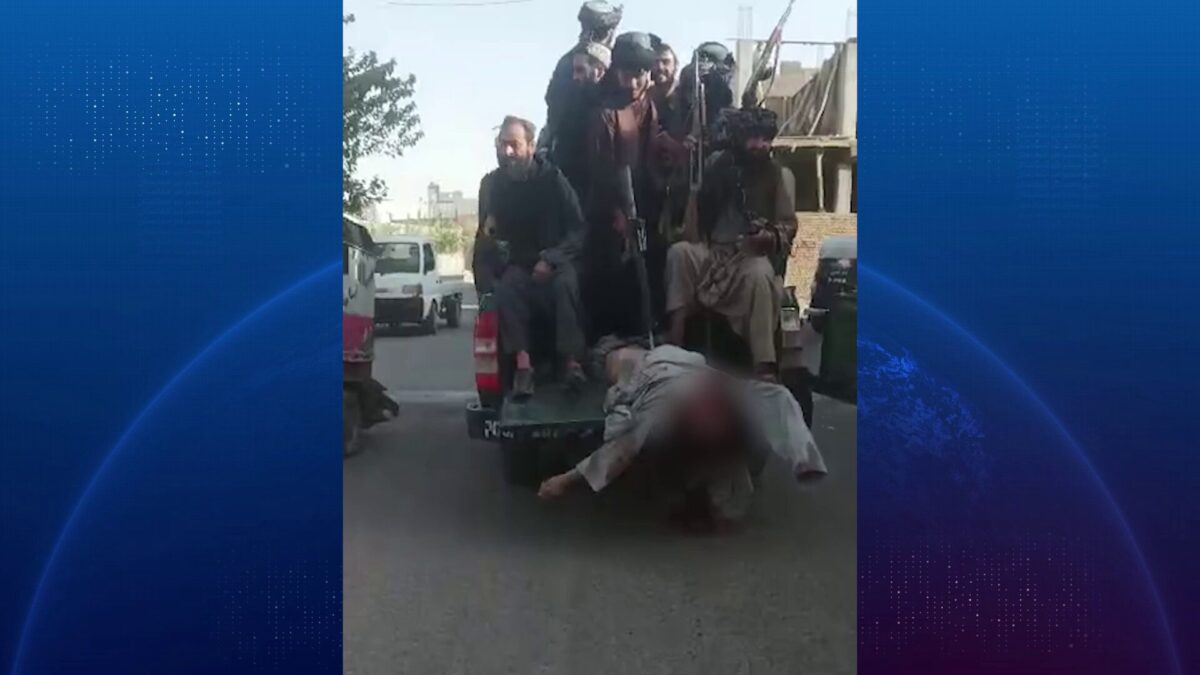
Mohammad Daud, a 34-year-old from Herat’s Pashtun Zarghun district, was the man Taliban fighters shot dead and then hanged in public on Friday — an act that has drawn outrage from Afghans and rights advocates, who condemned it as a summary execution and a desecration of human dignity.
Videos from the scene show Taliban members tying Daud’s body to an old tank at Herat’s busy Kandahar Gate, kicking his corpse as crowds gathered to film. A sign reading “Death to the Liberation Movement of Afghanistan” was placed on the body.
The Taliban’s police command in Herat claimed Daud had been a thief. One Taliban member in a video said he had killed two fighters, including Mawlawi Hassan Akhund, a Taliban police commander, who was shot dead earlier this week.
But the Islamic People’s Liberation Movement of Afghanistan, an armed opposition group, told Amu that Daud was one of its fighters. “One of our members, Daud from Pashtun Zarghun, was martyred by the Taliban in Herat,” said Nabi Jan Mubarez, the group’s communications chief. “He was the only one captured. The Taliban are lying when they claim they killed two.”
The group said Daud was killed during clashes in Herat’s 10th police district. It added that it has carried out 18 operations against Taliban forces since its formation after the collapse of the republic in 2021, including the recent attack that killed Commander Hassan Akhund.
The public display of Daud’s body provoked sharp criticism. “Taliban do not believe in human dignity. By hanging the body in public, they sought to terrify people,” a Herat resident told Amu.
Rights activists also condemned the act as a violation of both Afghan and Islamic norms. “Depriving a person of the right to life without a fair trial is a blatant breach of human rights,” said activist Hadi Farzam. “Hanging the corpse in public is a clear violation of human dignity.”
A women’s activist in Herat said: “Unfortunately, the Taliban have intensified executions and corporal punishments while denying defendants access to lawyers and fair trial procedures. Taking away someone’s life like this is against justice and even against Sharia.”
Gulbuddin Hekmatyar, the Hizb-e-Islami party leader, also weighed in, saying on social media that Islam forbids humiliating or mutilating a rebel once he has surrendered or fled. “If a fighter leaves the battlefield, he cannot be pursued, executed, or his body disrespected,” Hekmatyar wrote.
This is not the first time the Taliban have carried out public executions. In 2022, they shot four alleged kidnappers in Herat and hung their bodies in public squares. In April this year, four more people accused of various crimes were executed in Farah, Nimroz, and Badghis provinces.
Rights groups say such punishments highlight the Taliban’s reliance on public displays of violence to enforce order. Despite international calls to end extrajudicial killings, the group continues to carry out executions without due process.