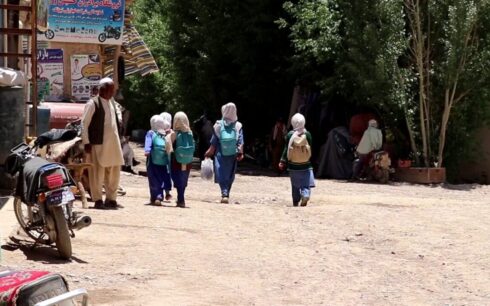
Taliban have imposed new restrictions on girls’ schools and religious seminaries in Herat, according to local sources, as their crackdown on women and public dissent continues to draw domestic and international scrutiny.
Sources told Amu TV on Saturday that Taliban morality police, or the PVPV enforcers, have warned administrators at several girls’ educational institutions that they could face closure if students are found not complying with Taliban-mandated dress requirements.
According to the sources, the requirements include wearing a prayer chador, face covering and socks. Taliban morality enforcers have also reportedly warned older female students, whom “authorities” consider to have reached puberty, not to attend school or religious classes without the prescribed attire.
Several families in Herat said similar warnings had been delivered to school administrators in recent days. Some parents said even young girls have been told they will not be allowed to attend classes unless they wear the required clothing.
The measures come days after Taliban detained at least 30 women in Herat over alleged violations of dress regulations, sparking rare public protests and a widening international backlash.
Some girls in Herat told Amu TV that fear of arrest has led them to avoid public spaces and leave their homes only when necessary.
Growing concern over restrictions
The latest restrictions coincide with reports of broader enforcement efforts targeting women across the province.
Doctors Without Borders, MSF, said on Friday that one of its female staff members in Herat was detained for two days after being accused of violating Taliban dress requirements while traveling to work at an MSF-supported hospital.
The organization said the employee was released only after signing a written commitment, along with family members, to comply with a specific form of dress mandated by Taliban.
MSF described the incident as alarming and warned that increasing restrictions on women were affecting both access to health care and the ability of female medical professionals to work.
UN condemns use of force
The United Nations has also expressed concern over developments in Herat, particularly the Taliban’s response to protests that followed the arrests.
“The situation is obviously very concerning,” Stéphane Dujarric, spokesman for UN Secretary-General António Guterres, said on Friday. “Lethal force should never be used against peaceful protesters.”
He said the United Nations would continue monitoring the situation closely.
The unrest began after morality police detained at least 30 women in Herat between June 6 and June 7, according to the UN Assistance Mission in Afghanistan (UNAMA).
The arrests prompted demonstrations in the city’s Jebrail area. UNAMA has confirmed that at least one boy was killed by gunfire during the protests and said it is investigating reports of a second fatality.
Human Rights Watch, UN Women and a group of UN human rights experts have since criticized the Taliban’s handling of the protests and called for accountability.
Focus on preventing protests
The developments come as Taliban leaders appear increasingly focused on preventing further unrest.
Sources previously told Amu TV that a recent cabinet meeting chaired by Taliban supreme leader Hibatullah Akhundzada in Kandahar included discussions on preventing the emergence and spread of organized protests.
The Taliban’s chief spokesman later said Akhundzada used the meeting to stress the importance of fully implementing his decrees.
According to a statement released by the Taliban, Akhundzada instructed Taliban officials to promote religious teachings, uphold piety, prevent what he described as immoral behavior and ensure the full implementation of directives issued by him.
Meanwhile, the Afghanistan Freedom Front, an anti-Taliban armed group, claimed responsibility for an attack Thursday evening targeting members of the Taliban’s morality police near one of its offices in Herat.
The group said three Taliban morality officers were killed and two others wounded. The Taliban have not commented on the claim. Sources told Amu TV the attack had happened, but did not provide details on possible casualties.
Herat residents say Taliban security forces remain heavily deployed days after the protests.
Local sources said Taliban patrols and checkpoints continue to operate across the city, contributing to an atmosphere of fear among many residents, particularly women and girls.