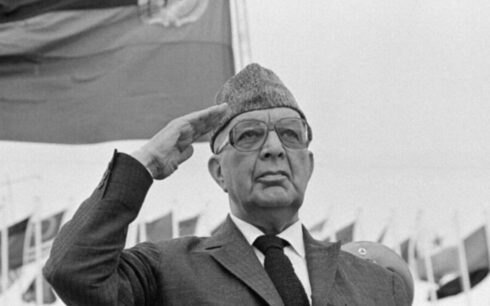
Monday, April 27, marks the 48th anniversary of the Saur coup, the 1978 military takeover that overthrew President Mohammad Daoud Khan and helped set the country on a path of prolonged conflict and instability.
The uprising, carried out on April 27 and 28, 1978 — known as 7 and 8 Saur in the solar calendar — was led by the People’s Democratic Party of Afghanistan, or PDPA, with support from factions within the military and close alignment with the Soviet Union. The event is widely known as the Saur Revolution.
Fighting quickly engulfed Kabul as military units aligned with the PDPA used tanks and aircraft to strike the presidential palace and other centers of power. Daoud Khan, who had seized power in a 1973 coup and established a one-party system, was killed along with most of his family inside the Arg palace.
The coup marked a decisive break in Afghanistan’s political order. The PDPA established a socialist government closely aligned with Moscow, led by Nur Mohammad Taraki, who became head of state and general secretary of the ruling party.
The new government introduced sweeping political, economic and social reforms, including land redistribution, changes to the education system and efforts to promote a communist ideology. Those policies, however, were met with strong resistance, particularly among religious and traditional communities.
The government’s response, marked by arrests, purges and executions, deepened unrest, while internal divisions within the PDPA further destabilized the country.
The turmoil ultimately prompted the Soviet Union to intervene militarily in late 1979, beginning a nearly decade-long war. Soviet forces faced sustained resistance from mujahideen fighters, in a conflict that left deep and lasting effects on Afghanistan’s society and institutions.
The Taliban, in a statement marking the anniversary, described the Saur coup as the beginning of foreign occupation and the imposition of communist ideology. They contrasted it with April 28, or 8 Saur, which marks the fall of the Soviet-backed government in 1992 and the entry of mujahideen forces into Kabul — a date they described as “historic and honorable.”
Interpretations of the two dates remain deeply contested in Afghanistan. For some, they represent the beginning and end of distinct political eras; for others, they mark the start of cycles of violence, civil war and instability whose consequences continue to shape the country.
After the Soviet withdrawal in 1989, the government of President Najibullah remained in power until 1992, when it collapsed and control passed to rival mujahideen factions. Their internal fighting soon plunged Kabul into another devastating civil war.
Nearly five decades after the Saur coup, it remains a defining moment in Afghanistan’s modern history — one that not only ended a political system but also set in motion decades of foreign intervention and conflict.