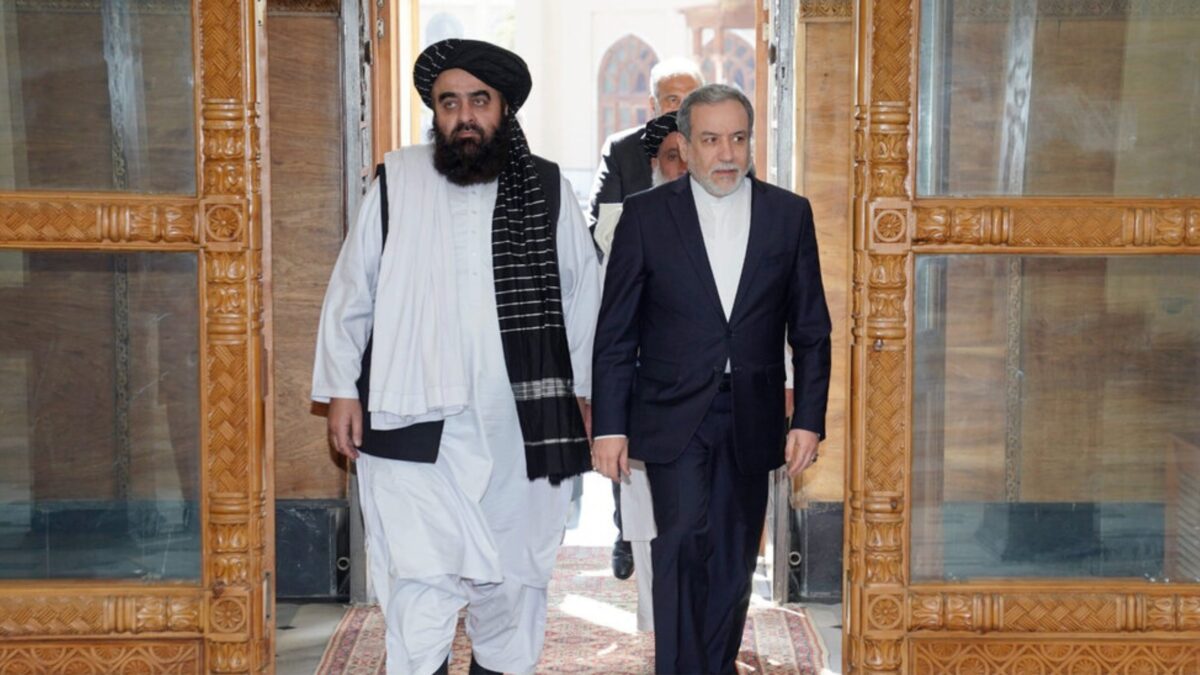
Iran’s Foreign Minister Abbas Araghchi, in a phone call with Amir Khan Muttaqi, the Taliban’s foreign minsiter, once again expressed his country’s readiness to support initiatives aimed at easing tensions across the region, the Iranian Foreign Ministry said.
The offer comes amidst heated tensions between Taliban and Pakistan that have continued for weeks.
The statement said the two sides discussed the regional situation and Tehran’s efforts to preserve peace and stability.
Araghchi and Muttaqi also stressed the importance of continued regional consultations and closer diplomatic engagement between two sides, the statement said.
Muttaqi, the statement added, welcomed Iran’s outreach and said the Taliban support ongoing regional dialogue aimed at improving the situation.
Taliban’s foreign ministry said Muttaqi reaffirmed their position regarding regional cooperation and the format of regional meetings, emphasizing that preserving stability and strengthening regional collaboration remains a key priority for Afghanistan.
According to the Taliban statement, Araghchi, for his part, provided an overview of his country’s latest efforts to enhance regional cooperation and underscored the importance of continued dialogue and engagement among regional countries.
The conversation comes amid intensified efforts by Tehran to mediate between Islamabad and Kabul, whose ties have rapidly deteriorated in recent weeks following a series of deadly border clashes and a complete breakdown in bilateral talks.
Iranian officials confirmed earlier this week that Tehran is working to host a regional summit aimed at reducing tensions between the Taliban and Pakistan. While no date or venue has yet been announced, Iranian diplomats have reportedly held preliminary phone consultations with several countries in the region, including Russia, Turkey, and Qatar.
The initiative comes after three rounds of high-level talks between Pakistan and the Taliban — including two in Istanbul and one in Doha — failed to produce any agreement, particularly over the future of the Tehrik-i-Taliban Pakistan (TTP).
Taliban officials have consistently denied sheltering or supporting the TTP but have resisted Pakistan’s demands to relocate its fighters or publicly denounce their activities. During recent negotiations, Taliban delegates reportedly rejected proposals by Pakistan that included the relocation of TTP members and the issuing of a formal religious edict labeling attacks inside Pakistan as illegitimate.
Pakistan, for its part, has insisted that any progress on talks requires firm action from the Taliban to dismantle cross-border militant networks. Last week, Islamabad said that future dialogue was contingent on “verifiable” Taliban action against groups like the TTP.
The standoff has led to broader consequences. Major border crossings between the two countries have been closed for weeks, halting trade, stranding goods, and placing immense strain on communities and businesses on both sides of border. Taliban officials, in response, announced new trade restrictions on Pakistan, including a decision to stop pharmaceutical imports — signaling a hardening of their position amid the diplomatic stalemate.
While Tajikistan, Uzbekistan, and other Central Asian neighbors have cautiously re-engaged the Taliban through economic channels, Iran remains one of the few regional powers to openly push for structured political dialogue — positioning itself as a mediator in a volatile and shifting regional landscape.
The phone call between Araghchi and Muttaqi follows a similar conversation between the Iranian and Russian foreign ministers, highlighting growing coordination between Tehran and Moscow on Afghanistan-related diplomacy. This marks the second time in recent weeks that Iranian and Russian officials have discussed the worsening situation along Afghanistan’s borders. This also marks the second conversation between Muttaqi and Araghchi this month.
Despite maintaining its embassy in Kabul, Iran has not formally recognized the Taliban and continues to call for an inclusive political settlement in Afghanistan. At the same time, Tehran has expanded its economic and infrastructure engagement with the country — a dual-track approach that balances regional stability concerns with pragmatic cooperation.