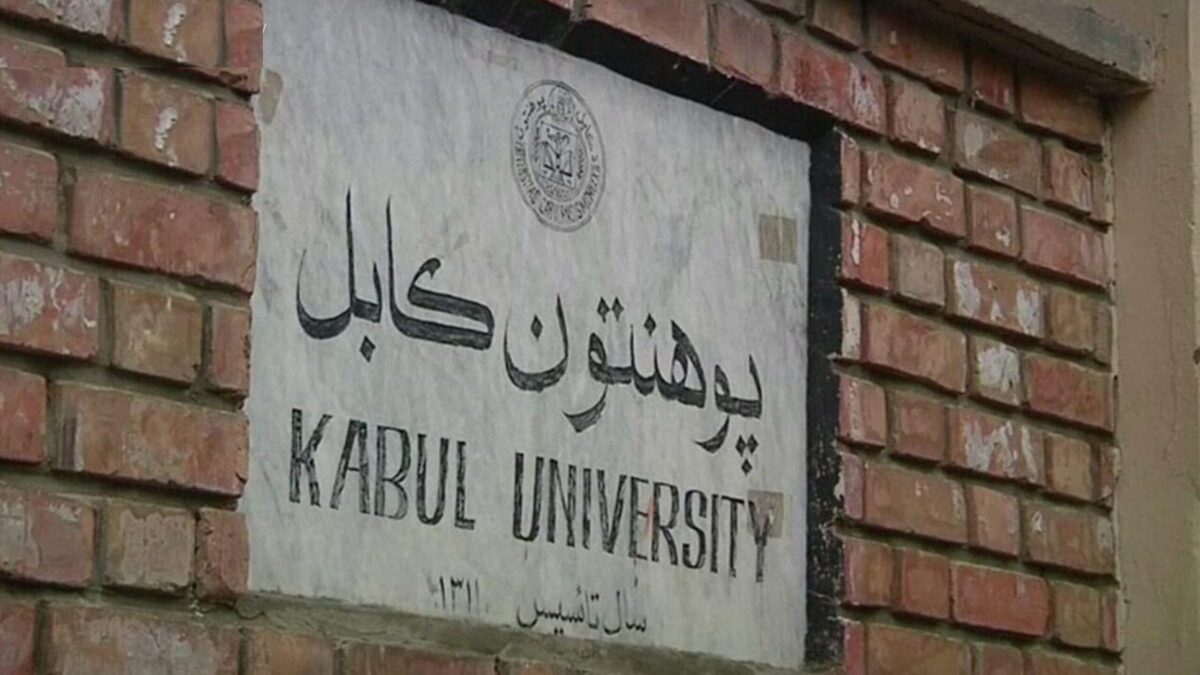
The Taliban-led Ministry of Higher Education has removed 18 academic subjects from university curricula across Afghanistan and ordered revisions to more than 200 others, according to an official letter obtained by Amu TV.
The directive, issued by Zia ur-Rahman Aryoubi, the Taliban’s deputy minister for academic affairs, states that the changes were made following a review by Islamic scholars and Sharia experts. The subjects were eliminated or modified to ensure that higher education content complies with “Islamic principles and the policies of the system,” the letter says.
“In accordance with the findings of religious scholars and experts, 18 subjects from various disciplines were removed for contradicting Sharia and national policy,” Aryoubi wrote in the letter addressed to public and private universities and higher education institutes.
In addition to the subjects removed entirely, the ministry said 201 others were identified as having “relative issues” and will be taught only after revision. These courses must now be delivered in a “critical and corrective” manner to bring their content in line with the Taliban’s interpretation of Islamic law.
University administrators were instructed to share the updated subject lists with relevant faculties and departments and to ensure the banned subjects are removed from teaching schedules. Institutions were also ordered to prepare the revised subjects for instruction without delay.
According to university professors who spoke with Amu TV on condition of anonymity, most of the eliminated subjects come from faculties of political science, philosophy, sociology and public administration.
The move is part of a broader effort by the Taliban to reshape Afghanistan’s education system around strict interpretations of Islamic teachings. In 2023, Taliban leader Hibatullah Akhundzada ordered a comprehensive review of the country’s academic curriculum in higher education institutions.
Since returning to power in August 2021, the Taliban have increasingly imposed restrictions on Afghanistan’s education sector, especially targeting subjects, institutions and individuals they view as contrary to their ideological and religious views.