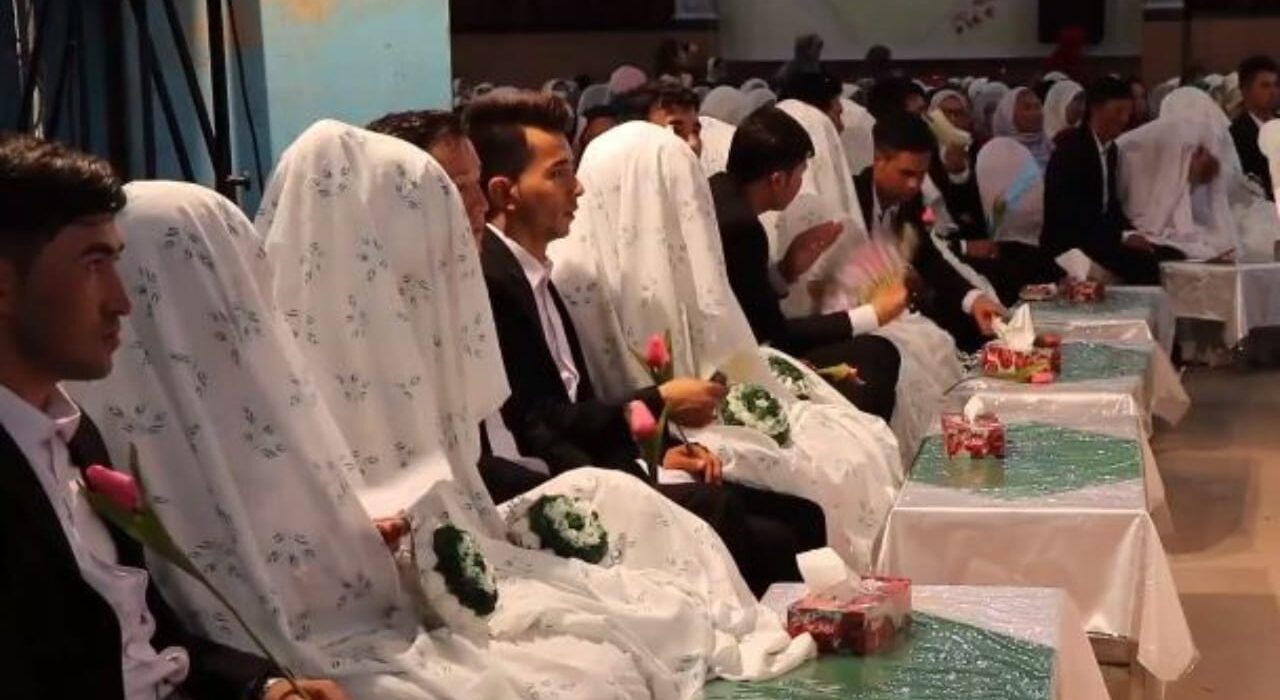
Taliban leader Hibatullah Akhundzada has issued a decree banning lavish customs at weddings, targeting practices he described as “un-Islamic” and financially burdensome for families.
The decree, published by the Taliban-run Ministry of Justice in the official gazette, prohibits a wide range of traditions, including excessive dowries, the payment of “toyāna” (a customary bride price), pre- and post-wedding parties, costly receptions, the “shirini khori” (the engagement ceremony), and extravagant gifts to the bride and groom.
The edict states that smaller dowries are preferable, setting a minimum of 10 dirhams but no upper limit. “The less that is asked for, the better,” it reads.
Among the key restrictions outlined in the decree:
Engagement parties should avoid “paiwazi” (a ceremony a day after engagement ceremony and wedding ceremony) and “shirini khori” (engagement ceremony) banquets.
At the “dastmal khori” (handkerchief ceremony), gifts should only be exchanged between the bride and groom, and such events cannot be held in hotels.
Brides should not be presented with repeated sets of clothing after engagement, except once a year. Likewise, brides are forbidden from giving clothes to the groom.
Wedding ceremonies must be held according to the groom’s financial means and location, without the bride’s family forcing expensive hotel venues.
State vehicles may not be used for weddings.
The groom is banned from sending food to the bride’s home during the wedding, and the bride’s family is barred from charging expenses for sweets ceremonies.
Families of brides may not demand money during the bride’s transfer.
Competitions awarding cars or other costly prizes, celebratory gunfire, and reckless driving during weddings are also prohibited.
Exchanging gifts such as cash or clothes at the end of the wedding, known as “ronumayi,” is forbidden.
Guests other than the groom’s family may not present gifts to the bride during the handkerchief ceremony.
The practice of “badal” — exchanging daughters between families to resolve disputes — is explicitly banned, with the decree warning it has “no good outcome.”
The payment of “walwar,” or bride price, and similar financial demands from the groom’s family are also outlawed.
The decree emphasizes that weddings should take place soon after the engagement and marriage contract, to reduce costs and delays.
The move comes as Afghanistan grapples with an economic crisis that has made marriage increasingly out of reach for many young Afghans. High unemployment, rising poverty, and Taliban restrictions on women — including bans on secondary and university education and employment in NGOs — have fueled frustration among families who say expensive weddings are deepening social hardships.
For years, Afghan youth have criticized the tradition of costly ceremonies and payments as a major obstacle to marriage, saying it leaves many unable to start families.