Taliban officials said Tuesday that state-owned enterprises generated billions of Afghanis in contracts, sales, and investment commitments over the past year, including more than 8.4 billion Afghanis ($121 million) deposited directly into their administration’s revenue accounts.
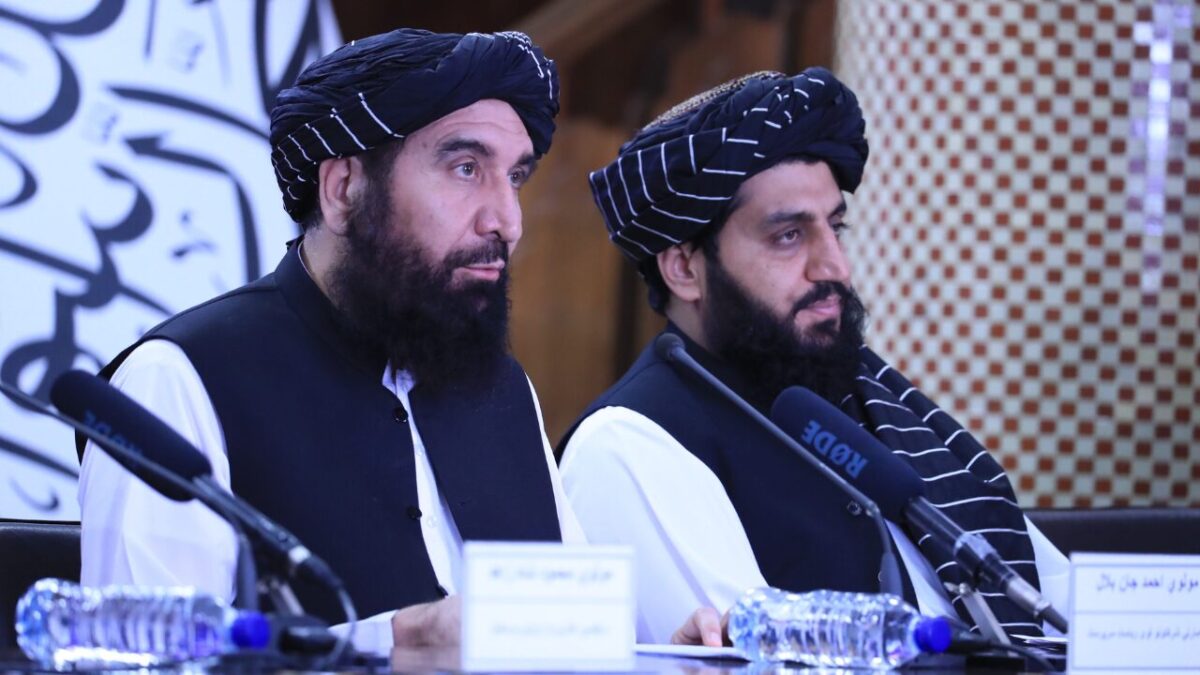
At a press briefing in Kabul, the Taliban’s General Directorate of State-Owned Corporations presented its annual performance report, saying that contracts worth 1.8 billion Afghanis ($25.9 million) were signed with Taliban ministries including Higher Education, Labor and Social Affairs, Public Health, and Education for food supply programs.
They added that food storage warehouses were activated at the provincial level.
The directorate reported that more than 5.3 million cubic meters of potable water had been distributed nationwide. Seventeen wells were drilled, 11 water supply projects designed, and about 70 kilometers of new water networks constructed, with 35 kilometers of aging systems repaired.
In energy and construction, Taliban officials from the agency cited the completion of the Tura Dam in Zabul Province, an administrative complex in Torkham Township of Nangarhar, and the production and sale of nearly 194,000 tons of cement from plants in Ghori and Jabal Siraj.
Coal remained a central part of operations. More than 70,000 tons were extracted and sold over the past year, with contracts signed for an additional 217,000 tons with private firms. Contracts for the extraction, transport, and sale of 63,000 tons of coal and 20,000 tons of other minerals were also finalized, the Taliban officials said.
Housing projects included the sale of 164 apartments in the Lala and Bagrami developments. Taliban officials said an “Energy Center” industrial complex had been established and that work on the Qosh Tepa Canal had reached 98 percent completion in its first phase and 94 percent in the second. Around 200,000 hectares of land were allocated for agricultural development around the canal.
Taliban also pointed to progress in the electricity sector. The Naghlu, Sarubi, and Mahipar hydropower plants produced 662.8 million kilowatt-hours of electricity last year. A new 220-kilovolt transmission line from Turghundi to Herat, stretching 85 kilometers, was completed. Taliban officials from Da Afghanistan Breshna Sherkat, the country’s power distributor, said Afghanistan secured World Bank approval for financing of the CASA-1000 project and signed contracts to generate 619 megawatts of power, with investments totaling about $591.6 million.
Oil revenues included 637 contracts signed with public agencies and private firms, the restoration of 12 oil reserves with a combined capacity of nearly 10,000 tons, and the issuance of 387 licenses for oil facilities.
In telecommunications, more than 90 new sites were activated in the south, 40 upgraded from 2G to 3G, and 386 transitioned from 3G to 4G. Service companies reported a 13 percent increase in revenue compared to last year, with more than 25 new contracts valued at over 5 billion Afghanis ($71.9 million).
On aviation, the directorate noted “successful flights” to 13 countries, the transfer of more than 6,000 Afghan pilgrims to Saudi Arabia, and the activation of new fuel reserves at Kabul International Airport.
Taliban officials said the past year saw 23 contracts and partnerships across various sectors ratified, with a total estimated value of 22 billion Afghanis ($316.5 million). They also announced that foreign investments worth more than 20 billion Afghanis ($287.8 million) had been attracted.
Financially, the directorate said it had deposited 8.4 billion Afghanis ($121 million) into “government accounts”, settled 2.77 billion Afghanis ($39.9 million) in claims from Taliban-run firms, and paid off 611 million Afghanis ($8.8 million) in liabilities.
The Taliban officials further stated that, under decrees issued by the Taliban’s supreme leader, more than one million jeribs of land (about 200,000 hectares) had been transferred to state-owned corporations for agricultural and commercial development. Fifty new investment opportunities were identified to attract additional capital, they said.
The directorate said that overall, its operations brought in more than 20 billion Afghanis ($287.8 million) in investment, which it claimed would play a “significant role in economic growth and job creation” in Afghanistan.
Despite the Taliban’s claims of expanding revenue and investment, recent World Bank and UN–affiliated assessments paint a fragile economic picture. The reports say that Afghanistan’s economy grew approximately 2.5 percent in 2024, its second consecutive year of recovery, driven mainly by agriculture, mining, construction, and trade. Still, growth remained constrained by weak manufacturing and service sectors, persistent trade barriers, and diminished foreign aid,
According to UN reports, high poverty rates and soaring food insecurity persist—an estimated 14.8 million people now face hunger, while millions more live below the poverty line—exacerbated by continued restrictions on women’s economic participation.
UN agencies warn that without restoring women’s access to work and education, reversing financial isolation, and regaining international legitimacy, Afghanistan is likely to remain trapped in economic stagnation with widespread humanitarian needs.