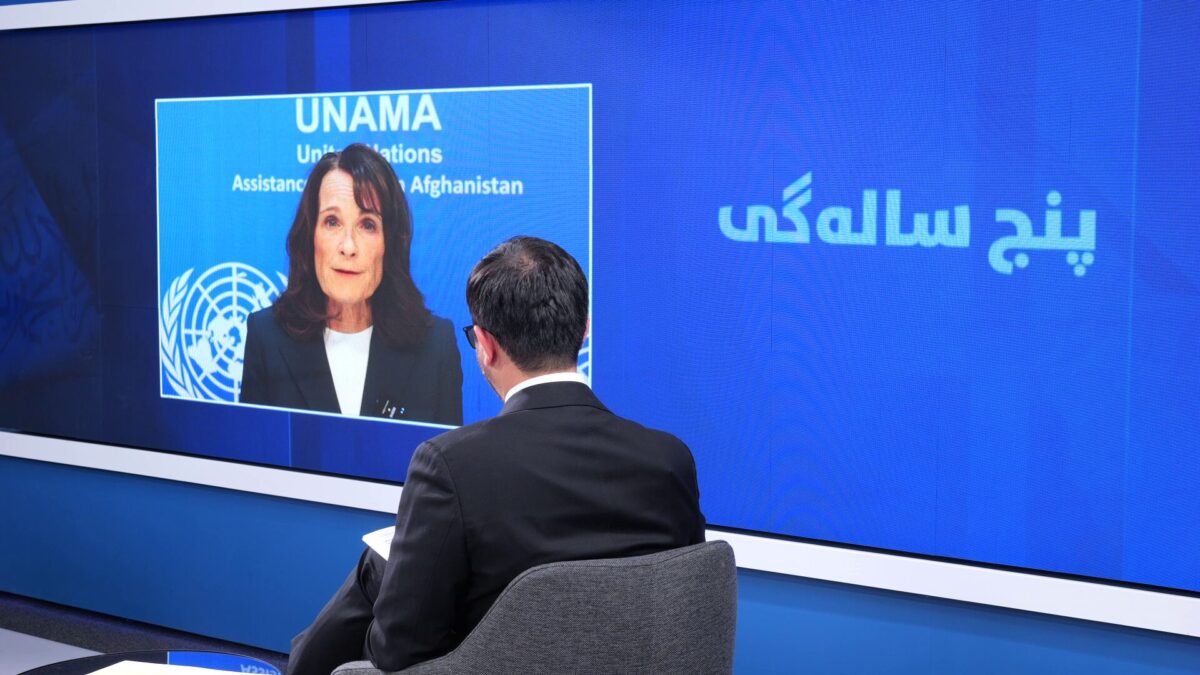
Shortened and edited for clarity purposes. Full transcript is available here:
LN: As someone who once led the human rights division of the UN mission in Afghanistan in and now leads the whole mission, what makes you get up every morning in Kabul and move?
GG: The Afghan people, particularly women and girls. It’s a very challenging time for them now.
LN: What does the new UNAMA mandate mean?
GG: Full UNSC support. Afghanistan remains a very important part of the international agenda. The mandate has asked us to work on three key priorities: political engagement and good offices, human rights, and coordination of basic human needs and humanitarian assistance.
LN: How important is it to have a political mission in Afghanistan at the moment?
GG: Very important. We are the eyes and ears. The political mission is seen as imperative and permits a lot of other actors to work and stay in the country.
LN: Where are we with the Dec 2023 UNSC resolution and the independent assessment?
GG: The assessment mandated by the UNSC was aimed at improving or starting structured, coordinated engagement with the de facto authorities. It recommended a number of steps. Some have been taken forward in quite a constructive way, such as counter-narcotics and private sector. Others have not: diplomatic recognition, counter-terrorism, international obligations, and inclusive governance. The de facto authorities (dfa) need to engage more with the international community in finding ways to resolve these hard issues.
LN: Why don’t they do that?
GG: They prefer bilateral engagement. It’s how they mainly conduct their foreign policy with different member states.
LN: Are you at least talking to them about it?
GG: There is a lot of discussion on all issues, including human rights and international obligations. But not a lot of action on their part. The action isn’t enough to take forward this whole multilateral approach to address these issues.
LN: How do you assess the situation on why they don’t take action?
GG: As I said, they need to do more. High-level UN officials visited last week — the High Commissioner for Refugees and the Administrator for UNDP. Their message was clear: help us help you.
LN: The Taliban let the heads of UNHCR and UNDP in — the money people — but not Richard Bennett, the UN Special Rapporteur for human rights. How can you explain this?
GG: There are many countries who are not pleased to have the highest-level human rights officials come into the country. It would be a very good move if Richard Bennett were permitted. UNAMA has its own human rights team, monitoring, documenting, and reporting on human rights very regularly.
LN: Bennett’s lack of access to the country is not justified, right? How can the Taliban cherry-pick who can come and who cannot?
GG: Several requests have been made for his entry into the country. It’s ultimately the DFA’s decision.
LN: Where are we on Doha Four?
GG: To move ahead with Doha Four, there would need to be more progress on some of the issues I’ve previously highlighted. We would like to see that happen, but there needs to be more action and movement on the part of the dfa.
LN: Like what specific steps? Letting girls go to school, cutting ties with the TTP and others? Letting UN Afghan female staff come to their offices?
GG: Some action on international obligations, particularly around girls’ education, and further action on counter-terrorism. Also some action around enabling more women to work in the private sector, to name a few.
LN: What is your current level of access and engagement with the Taliban? Kabul level or Kandahar as well?
GG: Our colleagues in our field offices meet with provincial governors, deputy governors, and also with Afghans working in different sectors, including women, business people, and those running NGOs. There is a very regular, deep engagement with many Afghans across the country.
LN: How about the Taliban leader?
GG: We have met with the PM and different ministers. Regarding the Taliban leader in Kandahar, no foreigner is meeting with him.
LN: The Qatari PM reportedly did meet with him a couple of years ago?
GG: The officials that we meet are in regular touch with the Taliban leader in Kandahar, and our discussions and requests are taken to Kandahar. The messages are getting through.
LN: He is not allowing your own Afghan female staff to come to their offices. Is that issue being addressed?
GG: This is a very challenging issue for us. It has been highlighted at the highest level of the UN — the Secretary-General, the Security Council — on how critical it is that our Afghan female personnel return to our premises. This continues to be among the highest priorities of the UN.
LN: Is that a red line? Has the red line been crossed? How much more time do you have?
GG: We will continue to push.
LN: Yes, but what are you hearing back from them?
GG: They are saying that they are working on this. Of course, it’s not a good enough answer. It’s a violation of the UN Charter.
LN: And is their response on why they don’t let girls go to school good enough?
GG: It’s not good enough. This is impacting not only Afghan women and girls, but the whole country. Afghanistan remains the only country that does not allow girls past grade six to attend public school.
LN: Is it politically correct to say that Hibatullah Akhundzada is not allowing girls to go to school? Can we at least name him?
GG: The fact is that girls are not going to public schools past grade six. This is a very serious issue and needs to be addressed. Our view is that the argument continues to need to be made to the Taliban leader by all those who have any influence over him.
LN: Two days ago, Abdullah Rahimi, a former Republic-era intelligence official, was killed after evening prayers in Ghor. Who kills these people?
GG: There was a general amnesty, as you may know, that was passed. However, what we have seen is that these incidents continue to occur.
LN: So there is no amnesty?
GG: This is a point that has been made to the dfa: you have put in place this general amnesty, you need to implement it fully.
LN: On poverty — two-thirds of Afghans don’t know if their next meal is coming. How is the world responding?
GG: International donors have provided $16 billion since 2021. Six million Afghans have returned to Afghanistan since 2023. The needs are very large. There need to be more international support, more international engagement.
LN: There are other priorities. What is your message to the world? Why stay engaged?
GG: 63% of Afghanistan is now under 24. What are all these young people going to do here? What is their future here? I think this is a concern shared [broadly]. People say that we want our young people, we want our families, to be able to stay in the country, to be able to work and be educated, and for this to be a place where they find a future. Given the challenges here, given the situation coming out of a long period of conflict, international support and engagement is needed. Abandoning the country will not result in that future.
LN: The new mandate also tasks you with the sanctions monitoring team, keeping an eye on terrorism. We’re on the 25th anniversary of 9/11 — speaking from Kabul, can you tell us Afghanistan is not a threat to the rest of the world?
GG: The UNSC did highlight again concerns around terrorism and the presence of terrorists inside the country. Many countries in the region are also concerned about the issue.
LN: Five years in, are we at a stalemate?
GG: There have been some good things that have happened over the past few years. But overall, there are immense challenges here on the political process and human rights, and if they are not addressed with increased engagement by the dfa, then the concern — the risk of increasing instability, the country not moving but staying at the status quo — will continue.
LN: What will happen if the status quo continues for another three to five years?
GG: If the status quo on the situation of human rights continues, there could be decreased international engagement. The country will not see greater prosperity, greater peace, greater stability, so that Afghans can stay and others can return.
LN: You will be joined by another woman soon to lead UNAMA. What message does that send to the Taliban?
GG: The message is clear: women are at the exact same level as any man and should be fully participating in every aspect of political life and public life.