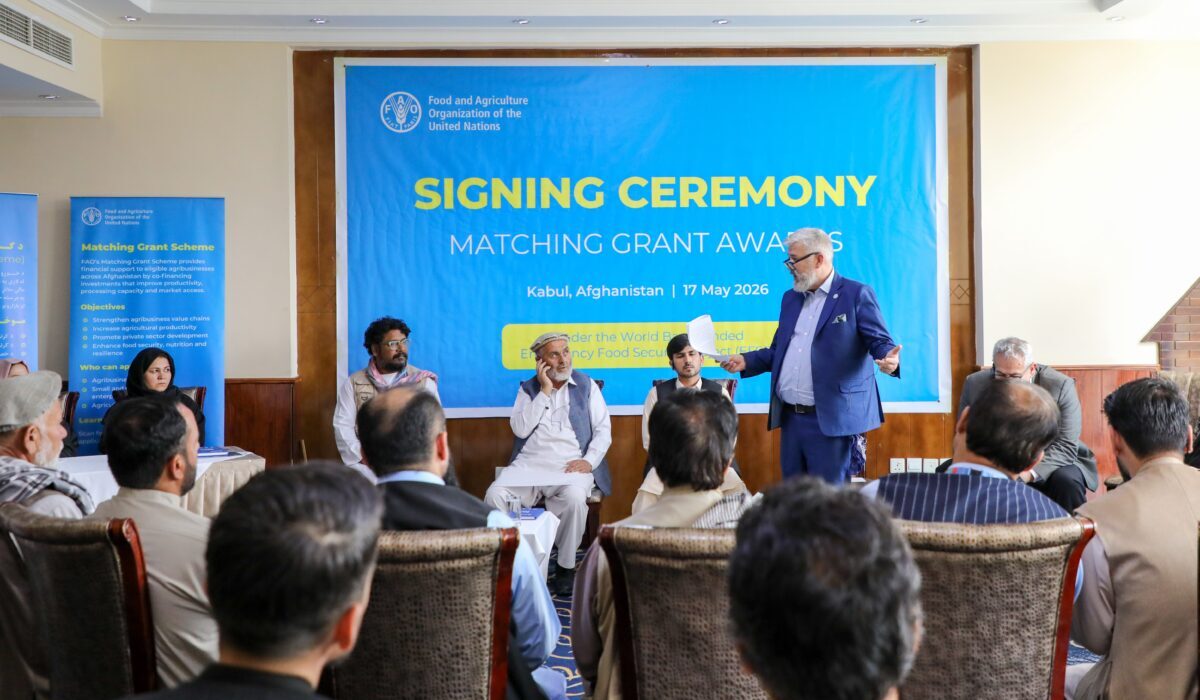
The Food and Agriculture Organization of the UN and the World Bank have launched a matching grant program to support Afghan agribusinesses, saying the initiative is intended to boost rural employment, strengthen agricultural supply chains and stimulate economic activity across Afghanistan.
Under the program, five Afghan agribusinesses have been selected as the first recipients of co-investment grants aimed at expanding production and improving links between farmers and markets.
The selected businesses operate in the sectors of seed production, saffron, dairy processing, soybean processing and food manufacturing in the provinces of Herat, Kapisa, Kunduz, Logar and Takhar.
According to the organizations, the grants will help finance projects including a soybean oil refining line in Kapisa, solar-powered dairy operations in Takhar and saffron-processing equipment in Kunduz.
Three of the five enterprises receiving support are led by women, the organizations said.
The initiative is being implemented through the Emergency Food Security Project, administered by the FAO and funded by the World Bank.
In addition to financial assistance, the businesses will receive technical support aimed at improving business planning, workforce development and operational management.
Richard Trenchard, the FAO’s representative in Afghanistan, said the program was intended to help rural producers connect more effectively with markets.
“Across Afghanistan, farmers are still too often cut off from markets,” Trenchard said in a statement. “Our role, together with the World Bank, is to help them scale up, reach more farmers, create jobs in rural communities and build stronger connections between production and markets.”
Agriculture remains central to Afghanistan’s economy and supports the livelihoods of roughly 80 percent of the population, according to the FAO.
The organization also said that more than half of Afghan women participating in the labor force are employed in agriculture, making the sector particularly important for women’s economic participation.
The launch of the grant initiative comes as Afghanistan continues to face widespread poverty, food insecurity and declining humanitarian assistance following years of economic crisis and international isolation after the Taliban returned to power in 2021.
International aid agencies have increasingly emphasized investment in local markets, agricultural production and private-sector activity as humanitarian funding declines and long-term economic pressures deepen.
The FAO and the World Bank said the program would later expand to support larger and export-oriented agribusinesses with greater capacity for employment generation and value-added production.