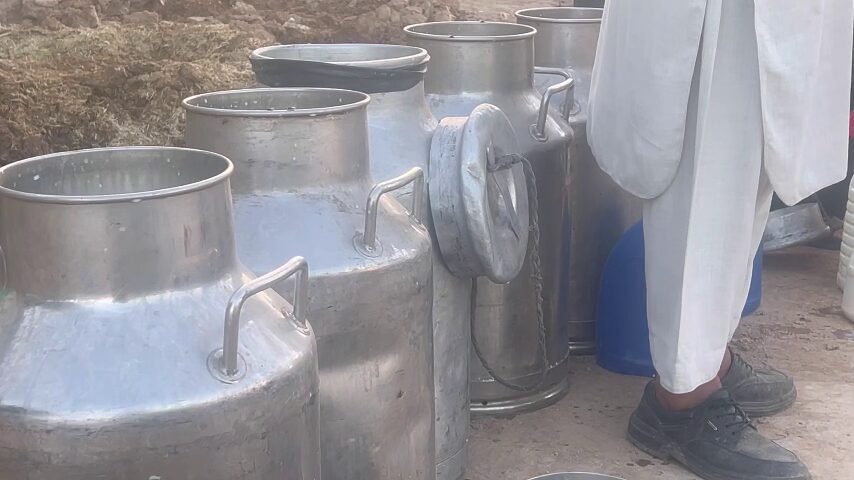
Along the highway connecting Herat City to Zindajan district, dairy farmers and cattle owners line the roadside each day selling fresh milk and other dairy products at prices they say barely cover their costs.
Residents and farmers in the western province say the lack of proper markets, cold storage facilities and dairy processing infrastructure has forced them to sell their products cheaply, even as demand and prices remain significantly higher in the city.
In Zindajan district, one kilogram of fresh milk sells for between 15 and 17 Afghanis (23 to 26 cents), according to local residents. In Herat City, however, the same amount can sell for around 35 Afghanis (54 cents).
Farmers say the large price gap reflects weak rural infrastructure and the absence of facilities needed to preserve and transport dairy products.
“We buy this milk for about 17 Afghanis per kilogram and take it to the city to sell,” said Ghulam Hazrat, a resident involved in transporting dairy products to Herat. “From this work, we earn about 200 Afghanis a day, which is very little.”
The complaints reflect broader economic pressures facing Afghanistan’s agricultural sector, which remains heavily dependent on small-scale farming and livestock production.
Agriculture and livestock are among the country’s largest sources of employment, particularly in rural areas, but farmers across Afghanistan have long struggled with poor infrastructure, limited market access and a lack of investment in food processing and storage.
In Herat, dairy farmers say rising feed prices have made cattle farming increasingly unprofitable.
“At the moment, livestock farming is not worthwhile,” said Ahmad, a cattle owner in Herat. “Animal feed has become expensive, but we are forced to sell milk at low prices.”
Farmers and livestock owners say cold storage facilities and standardized dairy processing plants are urgently needed to reduce waste and improve incomes.
They are also calling for greater support and technical training from agricultural authorities to help modernize the sector.
“Our suggestion is that officials in the agriculture and livestock departments pay more attention to farmers and livestock owners,” said Ghulam Saeed, another resident of Herat. “They should provide training opportunities so we can earn better incomes.”
Herat, one of Afghanistan’s major agricultural provinces, has historically been known for livestock and dairy production. But years of conflict, drought, economic instability and declining investment have weakened the sector.
Since the Taliban returned to power in 2021, Afghanistan’s economy has faced severe contraction, reduced international aid and rising unemployment, increasing pressure on rural communities dependent on agriculture.
Residents say the lack of cold storage, modern processing equipment and organized dairy markets remains among the biggest obstacles facing cattle owners in the province.
Many farmers say authorities have so far paid insufficient attention to those problems, leaving rural producers with little choice but to continue selling their products at sharply reduced prices.