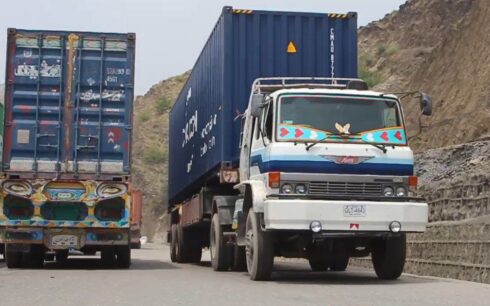
Nearly a month after cross-border trade between Afghanistan and Pakistan came to a halt, the economic toll is mounting on both sides, with thousands of commercial trucks stranded on both sides.
All five key border crossings — Torkham, Spin Boldak, Ghulam Khan, Angoor Adda, and Dand-e-Patan — remain closed for commercial traffic following escalating tensions between the Taliban and Pakistani authorities. The closures have paralyzed trade and transit, affecting thousands of businesses and sharply curtailing the flow of goods between the neighboring countries.
The Afghanistan-Pakistan Joint Chamber of Commerce and Industry estimates that up to 2,000 trucks used to cross these points daily. Now, that figure has dropped to zero. Officials from the chamber say that between 7,000 to 8,000 shipping containers are currently stalled on both sides of the border, including at Pakistan’s Karachi port, where traders are incurring steep demurrage penalties due to the delays.
“Traders on both sides are facing severe challenges because their goods are stuck,” said Naqibullah Safi, the chamber’s executive director. “Transshipment containers in Karachi are accumulating fines. This situation is damaging the private sectors of both countries.”
The economic ripple effects have been swift. In Afghanistan, the World Food Program (WFP) reports that the price of essential food items has risen significantly despite the strengthening of the Afghan afghani against the U.S. dollar. A 50-kilogram sack of flour has increased by 50 to 100 afghanis, and rice by up to 50 afghanis per sack, according to WFP’s latest data.
In Pakistan, meanwhile, the shortage of Afghan exports has contributed to rising prices for fruits and vegetables, as the border closures choke one of the country’s main agricultural supply routes.
Economic analysts warn that Afghanistan — heavily reliant on Pakistan as a key export market, particularly for perishable goods like fresh fruit and vegetables — will bear the brunt of continued disruptions.
“This is peak export season for produce,” said economist Sayed Haroon Amini. “If the border remains closed, Afghanistan’s fruit and vegetables could spoil before reaching market, leading to significant financial losses for farmers and exporters.”
Bahram Ramesh, another Kabul-based economist, echoed the concern. “The closure of trade routes directly affects the Afghan economy. Food prices rise, produce spoils, and jobs are lost,” he said.
The Afghanistan Chamber of Commerce and Investment says the closures are costing the two countries an estimated $200 million per month in lost trade. Hundreds of containers remain stalled at the Torkham and Spin Boldak crossings, as well as at the Karachi port, awaiting a resolution.
The closures come amid heightened military and diplomatic tensions between Pakistan and the Taliban, including border skirmishes and the failure of recent negotiations in Istanbul to yield a lasting agreement. While a fragile ceasefire remains in place, there has been no breakthrough in restoring trade routes — a development that continues to strain an already fragile Afghan economy.