Russia’s Foreign Minister Sergey Lavrov on Tuesday warned that the deployment of any foreign military infrastructure in Afghanistan or neighboring states under any pretext is “completely unacceptable,” saying such actions could spark fresh instability and conflict in the region.
“We reaffirm that it is completely unacceptable to deploy the military infrastructure of third countries in Afghanistan, just like in neighboring states, under any pretext whatsoever. The military presence of non-regional actors could lead to destabilization and to new conflicts,” he told the opening of the 7th Moscow Format Consultations Meeting on Afghanistan.”
“The history of Afghanistan knows quite a number of situations involving foreign military presence, and I believe that everybody should have long drawn the right conclusions,” Lavrov added.
Lavrov’s remarks come as US President Donald Trump has repeatedly called for the United States to “take back” the Bagram airbase in Afghanistan, citing its proximity to China’s nuclear development zones. The Taliban have strongly rejected those comments, calling Bagram an inseparable part of Afghan territory.
The Russian foreign minister also said that over the past four years, the Taliban administration— referred to by Moscow as the “Islamic Emirate” — has strengthened its hold on power.
“We state that over the four years of its tenure, the government of the Islamic Emirate has become stronger and is governing the state in a confident way. We pay tribute to Kabul,” Lavrov said.
He described Afghanistan’s humanitarian situation as “dire,” urging international donors not to condition aid on political demands.
“Once again, we call on foreign donors not to forget the Afghan people, to assist them, and not to make humanitarian aid conditional on political requirements,” he said, noting that more than half of Afghanistan’s population — around 22 million people — needs urgent assistance, while over 21 million lack access to clean drinking water and basic health services.
Lavrov said Moscow would continue and expand its humanitarian assistance to Afghanistan, adding that Russia recognizes the Taliban’s efforts to combat terrorism and narcotics production. According to UN estimates, opium cultivation in Afghanistan has dropped by 90 percent since 2022.
Lavrov also urged Western governments to abandon “hostile policies,” take responsibility for postwar reconstruction, and compensate for the economic damage caused to Afghanistan over two decades of conflict.
The Moscow Format Consultations — launched in 2017 — bring together Afghanistan’s neighboring and regional powers to discuss security, political reconciliation, and humanitarian cooperation. Participants in Tuesday’s meeting included representatives from Russia, Iran, Pakistan, China, India, Kazakhstan, Kyrgyzstan, Tajikistan, Turkmenistan, and Uzbekistan, as well as a delegation from the Taliban.
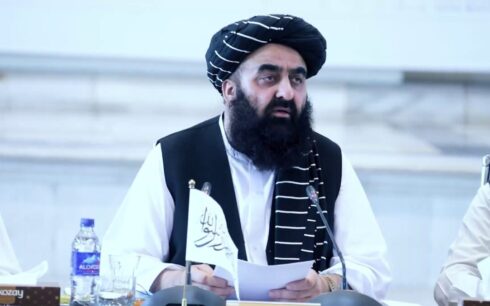
For the first time, Taliban Foreign Minister Amir Khan Muttaqi attended the meeting as an “official participant.” He is expected to hold bilateral talks with Lavrov on the sidelines of the event.
Lavrov said Afghanistan’s integration into regional political and economic processes would strengthen stability and promote multilateral cooperation. Russia, he added, lifted restrictions on intergovernmental cooperation with Kabul after officially recognizing the Taliban government in July.