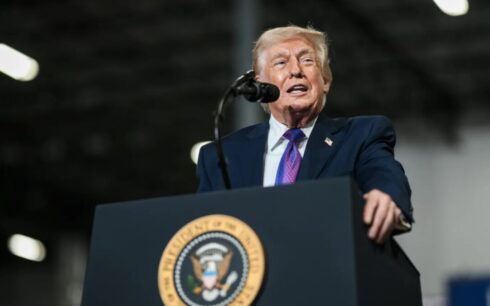
President Trump said on Sunday that the United States would impose an additional 10 percent tariff on any country aligning with the BRICS group of nations, a move that underscores his confrontational stance on international trade as leaders of the bloc convened for a summit in Brazil.
“Any country aligning themselves with the Anti-American policies of BRICS will be charged an ADDITIONAL 10% tariff. There will be no exceptions to this policy,” Trump wrote in a post on his social media platform, Truth Social. He did not clarify which policies he considered “Anti-American.”
The threat came just hours after the BRICS summit opened in Rio de Janeiro with a joint statement warning that escalating tariffs are undermining global trade—a veiled rebuke of Trump’s trade policies, which have long been criticized by multilateral institutions and U.S. allies.
With traditional forums like the G7 and G20 increasingly fractured by geopolitical tensions and nationalism, BRICS has sought to position itself as a counterweight, advocating for multipolar diplomacy and greater representation for emerging economies.
The bloc, originally formed in 2009 by Brazil, Russia, India, and China—and later joined by South Africa—expanded last year to include Egypt, Ethiopia, Indonesia, Iran, and the United Arab Emirates. While Saudi Arabia has yet to formally join, officials say more than 30 countries have expressed interest in membership or partnership.
In his opening remarks, Brazilian President Luiz Inácio Lula da Silva likened BRICS to the Cold War-era Non-Aligned Movement, which resisted pressures to align with either the U.S. or the Soviet Union. “BRICS is the heir to the Non-Aligned Movement,” Lula said. “With multilateralism under attack, our autonomy is in check once again.”
Speaking to business leaders on Saturday, Lula noted that BRICS nations now represent more than half the world’s population and 40 percent of global economic output, warning that rising protectionism threatens economic stability.
Trump’s administration is currently racing to finalize a series of trade agreements before a self-imposed July 9 deadline, when he is expected to unveil a broader set of retaliatory tariffs aimed at countries he accuses of undermining U.S. interests.