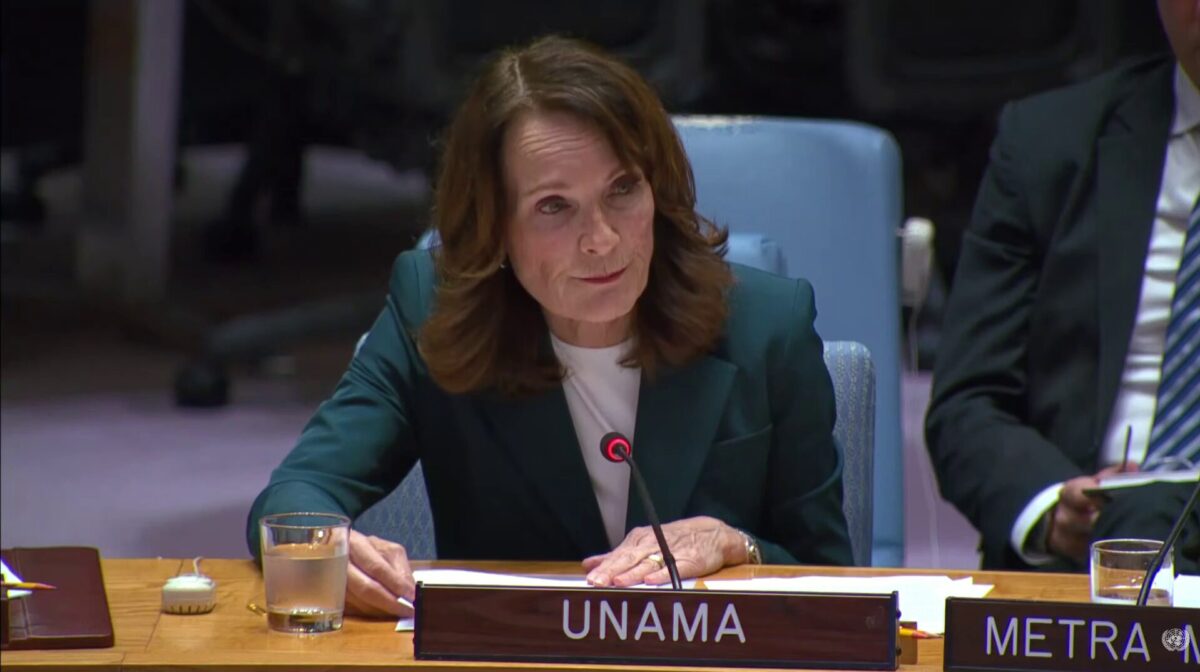
Georgette Gagnon, acting head of the UN mission in Afghanistan, told the UN Security Council on Monday that about 30 women had recently been detained in Herat by Taliban morality police for allegedly failing to comply with their dress code, citing the incident as part of a broader erosion of rights in the country.
Gagnon said the reported detentions were among a series of recent decrees and actions that are institutionalizing a system increasingly at odds with Afghanistan’s international human rights obligations.
The remarks mark one of the most direct acknowledgments by a senior UN official of the recent crackdown on women in Herat, where local sources previously told Amu TV that dozens of women and girls had been detained by Taliban authorities over alleged violations of dress regulations.
Gagnon also criticized a recent Taliban decree governing the judicial separation of spouses, saying it violates core principles of the Convention on the Elimination of All Forms of Discrimination Against Women and children’s rights protections. She said the decree was part of a broader pattern of policies restricting women’s freedoms and reinforcing discrimination.
Her comments came during a wide-ranging briefing on Afghanistan, in which she warned that restrictions on women and girls are causing long-term social and economic damage.
According to Gagnon, an estimated 3.8 million Afghan girls between the ages of 7 and 18 are currently out of school, including more than 2.6 million adolescent girls. Each year, roughly 250,000 additional girls are permanently excluded from secondary education, creating what she described as a “lost generation” of talent and potential.
She said the impact extends beyond education and is already affecting Afghanistan’s economy and public services.
Citing recent UNICEF analysis, Gagnon said restrictions on women’s education and participation in the workforce are undermining long-term economic development. She warned that sectors such as health care and education are facing a decline in qualified female professionals, with projections showing that Afghanistan could lose more than 25,000 skilled female workers by 2030.
The loss of female professionals, she said, is reducing access to health care, particularly for women and children, and worsening maternal and child health outcomes.
Gagnon also highlighted broader human rights concerns, including recent arrests of journalists and the closure of media outlets, which she said reflect declining freedom of expression and a continued narrowing of civic space in Afghanistan.
Beyond human rights, she warned of mounting economic and humanitarian pressures facing the country.
Nearly 5.9 million Afghans have returned from neighboring countries since 2023, increasing the country’s population by more than 10 percent, she said. Up to 2.8 million more are expected to return this year, many arriving with limited resources and few employment prospects.
At the same time, Afghanistan remains one of the world’s largest humanitarian crises, with 21.9 million people — about 45 percent of the population — requiring humanitarian assistance in 2026.
Gagnon noted that prolonged drought, water scarcity and environmental degradation are further straining livelihoods, particularly in rural areas where agriculture remains the primary source of income for more than 70 percent of the population.
Despite these challenges, she said Afghanistan remains politically stable on the surface, with the Taliban having consolidated territorial and administrative control and facing no significant armed or political challenge to their rule. However, she warned that the country’s long-term trajectory depends on whether Taliban continue to prioritize ideological policies that impose severe burdens on the population.
Gagnon reiterated UNAMA’s call for the Taliban to lift restrictions on women and girls, describing the measures as systemic and institutionalized harms with consequences that will affect generations of Afghans.