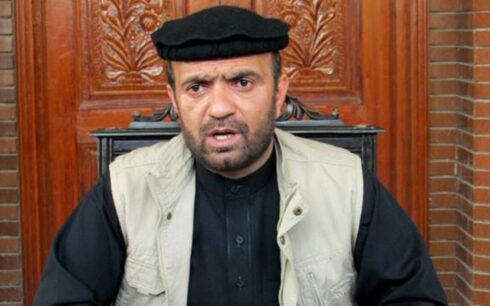
Mohammad Mohaqiq, a senior political figure and opponent of the Taliban, said in an interview with Amu TV that he recognizes the Durand Line as the border between Afghanistan and Pakistan, a position that remains deeply contentious in Afghanistan’s politics.
Mohaqiq said he accepts internationally recognized boundaries, framing his position as consistent with global norms.
“We are committed to internationally recognized borders,” he said. “That is what we consider Afghanistan.”
The comments prompted swift criticism from some former officials. Rahmatullah Nabil, the former head of Afghanistan’s intelligence service, described the remarks as a “questionable political shift,” suggesting they could be interpreted as transactional. Shah Hussain Murtazawi, a former presidential spokesman, said positions on territorial integrity should be based on careful judgment and broad national consensus, not emotion.
Others voiced support. Mujib Rahman Rahimi, a former government spokesman, praised Mohaqiq for taking a clear position and urged other political leaders to do the same.
In the same interview, Mohaqiq suggested that Pakistan might be willing to cooperate with opponents of the Taliban, though he stopped short of predicting such support with certainty.
“If cooperation is requested, I do not think they would refuse,” he said.
He added that political options remain his preferred approach but warned that his patience was “running out,” without specifying what actions he might consider.
Mohaqiq has taken a more openly critical stance toward the Taliban in recent months, particularly after Taliban confiscated some of his assets, including a television station, according to people familiar with the matter.
Taliban have not publicly responded to his remarks.
The comments underscore persistent divisions among opposition groups, which have struggled to unite against the Taliban since their return to power.
The Durand Line, a 2,640-kilometer border drawn in 1893 between British India and the Afghan emirate, has long been a source of tension between Afghanistan and Pakistan. While Pakistan recognizes it as the official international boundary, successive Afghan governments have historically disputed its legitimacy, arguing that the agreement was imposed under colonial pressure and does not reflect the will of the people, particularly ethnic Pashtuns living along the frontier. The issue has remained politically sensitive in Afghanistan, where formal recognition of the line is often seen as a concession on territorial claims and national identity.