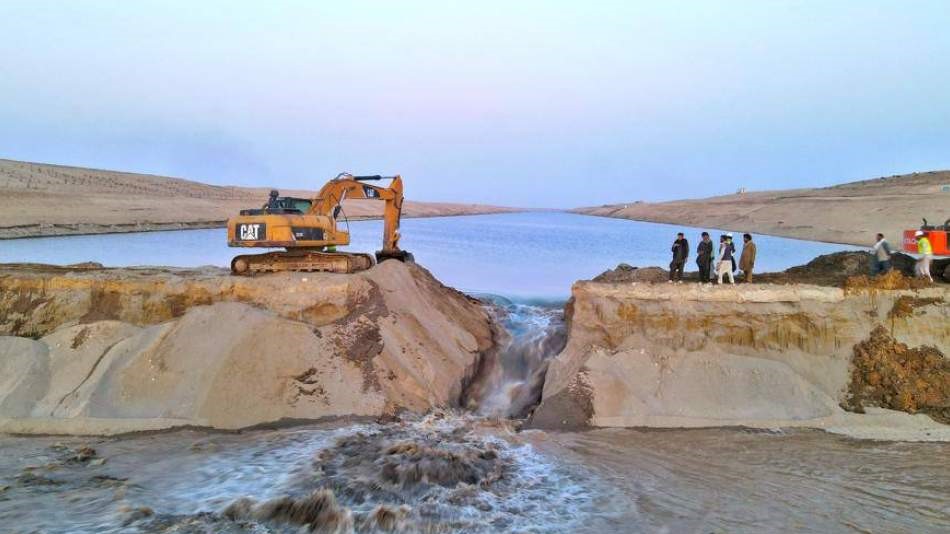
Uzbekistan’s water resources minister has warned that increased withdrawals by Afghanistan from the Amu Darya River through the Qosh Tepa Canal could pose risks to his country’s agriculture, while acknowledging the country’s right to use shared water resources.
In an interview with the Uzbek outlet Kun.uz, Shavkat Khamrayev said the scale of water usage remains a central issue in ongoing discussions between the two sides.
He said that if Afghanistan draws about 2 billion cubic meters of water annually, the impact on Uzbekistan would be limited. But higher withdrawals — potentially reaching 4 billion cubic meters — could create “serious risks” for the agricultural sector.
Khamrayev also said progress on the Qosh Tepa Canal project had slowed, noting that construction — originally expected to be completed by 2028 — is currently facing challenges, including a shortage of electricity needed to operate pumping systems.
The Qosh Tepa Canal is one of Afghanistan’s most ambitious water infrastructure projects, designed to divert water from the Amu Darya to irrigate farmland in the country’s north. Taliban have accelerated work on the canal since returning to power in 2021.
They have said the project could transform up to 580,000 hectares of land into arable farmland, significantly expanding agricultural production.
The canal, which is planned to stretch about 285 kilometers, is being built in phases. The first phase, measuring roughly 108 kilometers, has already been completed, according to Taliban officials, with additional phases under development.
While the project is seen as critical for Afghanistan’s economic development, it has raised concerns among downstream countries, particularly Uzbekistan, about water availability and regional stability.
Khamrayev said that cooperation on water management in Central Asia has improved in recent years, but emphasized the need for coordination to prevent tensions over shared resources.