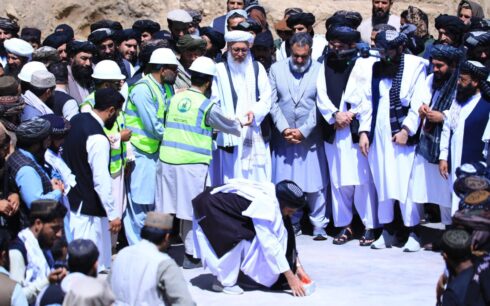
The fourth Imam Abu Hanifa National and International Trade Exhibition was inaugurated in Kabul on Monday, drawing regional business delegations in a bid to boost local industries and strengthen economic ties beyond its immediate neighbors.
Organized by the Taliban’s Ministry of Industry and Commerce, the weeklong exhibition aims to promote Afghan-made products and foster trade partnerships with regional countries. According to the ministry, business representatives from several nations, including Iran, have joined the event, with Iranian authorities confirming the participation of at least 90 traders and corporate delegates.
The exhibition features a wide array of Afghan goods, from agricultural products and dry fruits to textiles and handicrafts. Alongside the displays, Afghan and foreign entrepreneurs are expected to hold a series of business-to-business meetings to explore joint ventures and investment opportunities.
12,000 containers stranded in Pakistan
Speaking at the opening ceremony, Taliban commerce minister Nooruddin Azizi highlighted growing trade challenges with neighboring Pakistan, which he said had effectively stranded nearly 12,000 containers of Afghan goods at its ports due to ongoing political tensions and border closures.
“This decision to limit trade relations with Pakistan was not made out of preference, but necessity,” Azizi said, referring to Taliban’s last week’s moves to reduce dependency on Pakistan for imports, including pharmaceuticals. “But Afghanistan will keep its doors open to all regional countries,” he added.
His comments come amid a deepening diplomatic rift between Islamabad and the Taliban, exacerbated by accusations that the Taliban are harboring members of the Tehrik-e-Taliban Pakistan (TTP), a militant group behind deadly attacks in Pakistan. The standoff has led to the prolonged closure of critical border crossings like Torkham and Chaman, paralyzing bilateral trade that once exceeded $2 billion annually.
Iran promotes itself as trade corridor
Iran’s chargé d’affaires in Kabul, Alireza Bikdeli, also addressed the gathering, signaling Tehran’s intent to expand its role in Afghanistan’s economy and infrastructure development.
“Iran’s transport and transit capacities—including the ports of Chabahar and Bandar Abbas, as well as rail lines—are fully available to serve the people of Afghanistan,” Bikdeli said. “We are committed to supporting Afghanistan’s economic stability and development, now more than ever.”
He noted that Afghanistan’s exports to Iran, particularly dried fruits, agricultural goods, and minerals, hold significant potential for growth.
The remarks align with Iran’s recent push to position itself as a reliable alternative trade corridor for Afghanistan amid its growing isolation from Western markets and deteriorating trade ties with Pakistan. The Chabahar Port in southeastern Iran has emerged as a vital route for Afghanistan’s regional trade, especially for goods headed to India and beyond.
Despite international sanctions, diplomatic isolation, and the lack of formal recognition of the Taliban, Azizi say the country maintains commercial ties with over 80 nations, including China and Central Asian republics.
“We are not facing insurmountable problems,” Azizi said, pushing back against the narrative of economic collapse. “Our officials will continue their efforts despite the obstacles.”
While regional interest in Afghan markets persists, many international observers remain cautious, citing concerns over the Taliban’s restrictions on women’s rights, ethnic representation, and the overall transparency of their governance.