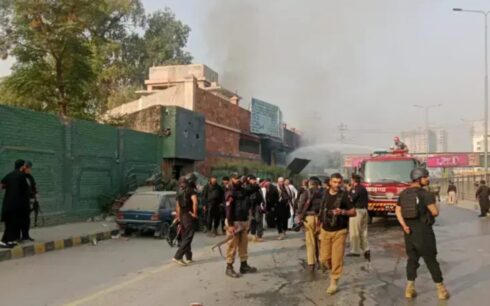
A car explosion near the historic Red Fort in the Indian capital killed at least 13 people and injured 20 others on Monday evening, prompting authorities to invoke a national anti-terrorism law as they opened an investigation into the blast.
The explosion, which occurred just before 7 p.m. local time, is believed to have originated from a Hyundai i20 car that had stopped at a traffic signal near the Red Fort, a UNESCO World Heritage site and one of India’s most iconic monuments.
“This was a tragic and horrifying incident,” Home Minister Amit Shah said after chairing a high-level security meeting late Monday night. “We are treating this as a terrorist attack until proven otherwise.”
Authorities have not publicly identified the cause of the explosion, but Indian media reported that investigators are probing whether ammonium nitrate, fuel oil, and detonators were used in the device. Forensic teams have been dispatched, and parts of the wrecked vehicle were sent to laboratories for analysis.
‘The conspirators will not be spared’
Prime Minister Narendra Modi, who was in Bhutan at the time of the explosion, expressed deep sorrow over the deaths and promised swift justice.
“I am returning with a heavy heart,” Mr. Modi said. “The horrific incident that took place in Delhi has saddened the entire nation. I have been in constant contact with the investigating agencies and have asked them to leave no stone unturned. The conspirators will not be spared.”
Delhi Police Commissioner Satish Golcha said the blast occurred in a slow-moving vehicle that had stopped at a red light. Nearby vehicles were also damaged by the explosion, he added.
Authorities have detained the car’s original owner after it was discovered that the vehicle was still registered in his name. Police said the car, registered in the Indian state of Haryana, was sold twice after 2013. The most recent buyer has also been taken into custody.
Red Fort closed for three days
The Red Fort, locally known as Lal Qila, will remain closed to visitors for at least three days as a precautionary measure, authorities said. The 17th-century Mughal-era fortress once served as the residence of India’s emperors and is a symbol of national pride. It is frequently the site of official ceremonies, including the prime minister’s Independence Day address.
The area surrounding the site has been cordoned off, and security has been heightened across the capital and in other major cities.
Leaders call for calm and justice
Defense Minister Rajnath Singh called the blast a “cowardly act” and said all responsible would be “brought to justice.”
“The government’s top agencies are conducting a swift and thorough inquiry. We will make the findings public soon,” he said.
As the investigation continues, authorities remain cautious about assigning blame, though the use of India’s Unlawful Activities (Prevention) Act — the country’s chief anti-terror law — signals a serious response and growing concern about the possibility of coordinated attacks in the capital.
No group has claimed responsibility for the blast.