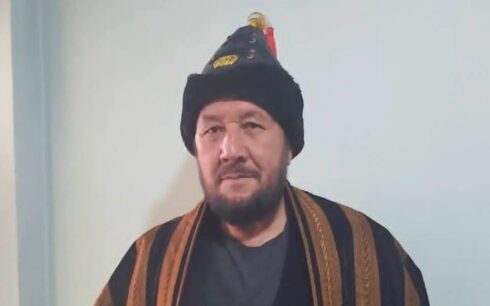
The Taliban’s army chief, Fasihuddin Fitrat, acknowledged on Tuesday that efforts to recover dozens of military aircraft flown to Uzbekistan during the 2021 collapse of the previous government have so far failed, but insisted they remain determined to reclaim them.
Fitrat said during a briefing in Kabul on annual activities of Taliban’s defense ministry that despite nearly four years of negotiations and pressure, the aircraft remain outside the their control.
“These aircraft belong to Afghanistan,” Fitrat said. “We will never give up our rights to what is ours. Although our efforts have not succeeded so far, we are not discouraged.”
The aircraft — including A-29 Super Tucano attack planes and helicopters such as Mi-17s, UH-60 Black Hawks, and MD-530s — were flown to Uzbekistan by Afghan pilots and personnel fleeing the Taliban’s rapid takeover in August 2021. On the day Kabul fell, Uzbek officials reported that 22 military aircraft and 24 helicopters had entered their airspace. The government in Tashkent later said it would not return the equipment to the Taliban, citing U.S. ownership and coordination with Washington.
Taliban officials have repeatedly called for the return of the aircraft, describing them as national property. Taliban Defense Minister Mohammad Yaqoob has previously warned that they would not allow the planes and helicopters to be retained or used by neighboring countries.
During Tuesday’s briefing, Fitrat also disclosed that the Taliban’s Ministry of Defense had downsized its personnel by 20 percent over the past year. The reduction follows an order from the Taliban’s supreme leader, Haibatullah Akhundzada, who earlier this year placed a fifth of all security personnel — across the defense, interior, and intelligence ministries — on “active reserve” status.
Fitrat also discussed the Taliban’s growing military footprint along the border with Pakistan. Over the past year, he said, the Taliban have built 15 regimental bases, three battalion units, and 765 border outposts along the frontier. He added that 340 kilometers of roads have been constructed to connect the border infrastructure, and that 13 cross-border coordination centers are planned — seven of which are currently operational.
Taliban, like successive Afghan governments before them, have refused to recognize the Durand Line as the formal boundary between Afghanistan and Pakistan. The two sides have repeatedly clashed in recent years over border fencing and construction of military posts.
Moreover, Fitrat rejected Daesh presence in Afghanistan, calling it propaganda and saying that the activities of Daesh and other groups have been removed significantly. “Their activities have been brought to near zero, if not eliminated fully,” he said in response to a question.
The Taliban’s remarks come as a recent Daesh attack in Kunduz province in February killed at least 19 people. Meanwhile, Russia and other countries in the region have expressed concerns over Daesh presence in the country. A UN monitoring group has reported that Tehreek-e-Taliban Pakistan, or TTP, has almost 6,000 fighters in Afghanistan.