Taliban officials on Thursday signed a memorandum of understanding with Kazakhstan to advance the construction of a railway line connecting the western city of Herat to the Turkmenistan border at Torghundi.
The agreement was signed during a visit to Kabul by a Kazakh delegation led by Murat Nurtleu, Kazakhstan’s deputy prime minister and foreign minister. Nurtleu held meetings with senior Taliban officials, including Abdul Ghani Baradar, the Taliban’s deputy prime minister for economic affairs, Baradar’s office said in a statement.
According to the Taliban statement, Nurtleu said the agreement reflected Kazakhstan’s desire to expand trade, transit, and economic ties with Afghanistan, noting that his delegation included representatives from multiple economic and technical ministries.
Baradar described the project as a “strategic step” toward improving bilateral economic cooperation and regional connectivity. “Investment in the Torghundi–Herat railway is not only vital for strengthening our economic relationship with Kazakhstan, but also critical for advancing Afghanistan’s role as a regional trade corridor,” he said.
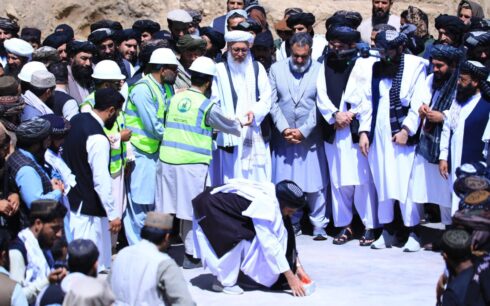
The agreement was signed by acting officials from the Taliban’s Ministry of Public Works and Kazakhstan’s Ministry of Transport.
The Torghundi–Herat railway is a planned 113-kilometer link aimed at connecting Afghanistan’s transport network with those of Central and South Asia. The route will extend from the existing Soviet-era line at Torghundi southward to Robat Paryan, on the outskirts of Herat city, with potential future expansion into the urban center.
According to project documents, the railway will be developed in three phases.
Phase one: Rehabilitation of the freight terminal at Torghundi and construction of a 22-kilometer spur to Sanobar, including sidings and storage facilities.
Phase two: Completion of a 90-kilometer stretch to Robat Paryan, forming the backbone of the corridor.
Phase three: Extension into Herat city, including station infrastructure and urban connectivity.
Once operational, the line will connect with the Khaf–Herat railway, a standard-gauge line extending from Iran, allowing for freight transit between Turkmenistan, Afghanistan, Iran, and Pakistan.
In April, Kazakhstan pledged $500 million toward the development of the corridor as part of a broader effort to strengthen regional infrastructure.