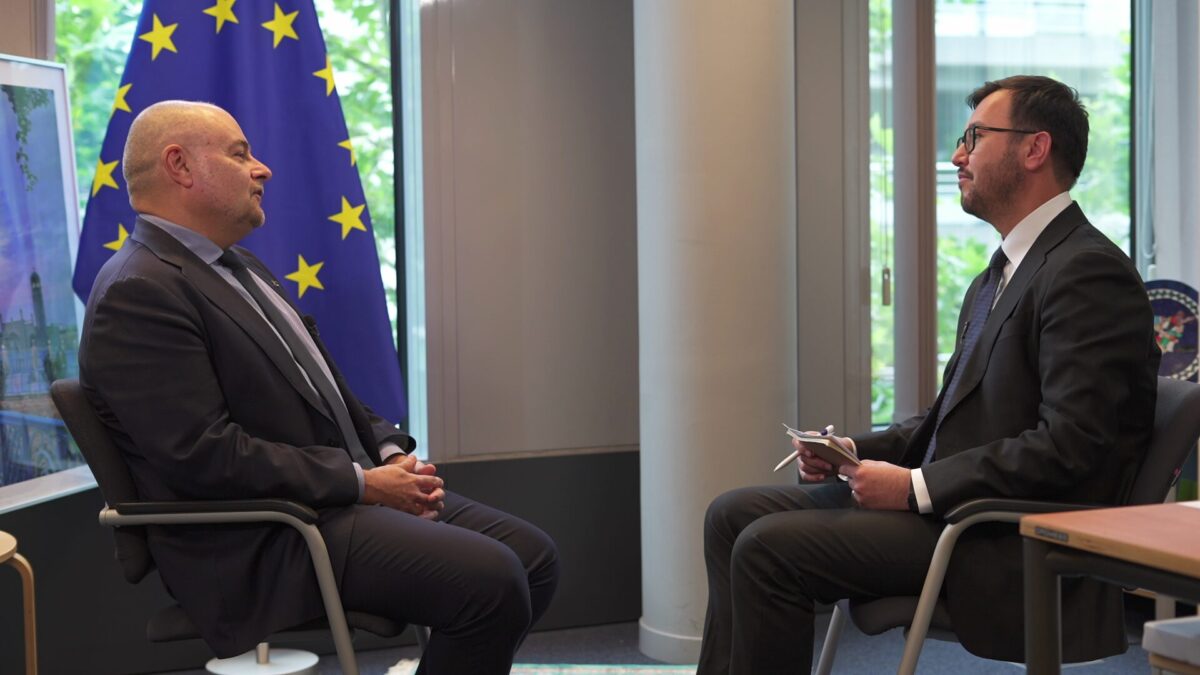
In this interview, EU Special Envoy for Afghanistan Gilles Bertrand sits down with Amu TV’s Lotfullah Najafizada to discuss five years of Taliban rule, women’s rights, regional security, and other relevant matters.
Here is the full transcript of the interview.
Lotfullah:
Ambassador, thank you for your time.
Bertrand:
Thank you very much.
Lotfullah:
You’re expecting a Taliban delegation. Why?
Bertrand:
We’re not expecting a Taliban delegation. I guess what you’re mentioning is actually the whole conversation has been in the media on a possible technical meeting to discuss the whole issue of returns from EU member states to Afghanistan. This is a conversation that has been going on. There have been technical meetings in Kabul on that topic. There is a possibility that some of these conversations would continue in the EU or somewhere in the EU, but this is pretty much as much as there is. So it’s a conversation on a technical issue, which is returns, the possibility of returning Afghans who are in an irregular situation back to Afghanistan. It’s a conversation that some of our member states have been having separately, but on which our member states have asked us to coordinate and play a part in coordinating the conversation among themselves and in their conversation with the de facto authorities.
Lotfullah:
So 19 members of the EU plus Norway signed a letter asks your office to invite the Taliban to Brussels. I understand that three of them are planning to come here and that is in the work to happen in the next couple of weeks. Is that not confirmed you’re saying?
Bertrand:
They asked the EU and particularly our director in general for Home Affairs, which is like the Interior Ministry of the European Union to play a coordinating part in this. So as I said, there were exchanges that took part in Kabul. There is the possibility that these exchanges may take place in the EU and that’s the continuation of a technical level conversation. For the timing, these are things that are under discussion through our colleagues from the European Commission. And I mean, that’s about what there is.
Lotfullah:
But why not in Kabul? You have an office there. You go to Kabul yourself. The Interior Ministry of the EU went to Kabul last year in January. Why not there?
Bertrand:
Well, as I said, I mean, some of these conversations have already taken place in Kabul.
Lotfullah:
Right. I understand the Taliban asked for a Brussels meeting.
Bertrand:
No, what we actually have to factor in is that some of our member states are not necessarily travelling to Kabul and there is also a whole need basically for a conversation for, well, pretty much the 20 of these. So it may not be so convenient to fly everybody to Kabul. So there’s been a conversation on having that meeting in another place and possibly inside the EU. That’s pretty much a technical and a logistical reason, first of all.
Lotfullah:
And it’s convenient to have Taliban’s coming to Brussels and roaming around and the way they are. Is that convenient for the European public, the 250 million women in the EU, you think?
Bertrand:
I think we’re talking about if they happen technical level meetings. There have been technical meetings with the Taliban in other places. We’re not talking about a political visit. And I think the main element is that this is not changing the EU’s policy of not recognising the de facto authorities. The world and actually the EU have said very clearly what are the criteria that we are considering and why we are not recognising the de facto authorities as the legitimate government of Afghanistan. And this is pretty much still on.
Lotfullah:
And there are, I understand a lot of Afghans that European states, member states of the EU would like to deport back to Afghanistan and that’s the reality.
Bertrand:
This is a conversation that really varies from one member state to the next. I mean, the decisions on cases, individual cases and migration policy belong to each of our member states.
Lotfullah:
Germany has sent 50 plus Afghans in the past year or so. Belgium wants to send 75 Afghans who were convicted of crimes here. Austria wants to do it. Other countries want to do it. This is a fact. This is what European members did want to do it.
Bertrand:
But these are conversations that are different in each member state and that really belong to the responsibility and the decisions of each member state. What they asked was basically to coordinate the effort and the countries that asked are 19 member states or members of the Schengen Base.
Lotfullah:
And you represent all of them as we see in the flag here. So how is that happening? So what do you give Taliban in return?
Bertrand:
It’s not an issue of giving anything in return. It’s very much an issue of … I mean, we have, and that’s set since 2021, the very first weeks after the takeover of Kabul by the Taliban, we have a policy of principled engagement. We engage with the Taliban to discuss a number of issues that are linked to our values, that are linked to our interests, that ranges from human rights to issues linked to counter-terrorism, security in general, regional security, of course, humanitarian aid reaching the Afghan population. And I mean, this is just one of our interests that we are also discussing with the Taliban, a topic that is important in a number of member states and on which we are playing that coordinating part. Again, this is really not … I know it has been portrayed as a change in our policy. It’s not in the sense that our policy on recognition is very clear. It’s also set actually by the council conclusions and it remains very much the same.
Lotfullah:
And the experience of Germany, that experiment as my last question on deportation, has that been successful? Should we expect other members of the EU follow suit?
Bertrand:
I think that’s very much a question to ask Germany. I mean, this is where each member state has its own policy driven by a number of policy, political and other elements. So I mean, this is something on which as I said, the question or the request from our member states to our directory general for home affairs has been to play that coordinating role.
Lotfullah:
Right. And some countries like France, I understand they have not signed that letter. So there is that sort of division within the EU as well and how they want to deal with Afghanistan. I don’t know.
Bertrand:
That’s a question you could ask France actually because that also boils down to their own policy and their own motivations.
Lotfullah:
There are about nearly half a billion people in the EU 27 countries have 200 million, 50 million women live here. And when you engage with the Taliban, you talk to them. What are some of the core fundamental messages you have for them or what European values you represent in your dealings with the Taliban?
Bertrand:
I think what we very much repeat to the de facto authorities in pretty much all the interactions we have with them is precisely that the world, not just the EU, but the entire world through the Security Council has set three conditions to consider taking steps towards recognising them as the government of Afghanistan. One of them is not to be a safe haven for terrorism. The other one is to take over the international commitments of Afghanistan, in particular on human rights and in particular within this on women’s and girls’ rights. And the other aspect is of course to evolve towards a more inclusive government. These are the three conditions that were set and these are really elements that we discuss in every conversation, every interaction we have with them. Women’s rights in particular is a fundamental point. I can tell you there’s not one meeting I’ve had with anybody from the de facto authorities where I have not mentioned it, but what we also mentioned to them is that it’s not only an issue of values. It’s not only an issue of fundamental rights. It is also an issue of the sustainability of the very social fabric of Afghanistan. They cannot have a society where women are banned from or girls are banned from studying beyond sixth grade. This is not an issue of religion or culture because there are many-
Lotfullah:
I understand. Yeah. Yes, I think I agree with you, but is it like talking, when you speak with them on these matters, is it like talking to the wall? Do they acknowledge this?
Bertrand:
They do. And I think we have very … I mean, there’s different levels of engagement, of course, depending on the interlocutors, but what I perceive is that this argument that the policy that has been followed on women by the de facto authorities is actually preventing the country from being economically and socially sustainable that if this policy continues for even a few more years, you will end up with a country where you have nobody who’s able to teach the girls, nobody who’s able to cure a woman who goes to hospital, nobody who’s able to … I mean, no lawyer who’s able to go and defend a woman before a court.
Lotfullah:
You think the Taliban do not understand this?
Bertrand:
I do not know. I have actually a feeling that some of them understand this. I think there is a certain degree of internal debate on these questions, but for us, what matters is not the internal debate. For us, what matters is that there are international commitments that the country has actually subscribed to and the de facto authorities, if they want to behave like the government of Afghanistan actually have to defend and uphold these international commitments.
Lotfullah:
And when the Afghan audience watch our conversation and talk about EU’s policy on Afghanistan, of course they’re also reminded of the International Court of Justice based in the EU, International Criminal Court, based on the EU, the Roman statute. And then of course, in a discussion of the Taliban, the Taliban’s visit here, what kind of message does it send to at least the 2.6 million girls who are not going to school?
Bertrand:
I mean, our message and the message we’ve spent through our, or we’ve sent through our entire humanitarian and basic needs support, the message we’ve sent politically time and again is that we stand by the Afghan women. All of our aid is implemented through a logic, which is by women and for women. We actually have that policy and that insistence in all our engagements to recall the needs for the de facto authorities to improve the situation of women and girls to respect women’s and girls’ rights in the country. And this is really probably the major element that needs to be overcome if the de facto authorities want to engage more forcefully with the rest of the world, and particularly with the EU and a number of other Western countries. I think that message is quite clear. So this is really a message also for Afghan women. We know the suffering of Afghan women.
We know it because we have aid programmes everywhere in the country and we see the situation and the deterioration of the situation when it comes to human rights. We haven’t forgotten the Afghan women and we will not forget them.
Lotfullah:
What can you do for the women of Herat?
Bertrand:
Well, there’s a number of things that we do and we do through our aid programmes. There’s a lot of, for instance, we work a lot on female entrepreneurship. We work on a number of programmes to continue encouraging schooling even by different informal ways. We work on the role of women in their community, in the business. This is very much the policy, as I said, that is really driving our entire rate policy. On what’s happening in Harat, I think we can only share what the rest of the international community has been saying. We think that what’s happening at this moment is extremely serious. We feel that the women of Afghanistan cannot on top of it be subjected to the kind of violent actions that we have seen and repression that we have seen from the part of the de facto authorities and we very much condemn that evolution.
Lotfullah:
So when the Taliban opened fire, let’s say in Herat, which they have done and at least one child has been killed and we also hear reports of a woman and a man have also been killed. We’ve seen footage. So what do you do in such situation? Do you pick up the phone and talk to the Taliban foreign minister and tell them that this is unacceptable for Euro constituents, the European Union member states and people, or this is basically for them to run their country however they want to?
Bertrand:
No, there’s a number of messages that we have passed. We pass them discreetly. We pass them publicly. Our message on women’s rights is very well known. We condemn what is happening at the moment in Harad and this is very much a clear policy by the European Union that as I said, has been the same throughout and will never change.
Lotfullah:
You ambassador also visit Kandahar when you go to Afghanistan?
Bertrand:
I am planning to start going outside Kabul, but in the … I went to Afghanistan three times. I started on this job since September and so far I’ve actually only visited Kabul, so I haven’t gone out. But yes, it would be on my plans to visit Kandahar to visit also other places, other parts of the country.
Lotfullah:
And if you’re planning to visit Kandahar, you think you can meet with the Emir?
Bertrand:
I don’t know. That’s very much up to the de facto authorities to tell us. What our policy of principled engagement is, is that we speak with the Taliban at all available levels. And as I said, we’ve always made clear what our concerns are, what our policy is, and how we can actually, I mean, even more forcefully pass these messages to make sure that these changes happen. But then I also have to say that these are not conditions set by the international community just because we want to constrain the future of Afghanistan. These are also the best decisions that can be taken by the de facto authorities if they want the country to have a sustainable future.
Lotfullah:
Right. We have been saying this for, you have been saying this as EU for the past five years and we are on the fifth anniversary of the Taliban takeover. Which direction the country is heading to.
Bertrand:
I think when you look at the main three asks of the international community, the one on which there’s been partly some progress is the whole aspect of terrorism and particularly the fight against ISKP. But beyond ISKP, there’s a number of groups that are present in Afghanistan and on which a number of members of the international community express concern. I mean, the EU for sure, but actually pretty much everybody else when you look and listen around. On the other two topics, clearly on human rights and international commitments, the only thing we see is actually steps backwards, steps that tend to go in the wrong direction. And we very much believe that these steps should at the very minimum stop so that there could be an engagement on how the situation can be improved. And on inclusiveness, sadly, when you look at the Afghan de facto authorities, you realise that there’s very little inclusiveness in the government. I mean, it’s a government of exclusively male religious scholars coming only from one part of the country and from one particular religious school and also overall culture from some of the rural Pashtun areas that does not reflect the diversity of Afghanistan. And there again, it’s not just an issue that we as international community want to see diversity reflected. It’s an issue that a government has to reflect the diversity if it actually wants to be sustainable in a country.
Lotfullah:
How bad is the situation of human rights if you grade it from one to 10?
Bertrand:
I think no, the situation on human rights is extremely serious. I think it gets close to any maximum scale you can consider. Quite frankly, this is the only country in the world where girls are barred from going to school. This is the country in the world where the level of segregation against women is most serious, but there’s equally also concerns on freedom of the press, on freedom of expression that we have raised repeatedly and these are really, all these elements point to not only an extremely bad, but also a deteriorating situation in terms of human rights and particularly women’s and girls’ rights.
Lotfullah:
And you think the Taliban do this by design or this is a bandwidth or a capacity issue?
Bertrand:
That’s a question you should ask them probably, but my understanding is that there’s a certain degree of division maybe among the Taliban ranks on how when these measures should be implemented, but certainly what we have seen lately that tendency to codify some of these elements, I mean sometimes trying to opt for not necessarily the absolutely worst option, but basically turning into practise and turning into law and into custom violations of human rights, violations of the international commitments of the country. This is clearly going in the wrong direction and this is clearly, as I said, it’s actually building a society that is not only a place where human rights are violated and particularly women’s rights, but also society that is not sustainable and where incidents like the ones you were mentioning in Herat are actually also bound to happen again.
Lotfullah:
And what could happen if the country proceeds like this for the next five years?
Bertrand:
I don’t know, but we certainly have the feeling that if the country wants to reach a certain degree of economic stability, if the country wants to actually return to a level of economic growth, there’s been actually calculations that were made on this. Even if you leave aside the question of the rights, the economic loss out of the absence of women…
Lotfullah:
Yes, a billion dollar.
Bertrand:
Yeah, that was the figure that was calculated on an annual basis.
Lotfullah:
But these are the assumptions that if the Taliban change, but the trajectory that we’ve been saying is that they don’t change. So let’s talk about the probability which is sort of more possible and that there hasn’t been a significant change in policy. So where do you see the country, let’s say in the next three years or five years, if things remain the same?
Bertrand:
We continue to work along the assumption that if the country or if the de facto authorities do not change their approach, things are actually going to get worse, particularly from the economic point of view.
Lotfullah:
And that means millions of people coming to Europe.
Bertrand:
Well, I mean, you already have 22 million people in need for humanitarian aid in Afghanistan. There’s been a start decrease in the amounts of aid, foreign aid available in the country. We as EU have maintained our level of aid, but there’s a number of donors around the world who’ve actually reduced-
Lotfullah:
The United States in particular.
Bertrand:
In particular, the United States. So more and more people in need of aid, less aid, you have five million people who’ve returned to the country and actually the word return is sometimes not the correct one because some of them are arriving to Afghanistan for the first time-
Lotfullah:
For the first time, yes.
Bertrand:
… from Iran and Pakistan.
Lotfullah:
Yes. Two million in the past year from these two countries.
Bertrand:
Yes. You have an extreme climate situation. Afghanistan is one of the most climate sensitive countries on earth. Last year you already had one million people displaced internally because of climate events. You have the risk that Kabul in a number of large cities, but particularly Kabul could run out of water any of the next autumns. When you put all of this together, these are really elements that make life in Afghanistan more and more difficult. And we believe that this should actually be the priority of the de facto authorities to actually address these issues rather than address a number of or continue in some of the practises in terms of human rights and others.
Lotfullah:
I’m curious, why don’t you call them the Taliban when you mentioned we talk about de facto authorities, what happens if you call them the Taliban?
Bertrand:
I mean, de facto authorities is the-
Lotfullah:
It’s the name they’ve chosen for themselves.
Bertrand:
Well, it’s also the legal term in international law for people who exert a de facto authority but are not the legitimate government of a country.
Lotfullah:
But they are the Taliban.
Bertrand:
Yes.
Bertrand:
You can call them the Taliban de facto authorities if you wish.
Lotfullah:
I was just curious if there is an understanding that what the international community should call them.
Bertrand:
No, I mean, we make that distinction because this is the one that under international law is how you define a movement that exerts authority de facto, but is actually not recognised as a legitimate government.
Lotfullah:
Ambassador, you are also in charge of Pakistan in the EU’s foreign ministry, if we say it that way. Things are pretty serious between Afghanistan and Pakistan at the moment. There was an incident I think just last night. How bad is that situation and why there is an escalation in violence?
Bertrand:
Well, I mean, I think the reasons for the escalation and the concerns on the Pakistani side in terms of the increase in attacks and terrorist attacks that they consider can be traced back to Afghanistan, especially by the TTP, those reasons are well known and they are the ones that led to the serious upsurge in violence in October again in February and still now to the continuation of airstrikes, particularly in the border area. On this, I think just like many in the international community, what the EU has passed to both sides is a message of seeking de-escalation. We consider that of course the Pakistani government has to react when it is under terrorist pressure and if it sees that direct link and it’s addressing it with the de facto authorities.
Lotfullah:
You agree with the Pakistanis that there is a link between the escalation of violence in Afghanistan and Pakistan with the Taliban and Afghanistan?
Bertrand:
Well, they’ve put forward quite a number of elements. We all know that the border area is complex, porous, tribal and rather unstable area.
Lotfullah:
But they’re bombing Mazar-e-Sharif, they’re bombing Kabul and why is that? Is TTP there?
Bertrand:
I mean, the conflict itself, the main message we have passed to both parties is that they have to respect international humanitarian law, they have to protect civilian lives, and of course, whenever we see UN verified reports of civilian casualties, we take them very seriously.
Our messages come that we consider that this can only be solved through dialogue. We consider that deescalation is actually what is needed between the two.
Lotfullah:
I understand your message, but I’m trying to understand the reason for the escalation is the Taliban cannot decouple from the TTP. Is that the reason?
Bertrand:
I mean, this is very much a question to ask both protagonists. What we have passed as a message to both parties is to take seriously and particularly to the de facto authorities to take seriously Pakistan’s concerns to see what can be done to address the security concerns of Pakistan and particularly the whole question of the TTB’s presence and its potential ability to undertake attacks on Pakistani soil from Afghan territory. But again, we believe that this is based on through dialogue. We actually know that a lot of members of the international community have tried to engage in that conversation in that mediation. Turkey and Qatar did it, Saudi Arabia, more recently China. We believe that all these efforts go in the same direction in the right direction. We are not mediating as such, but we have passed these messages to both sides and we are very much hoping that they can get around the table, take seriously each other’s concerns and basically come to an understanding and an agreement on how to handle their security issues.
Lotfullah:
And Pakistan has the right of self-defense and that’s what you’re saying?
Bertrand:
Pakistan as a government cannot stay idle when it’s facing such an intensity of terrorist actions and-
Lotfullah:
Emanating from Afghanistan.
Bertrand:
And they have come with elements that are pointing towards Afghanistan.
Lotfullah:
And you’re convinced as somebody…
Bertrand:
We know that not only the TTP, but a number of terrorist groups have been present in Afghanistan. These are concerns that are expressed routinely by the entire international community. You can listen to the Russians, you can listen to the Chinese, you can listen to the US, you can listen to Europeans. This is one of the three core elements on which the de facto authorities have to take steps to make sure that the country does not become or does not become, again, a safe haven for a number of terrorist actions.
Lotfullah:
And for TTP it is apparently.
Bertrand:
Well, that’s where through that conversation between the two, they have to basically address any of the outstanding issues in the border area that make it possible to have attacks on Pakistani soil.
Lotfullah:
You mentioned Daesh, ISKP, you said that there has been some progress and I’m curious if you can elaborate what does that mean? Why the world should believe that the risk of ISKP emanating from Afghanistan is lower now?
Bertrand:
Well, I think if you compare with a few years ago, there have been decisive steps that have been taken by the de facto authorities to reduce the ability of ISKP to conduct attacks also because ISKP is an enemy of the Taliban. So this is really an element where we have seen progress, but that progress doesn’t mean that ISKP has vanished. There are also a number of elements that point to ISKP constantly trying to regroup and to morph geographically or in its approach. ISKP remains a threat, but it is a threat that we feel that the de facto authorities have taken seriously and on which they have taken steps over the last years. Again, not saying that it’s not a concern and that it has vanished forever. It is something that as EU, we continue considering Daesh and ISKP as the main global terrorist threat that’s emanating from Afghanistan.
But there also the difference between regional and global groups is not always clear in the sense that there’s certain fluidity between terrorist groups and there’s always a risk that you basically see suddenly a regrouping of one or the other.
Lotfullah:
And if the Taliban have the capacity to go after Daesh, they should have the capacity to go after TTP as well.
Bertrand:
Well, we believe it’s the duty of any authority in a country to basically go against the terrorist risk. The terrorist risk is a risk for all of us. It’s also ultimately a risk for the de facto authorities themselves. And on this, I think the world has been quite clear that there is a need for more forceful steps from the de facto authorities.
Lotfullah:
TTP is a terrorist group?
Bertrand:
I mean, yeah, it is part of the groups, the militant terrorist groups that are actually active or potentially active from Afghan territory and that have to be managed.
Lotfullah:
And the Taliban cherry pick which one to go after and which one to be friends with.
Bertrand:
I don’t know. I mean, this is again, this is a question that you should ask them. I mean, this is just part of being or trying to become a normal member of the international community is to actually address any risk of terrorist action emanating from their soil.
Lotfullah:
How about Al-Qaeda? We haven’t heard about Al-Qaeda threat from Al-Qaeda. This is the 25th anniversary of 9/11. Is that a concern? Is that something you worried about?
Bertrand:
I think this is one of the … When you look at particularly the reports by the UN Sanctions Committee and others, Al-Qaeda is one of the groups on which they are still concerned. It’s been less active recently. That does not mean that we should not be worried about them. I think generally speaking, the whole issue is really that wherever it comes from or whichever group it is, there is clearly a need for the de facto authorities to do more, to convince the world that Afghanistan is not a potential threat in terms of terrorism for the rest of the world any longer.
Lotfullah:
Right. Ambassador, you mentioned one of the three pillars of areas that you focus on the inclusivity as an area that we can’t grade Taliban with a good number. And the UN has began a process called the Mosaic. Is there any progress in that you think?
Bertrand:
Well, the Mosaic is actually about a much broader number of elements. It’s also part of meeting the international commitments. It’s also part of the … There are six major chapters in it. We know that there have been conversations between the UN, UNAMA in particular, and the de facto authorities on this. We would actually want the Doha process to make progress because we believe that this is exactly the space that we need where the international community and the de facto authorities can take mutual steps in each other’s direction to try actually to get that stabilisation and that change from within that Afghanistan needs. That would also lead us over time to be able to consider progress on their part and the potential recognition. But we are still very far from those elements. As I said, from the three big elements, there’s been no progress on two of them and very partial progress on one.
Lotfullah:
And the ball is in the…
Bertrand:
And the ball is quite squarely, I think, in the de facto authorities camp, yes.
Lotfullah:
And they’re not willing to kick it.
Bertrand:
I mean, this is a conversation, as I said, a message that we pass consistently, not just the EU, not just the Western countries. It’s a message that has been passed repeatedly by pretty much all the partners from the international community. And we very much hope that the message will actually end up being understood for what it is, which is basically not just asks from us, but actually also a path towards an Afghanistan that is at peace with Itself and at peace with its neighbours.
Lotfullah:
But if they are not willing to talk about girls’ education, they’re not willing to talk about the political process, they want to talk about, let’s say, counter-terrorism in a very narrowed fashion or deportation, they set the agenda.
Bertrand:
Well, I mean, they set the agenda in a way we continue with the same agenda on the other side. So it’s not party sets the agenda. It’s just that our asks are clear and the ball is in their camp to basically take steps in our direction.
Lotfullah:
Well, maybe they will bring the ball when they come to Brussels. And there talks about a renewed mandate for UNAMA, the UN political mission in Afghanistan. What is your position on that? It’s good to have a political mission in Afghanistan. You have your own office there, but a UN and what kind of changes you want to see in that?
Bertrand:
I mean, we have our delegation that is our embassy, that’s how the EU calls its embassies, but that’s not the same at all than having the United Nations and a mission by the UN on the ground. The UN, quite frankly, in Afghanistan, like in many other countries in crisis, I mean, they are our eyes and our ears on the ground for the international community. They are able to have an understanding through their field offices of what is happening also outside the capital. They are a vital partner in any crisis country on the planet. So for UNAMA, of course, we support first of all that UNAMA should have a mandate. We very much hope that within a week we will have a mandate for a sufficient number of time. There are elements where the UN’s footprint in Afghanistan probably has to be adjusted and adjusted in particular to the fact that international aid has been drastically reduced compared with past levels.
Lotfullah:
Adjusted means downsize?
Bertrand:
Yeah, downsized in the sense of the overall amount and cost of the operation that was justified when you were talking billions of dollars coming in and that is less justified when you talk hundreds of millions of dollars coming in every year.
Lotfullah:
They’re running out of business.
Bertrand:
I don’t think it’s fair to call it business because really also in terms of aid and the administration of aid and the conduct of humanitarian aid, the UN is an essential partner.
Lotfullah:
But those are UN agencies which have their own sort of agency representatives there, but we’re talking about more of the political mission, which is especially-
Bertrand:
What I was saying was that the overall footprint of the UN system was built for a different magnitude of aid, but in terms of UNAMA itself, we believe that very much the core elements of the mandate have to remain and we believe that we need a strong UNAMA also to be able to conduct that conversation on the Doha process. And by the way, that also includes the whole issue of having a special representative of the Secretary General appointed soon because it’s also important that UNAMA has a face and a face that is actually able to discuss…
Lotfullah:
At a- I think the international community should also define what soon means. We’re a little confused.
Bertrand:
I mean, the decision is in the hands of the UN. I believe that once we have a mandate that is clarified for UNAMA, which hopefully is happening as we speak in the Security Council. Then I believe that this may be the moment and I hope this will be the moment for an appointment of a special representative.
Lotfullah:
And UNAMA has to of course engage with a Taliban to secure access for their own female staff to get into the offices, let alone advocating for the 20 million Afghan women.
Bertrand:
Well, I mean, UNAMA has played an important part in monitoring the situation of women inside the country, not just their staff. There is a specific issue, of course, with the access of their staff to the UN compound. This is an issue that has been raised repeatedly with the Taliban. But I think to be fair to UN women and to the work that is done by the UN, their advocacy and their monitoring work goes well beyond the only issue of their staff, which is of course important, which is not the only issue or even potentially the main issue affecting women in Afghanistan today.
Lotfullah:
If you had shut down your office in Kabul in 2021 and not given Afghanistan, is that two billion euro so far around that in five years, how bad the situation could have been?
Bertrand:
I don’t know. I mean, our decision at the time was basically was based on the very simple premise that every time the international community has forgotten about Afghanistan, Afghanistan has got back pretty much to the top of the list of concerns and of priorities. We as European Union want a stable Afghanistan, I know many countries say it, but we actually also mean it. I’m not saying that all the others don’t, but we mean it in the sense that all our interests in Afghanistan, whether it’s the issue of terrorism, whether it’s the issue of narcotics, whether it’s the issue of regional stability of human rights, of controlling any kind of future waves of mass migration, all of these elements actually point to our interest as European Union, the interest of the 27 member states and of this institution is actually that Afghanistan becomes more stable, becomes economically more robust and becomes that Afghanistan at peace with itself and with its neighbours that we’ve spoken so much about.
So this was also the logic and the reason why we maintained our presence. We wanted to be with, and we’ve always been with the Afghan people.
The aid that you were mentioning is designed and built in such a way that there’s not even a euro of that aid that goes through the de facto authorities. It goes through the UN, it goes through the NGOs, a number of partners that are basically operating directly within Afghan society. And it’s also that by women, for women approach, that has guided us from the very beginning. We consider that without that aid, the situation of the Afghans, of the ordinary Afghans would have been even worse than it already is. And that’s where we consider that as European Union, we have made the contribution to the situation of the Afghans.
Lotfullah:
Staying on that topic, there’s a lot of confusion or probably misunderstanding about this $40 million cash shipment into Afghanistan every week and given to the Taliban. That is inaccurate, that’s what you’re suggesting, right? So your money is going into Kabul, you fly it in cash.
Bertrand:
No, we don’t fly in cash into Kabul. I mean, our money goes through the UN system, it goes through NGOs and it goes to operations that then are basically monitored in a very robust way to make sure that that money is basically reaching its beneficiaries. I can assure you that I’m not even flying with a 50 euro bank note when I enter Kabul.
Lotfullah:
I didn’t mean personally, but the international community’s money is when it’s flown into the country, I assume that given the banking restrictions, it’s flown in.
Bertrand:
I mean, certainly for the EU, we’re not flying in. I mean, we are flying in humanitarian aid, but we’re not flying money into the country.
Lotfullah:
And there is no money given to the Taliban. Is that what you’re assuring the Afghan people?
Bertrand:
Yes. There’s not one euro that goes through the de facto authorities or the government system. That’s the way we have chosen to deliver our aid precisely. That’s what we define as principled engagement and that’s what we consider as a guarantee that the money is basically reaching the people who need it.
Lotfullah:
And the Taliban are happy about this when they engage with you?
Bertrand:
I mean, the Taliban realised that what we are doing is helping the Afghan people, I assume. And in terms of the conversation with them on our humanitarian and basic needs approach, they seem to be fine with what we are doing, but this is not money that goes through them or that is spent through the state.
Lotfullah:
And then lastly, on the mood of the country, you engage with youth, you engage with women when you go. How would you summarise that when you come and talk to your colleagues or your staff here?
Bertrand:
I mean, when I compare it with the Afghanistan I knew many years ago, my feeling is certainly that it’s a country where you feel more suffering, more difficulty to make ends meet. At the same time, what is always a paradox in Afghanistan is that it’s a society that still has a huge potential for liveliness. It’s a very young society. It’s society where you would imagine that if the women, if the youth were able to have more agency to propose solutions to be part of society and to basically design the Afghanistan of the future or the future of their country, they could actually go a very long way.
Lotfullah:
And they feel hopeless now or you see that in their face?
Bertrand:
I have a perception that many people actually feel hopeless in the country or feel that there is no particular hope that their situation will improve over the foreseeable future, both the situation of society in general, but also in particular the situation, I mean the economic situation and the possibility of making a better living. I still feel that the Afghans are trying, I mean, that there is an incredible resilience in Afghan society, but I also really feel that there is a real ability or there would be a real ability for society to put itself in motion if it could do it. And that’s where the whole issue of women’s rights of freedom of expression of human rights in general, being able also to have that intra-Afghan dialogue or any element of inclusiveness that would actually improve the situation.
Lotfullah:
But somebody’s blocking it. Right. I mean, the Taliban are blocking it. They’re not engaging with the society.
Bertrand:
I think this country is probably living at a very, very little level of its complete potential and I think it is up to the de facto authorities to actually unlock that potential. I think it would also take an effort from everybody also from the Afghan society and actually inside the country and also outside to try to find maybe new ways to come together, new way to discuss the future of the country.
Lotfullah:
Do you have any recommendations? I mean, we’re running out of ideas.
Bertrand:
Well, I think that precisely what we’ve always tried to say as international communities that this is a path that the Afghans have to design by themselves. I mean, it’s not up to the international community to tell Afghanistan how it should reflect on its future.
Lotfullah:
I understand. But with the Taliban, let’s say, let girls go to school. If I become to a Talib or I go kiss Hibatullah’s hands, what should we do? I mean, what’s your …
Bertrand:
I don’t know. I mean, I understand that it’s a very complex situation. I also understand there’s a lot of frustration from the part of many Afghans who had to leave the country and who live abroad and watching your own country from outside can be extremely, extremely frustrating and extremely difficult. I somehow have a feeling that this can be solved through dialogue and probably building a meaningful dialogue between the ones outside, the ones inside the country, the ones on all sides of the ethnic, ideological, religious divides. I think Afghanistan is actually a country made up of very diverse communities, but also a country that has a very strong identity. I think Afghans feel Afghan and I think they probably have to try to build on this to build a different future for their country.
Lotfullah:
Well, I assume that, or I feel that this is a very difficult task for the Afghan society and also I want to acknowledge that you also have a very difficult job.
Bertrand:
Well, I think when we see Afghans trying to make ends meet and trying to live in very.
Lotfullah:
But they don’t right now. You said 20 million Afghans don’t have enough food.
Bertrand:
Precisely. When we see what they are going through, I think our jobs may be difficult, but it’s not exactly comparable with the difficulties that ordinary Afghans, if I can use that word, are actually facing on a daily basis and of course particularly among them women and girls.
Lotfullah:
Well, do you have any message for girls in Afghanistan who graduate from grade six this year?
Bertrand:
I think the message is very much that the world has not forgotten about them, that the EU in particular will continue to tirelessly defend their rights, make the point. You were saying, or you mentioned a number of times that we’ve made that point repeatedly over the last five years and it has not gone through where we will continue making that point for the next five years and beyond. And my experience from other countries is that sometimes by repeating your message, you make it clear first that you have not changed your mind and also you generate sooner or later a thinking process on how the country can actually do things differently.
Lotfullah:
Ambassador, I wish you good luck. Thank you.
Bertrand: (52:13):
Thank you very much.