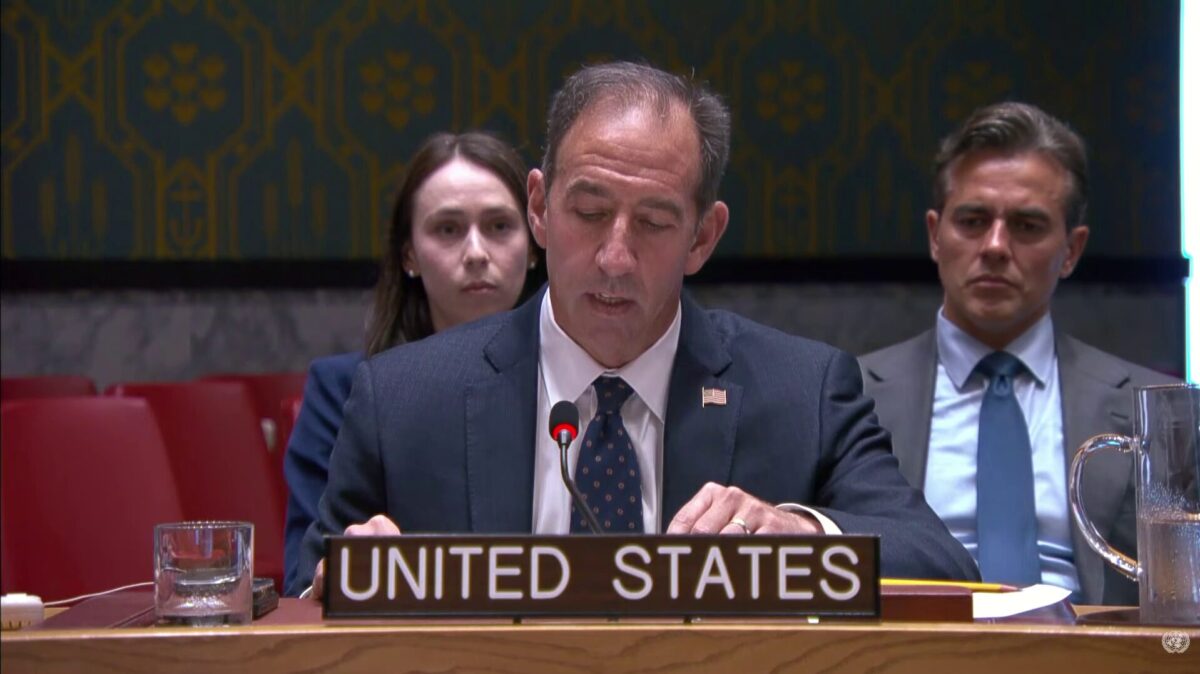
The United States on Monday called on members of the United Nations Security Council to condemn the Taliban for sheltering terrorist groups and failing to uphold counterterrorism commitments, arguing that the Taliban’s actions continue to threaten regional and international security.
Speaking at a Security Council meeting on Afghanistan, Ambassador Jeffrey Bartos, the US representative for UN Management and Reform, urged member states to take a firmer stance toward the Taliban.
“We call on all Council members to echo our condemnation of the Taliban’s sheltering of terrorist groups and their refusal to implement counterterrorism commitments,” Bartos said.
He also condemned what he described as the Taliban’s continued practice of “hostage diplomacy” and called on Security Council members to denounce the detention of American citizens in Afghanistan.
“The Taliban’s abhorrent practice of hostage diplomacy continues,” Bartos said. “We call on all members of this Security Council to condemn the Taliban for their unjust detention of United States citizens.”
The remarks came during a Security Council session that focused on Afghanistan’s political, humanitarian and human rights situation nearly five years after the Taliban returned to power.
Bartos said the Taliban have worsened Afghanistan’s humanitarian and economic crises through policies that restrict basic freedoms, obstruct aid efforts and limit access to essential services.
“The Taliban continue their appalling and frankly horrific treatment of the women and girls of Afghanistan,” he said.
His comments followed warnings from UN officials that restrictions on women and girls are becoming increasingly institutionalized. During the same meeting, Georgette Gagnon, the acting head of the United Nations Assistance Mission in Afghanistan, reported that about 30 women had recently been detained in Herat for allegedly violating Taliban dress requirements.
Bartos also criticized Taliban restrictions on the United Nations itself, noting that Afghan female employees remain barred from entering UN offices across the country.
“The Taliban’s actions also impede the functioning of UNAMA, including by preventing Afghan female staff from entering UN premises across the country,” he said.
The US diplomat questioned whether continued international engagement with the Taliban was producing results, saying the group’s refusal to change course had raised concerns about the effectiveness of ongoing efforts.
“The Taliban’s intransigence forces us to ask hard questions about the value of continued international engagement and resources,” he said.
Bartos specifically pointed to UNAMA, the UN’s political mission in Afghanistan, describing it as the most expensive special political mission in the organization and calling for closer scrutiny as member states prepare to renew its mandate.
“All missions, including UNAMA, must provide value for money and must adapt to conditions on the ground,” he said.
Despite the criticism, Bartos said the UN-led Doha process remains a potential framework for engagement with the Taliban, but warned that progress toward normalization would depend on concrete actions by the Taliban.
“Tangible progress in the Doha process is not optional. It is urgent,” he said.
“The international community cannot indefinitely sustain a framework for engagement while the Taliban detains innocent Americans, ignores the needs of the Afghan people, denies Afghan women their basic rights, and fails to meet their counterterrorism commitments,” he added.
Bartos also called for the appointment of a permanent U.N. special representative for Afghanistan, saying the prolonged vacancy had weakened efforts to coordinate international diplomacy and hold the Taliban accountable.
“The absence of a permanent SRSG weakens the international community’s ability to coordinate, advocate, and hold the Taliban accountable,” he said. “That vacancy must be filled without further delay.”
The United States has not recognized the Taliban rule and continues to condition any broader normalization of relations on progress in human rights, counterterrorism cooperation and the treatment of detained Americans.