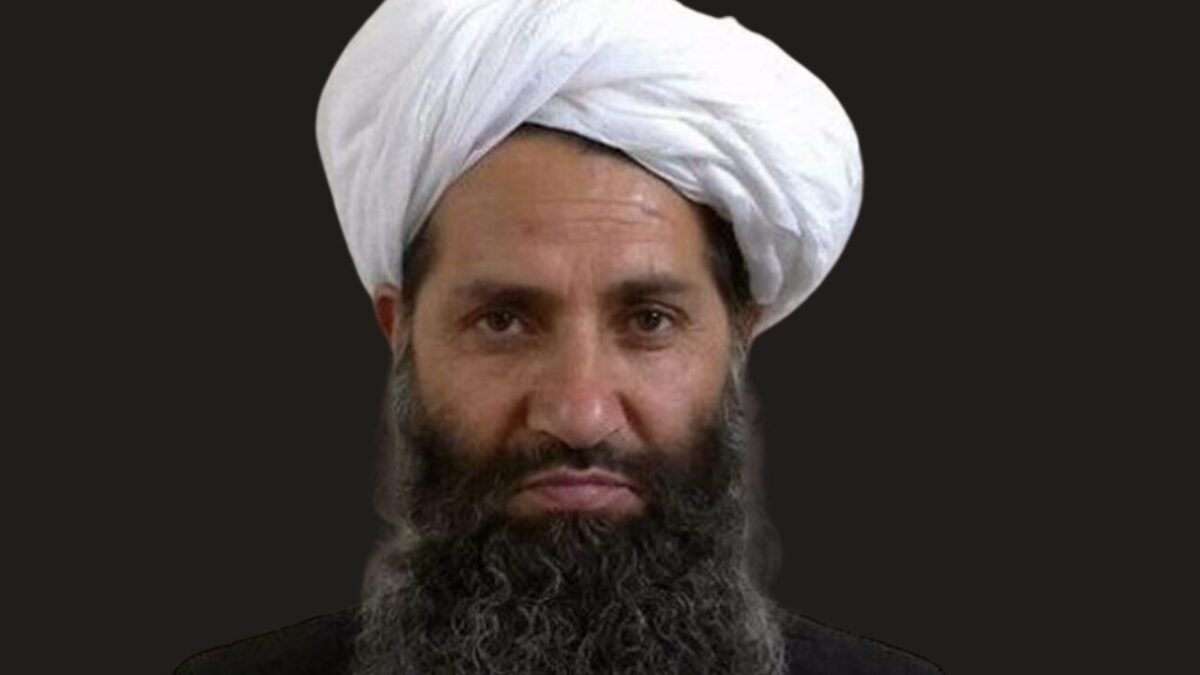
The Taliban’s supreme leader has ordered public institutions to identify and replace what he described as “foreign terms” in official documents, according to a directive published by the Taliban’s Justice Ministry, in a move that could significantly reshape administrative language across Afghanistan.
The order, issued by Hibatullah Akhundzada, instructs all Taliban-run agencies to compile lists of non-native terminology used in their official and legal documents and propose suitable replacements. The directive requires that each suggested alternative be accompanied by justification and submitted in a formal report for review.
A special committee has been tasked with overseeing the process. It is to include representatives from the Taliban ministries of justice, higher education, education, and information and culture, along with officials from the Academy of Sciences and the administrative affairs office.
The directive does not specify which languages or terms are considered “foreign.” However, it explicitly recognizes Arabic as an acceptable “Islamic” language and affirms the use of what it describes as native terminology.
“All institutions are obligated to collect foreign terms used in their respective administrations and official documents, propose appropriate alternatives with justification, and submit them to the evaluation committee,” the order states.
Part of a broader language policy
The directive formalizes a pattern that has emerged since the Taliban returned to power in 2021, during which certain Persian-language terms have been removed or discouraged in official and academic settings.
In some cases, widely used words have been eliminated from public signage and institutional materials. The Persian term for “university,” for example, has been removed from the entrance of Balkh University, while Uzbek-language terminology has reportedly been altered on signage at Jawzjan University.
At Takhar University, the engineering faculty issued a notice last year instructing students and faculty members to refrain from using terms equivalent to “university” and “faculty,” declaring compliance mandatory.
In May 2025, the Taliban’s Higher Education Ministry formally instructed academic staff at Kabul University to avoid using Persian words such as “university,” “faculty,” “court” and “prosecution” in scholarly writing.
The policy has drawn criticism from cultural figures and human rights groups, who argue that it risks erasing linguistic diversity in a multilingual country where Persian, Pashto and Uzbek are widely used.
Some critics have described the move as a form of “linguistic apartheid,” saying they disproportionately target commonly used Persian terminology and limit cultural expression.
Taliban have not directly addressed those criticisms but have framed language reforms as part of broader efforts to align governance with their interpretation of Islamic and national identity.