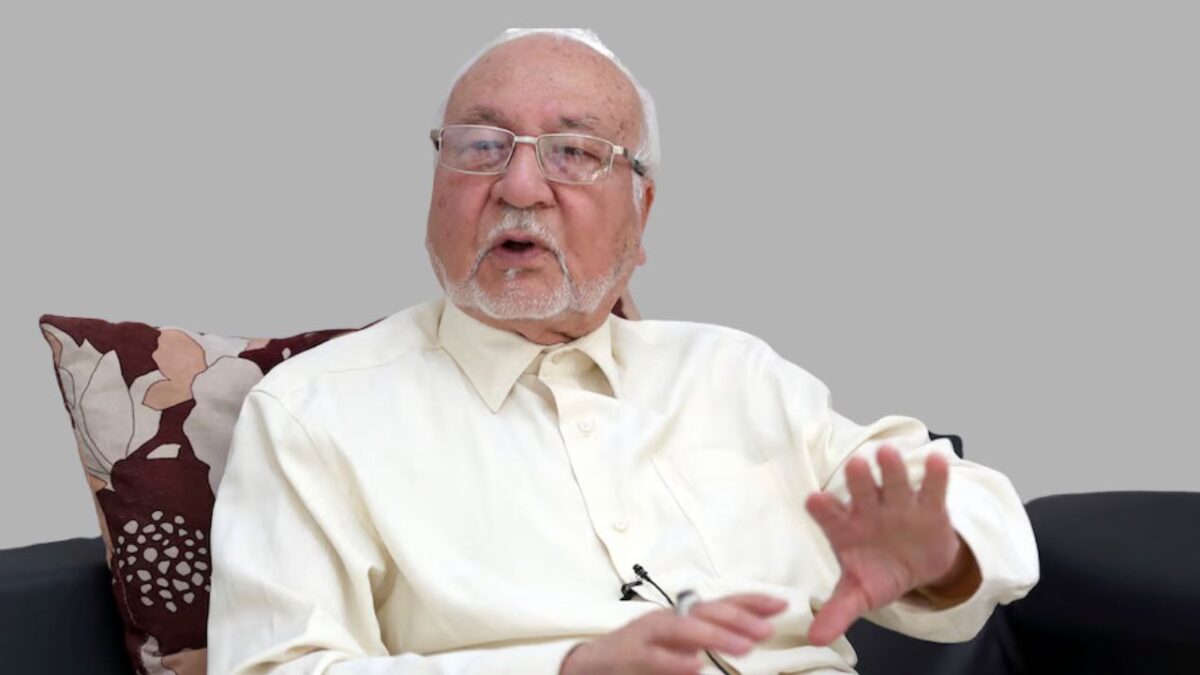
Mohammad Ismail Qasimyar, a prominent Afghan legal scholar and political figure, died early Thursday in Strasbourg, France. He was 92.
Friends and relatives confirmed his death.
Qasimyar served as chairman of the Independent Commission for the convening of the Emergency Loya Jirga in 2002, a landmark gathering that brought together 1,652 elected representatives from across Afghanistan after the fall of the Taliban’s first regime. He was also a senior member of the now-defunct High Peace Council, playing a role in reconciliation efforts, including talks with Hezb-e-Islami.
Born in the western city of Herat to an intellectual family, Qasimyar was the son of the late Abdul Qasim Bayat, a prominent figure in Afghanistan’s independence movement. He earned a degree in law and political science and held the academic rank of an associate professor, specializing in legislative affairs and legal research.
He taught constitutional law for more than six years at Kabul University’s Faculty of Sharia, trained judges, and helped draft Afghanistan’s civil and criminal codes. In 1968, he was among the founders of the country’s Center for Judicial Studies and Training, which played a key role in strengthening the judiciary.
After the Bonn Agreement in 2001, Qasimyar oversaw preparations for the Emergency Loya Jirga, the first in the country’s history to elect its members through a nationwide vote. In exile, he led the Council for National Cohesion and Strategic Studies of Afghanistan.
He was the author of Memoirs of Legal and Political Affairs, in which he recounted his experiences and views on Afghan law, politics, and diplomacy.