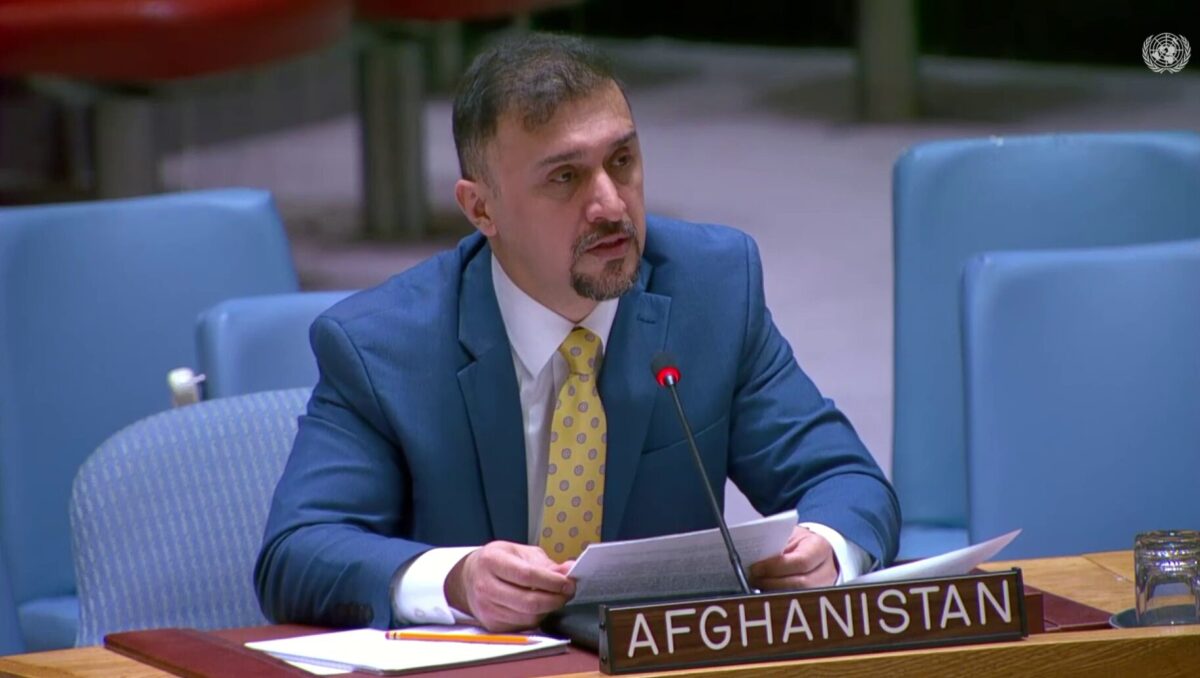
Afghanistan’s chargé d’affaires to the United Nations, Naseer Ahmad Faiq, welcomed the Security Council’s unanimous decision to extend the mandate of the UN Assistance Mission in Afghanistan (UNAMA) for another year, while urging the international community to remain focused on human rights, inclusive governance and political dialogue in the country.
Speaking after the Security Council adopted Resolution 2822 on Monday, Faiq described the continued presence of the United Nations in Afghanistan as “indispensable” amid what he called a multidimensional political, humanitarian, economic and human rights crisis.
“UNAMA plays a vital role in promoting peace and stability, facilitating political dialogue, coordinating humanitarian assistance, monitoring and reporting on human rights, and maintaining international attention on the plight of the people of Afghanistan,” Faiq told the Council.
The Security Council voted unanimously to renew UNAMA’s mandate through June 2027, restoring the mission’s customary one-year mandate after an unusual three-month extension approved in March.
Faiq thanked Council members for supporting the resolution and praised China, the Council’s penholder on Afghanistan, for helping build consensus around the measure.
Human rights concerns
A significant portion of Faiq’s remarks focused on what he described as a deteriorating human rights situation under Taliban rule.
He pointed to recent events in Herat, where Taliban morality police detained dozens of women and girls over alleged violations of dress requirements, triggering protests and international criticism.
Faiq said Taliban responded to peaceful demonstrations with live ammunition, resulting in civilian casualties, including the deaths of a woman and a child.
The Taliban have not publicly acknowledged those deaths. The United Nations has confirmed that at least one child was killed during the unrest and has said it is investigating reports of additional fatalities.
Faiq said the events in Herat reflected a broader pattern of repression that has intensified since the Taliban returned to power in August 2021.
“These events are not isolated incidents,” he said. “They reflect a broader pattern of systematic discrimination, repression and exclusion.”
He argued that Taliban policies have sought to remove women and girls from public life by restricting access to education, employment, freedom of movement and participation in society.
Faiq also criticized what he described as growing restrictions on information and communication, including a reported ban on smartphones in government institutions, which he said was intended to suppress dissent and conceal abuses.
Call for inclusive government
Faiq welcomed language in the Security Council resolution emphasizing human rights, the rights of women and girls, and the importance of inclusive governance.
He said lasting peace and stability in Afghanistan could not be achieved through exclusion and called for a political process that includes all segments of Afghan society.
“A durable political solution requires the meaningful participation of all Afghans,” he said, including women, ethnic and religious communities, youth, civil society groups, political actors and persons with disabilities.
Faiq urged UNAMA to continue facilitating dialogue with a broad range of Afghan stakeholders both inside and outside the country.
He also called for implementation of Security Council Resolution 2721, adopted in 2023, which endorsed recommendations for a more structured international approach to Afghanistan, including the appointment of a UN special envoy.
“The timely appointment of a highly qualified Special Representative of the Secretary-General will be essential,” Faiq said.
Security and terrorism concerns
Faiq also warned that Afghanistan continues to face significant security challenges, citing the presence of terrorist groups operating inside the country.
“The continued presence of terrorist groups on Afghan soil remains a matter of concern for Afghanistan and for regional and international peace and security,” he said.
He welcomed the resolution’s references to counterterrorism cooperation and support for the Security Council’s sanctions monitoring mechanisms.
Support for UNAMA
Faiq said he also supported the resolution’s emphasis on humanitarian assistance, economic development, regional cooperation and engagement between Afghan stakeholders and the international community.
At the same time, he stressed that humanitarian efforts should not come at the expense of UNAMA’s political and human rights responsibilities.
As the mission begins another year of operations, Faiq said Afghans continue to view the United Nations as a trusted partner during one of the most difficult periods in the country’s recent history.
“The people of Afghanistan continue to look to the United Nations as a trusted partner and a source of hope,” he said.
He urged governments to maintain a principled approach to Afghanistan centered on human rights, women’s participation, counterterrorism and the pursuit of what he called a legitimate, representative and accountable political order.
“The people of Afghanistan deserve protection, dignity, accountability and a future defined by rights, opportunity and hope, rather than fear and repression,” Faiq said.