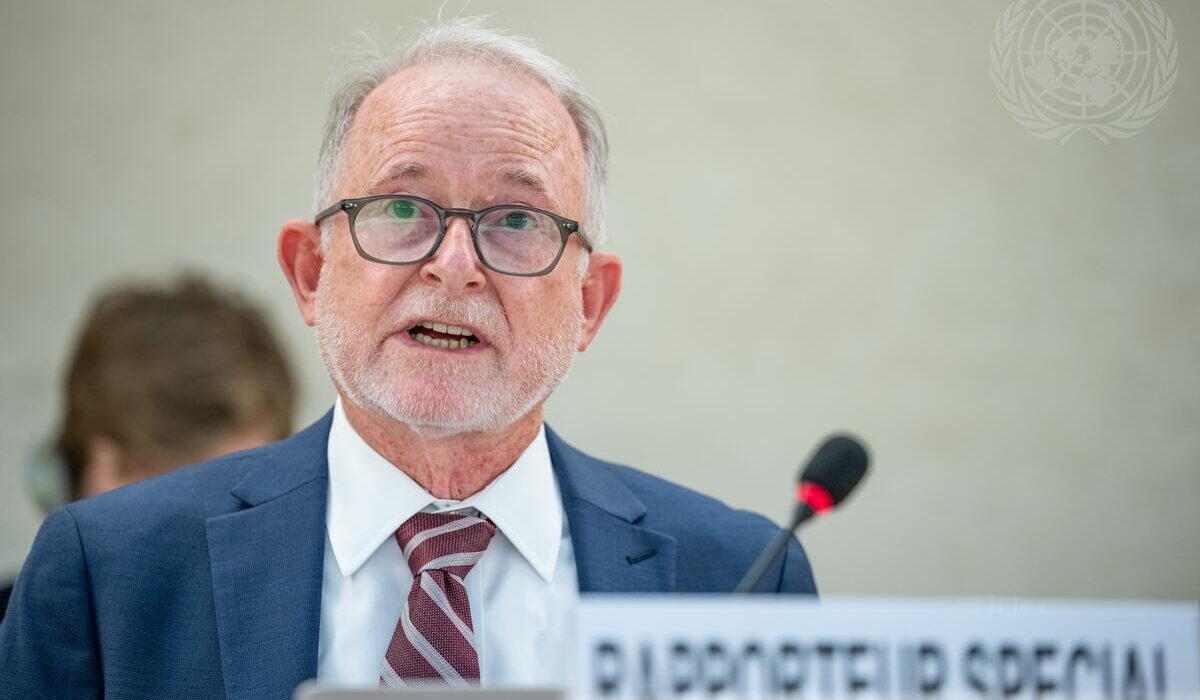
Afghanistan faces a “profound and escalating health and human rights crisis,” particularly for women and girls, the United Nations special rapporteur on human rights in Afghanistan told the Human Rights Council on Thursday, presenting a new report focused on the right to health.
Richard Bennett, the special rapporteur, said his findings were based on consultations with more than 100 Afghans, nearly all of them inside the country, as well as cooperation with the United Nations Assistance Mission in Afghanistan and the UN country team.
The report concludes that under Taliban rule, Afghanistan’s already fragile health system — weakened by decades of conflict, poverty, chronic underinvestment and heavy reliance on foreign donors — is deteriorating further. While recent cuts in international aid have compounded the crisis, Bennett said the Taliban’s “gender-oppressive policies” are causing even greater harm by preventing women and girls from accessing essential services.
Those from minority and marginalized communities, he added, face “intersecting and compounding barriers.”
“These findings reinforce my previous conclusion that the Taliban are systematically depriving women and girls of their fundamental rights, permeating all areas of life and amounting to crimes against humanity,” Bennett told the Council.
Quoting a woman doctor still working inside Afghanistan, he described how health for women and girls now depends on more than medical care.
“Today in Afghanistan, being healthy means much more than not being sick,” Bennett said, quoting the doctor. “It means having access to basic health care, enough nutritious food, clean water, safe shelter, and mental well-being. But for women and girls, health also depends on something even more fundamental — freedom: freedom to move, freedom to study, freedom to work, and freedom to seek care without fear.”
Despite mounting restrictions, female health workers remain on the front lines delivering essential services, Bennett said, calling their work a reminder that protecting the right to health requires restoring the rights and dignity of women and girls.
Since the Taliban’s return to power in 2021, Afghanistan has endured what Bennett described as multiple shocks: a shrinking economy alongside a growing population, severe droughts and earthquakes, sweeping cuts to foreign aid, and the largely involuntary return of more than 2.7 million Afghans from neighboring countries in 2025 alone. At the same time, he said, the country is governed by what he called “an extremist de facto authority committing egregious human rights violations.”
Bennett highlighted several recent developments that he said warranted urgent attention.
Last month, the Taliban announced new criminal rules for the courts that, he said, set the stage for further widespread human rights violations. He also cited recent decrees concerning the separation of spouses and regulations on preachers, saying they would be subject to further scrutiny under his mandate.
He expressed deep alarm at the increasing use of corporal punishment, noting that there were more public floggings last year than in all previous years combined since the Taliban retook power, and that the upward trend was continuing.
Bennett also raised concerns about retaliatory attacks, including extrajudicial killings of former government and security officials, particularly those who have been forcibly returned to Afghanistan.
In addition, he criticized the Taliban’s decision to bar Afghan women, including UN staff members, from entering United Nations premises in the country. “The longer this attack on women’s rights is allowed to continue, the more the Taliban will feel emboldened,” he said, urging member states to demand the immediate reversal of the ban.
Recalling his address to the Council a year ago, Bennett said he had warned that the Taliban were cementing their control over nearly every aspect of Afghan life and that the situation was likely to deteriorate further.
“Under autocratic regimes, things tend to go from bad to worse in stages, step by step,” he said. “What yesterday seemed outrageous becomes normalized today. Are we normalizing the outrageous actions of the Taliban while Afghans endure the consequences?”
Still, he said, “the situation is not hopeless.” He welcomed the Council’s establishment of an independent investigative mechanism and called for it to become operational as soon as possible, stressing that accountability processes are essential.
At the same time, he urged governments to provide practical support to the Afghan people without benefiting the Taliban unless and until they reverse their policies, particularly those affecting gender equality.
“Only when rights are restored,” he said, “can the people of Afghanistan thrive and shape the future they deserve.”