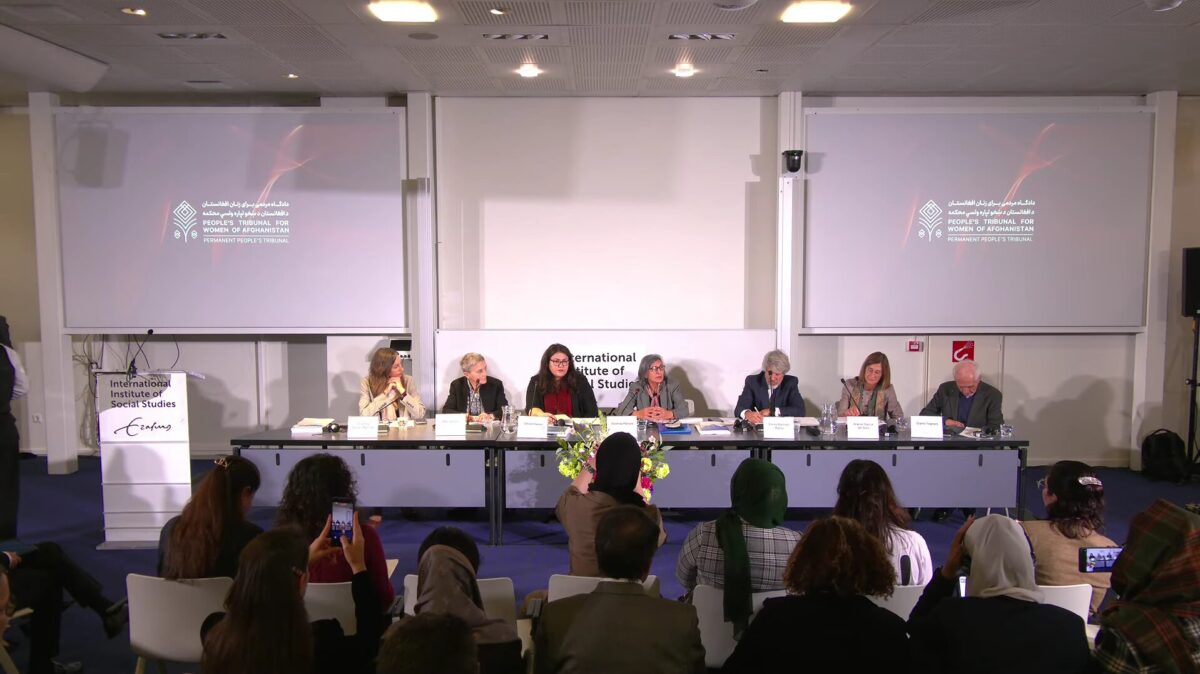
The second public tribunal examining human rights violations against women under Taliban rule opened in The Hague on Thursday.
Organisers say the process aims to hold the Taliban morally accountable in the absence of formal international proceedings.
Participants said the “People’s Tribunal for Women of Afghanistan,” held in The Hague, was convened to document and assess cases of systematic rights abuses. Several Afghan women activists presented allegations that senior Taliban leaders had enacted policies amounting to crimes against humanity, including the exclusion of women from public life and the creation of a male-dominated social order.
A spokesperson for the event said the format mirrored an earlier hearing in Madrid but that this session would move beyond testimony to the delivery of a public judgment by the tribunal’s panel of judges. “The reason we chose The Hague is the presence of two international courts — the International Criminal Court and the International Court of Justice — both relevant to the cause of Afghan women and girls,” the spokesperson said.
The agenda for the judgment session lists a panel of international jurists and experts, including Rashida Manjoo, Araceli García Del Soto, Elisenda Calvet Martínez, Emilio Ramírez Matos, Ghizal Haress, Kalpana Sharma, Mai El-Sadany and Marina Forti.
Judges were scheduled to announce the tribunal’s findings before speeches by several UN mandate holders: Richard Bennett, UN Special Rapporteur on human rights in Afghanistan; Reem Alsalem, Special Rapporteur on violence against women and girls; and Ivan Krstic, vice-chair of the UN Working Group on Discrimination Against Women and Girls.
Subject-matter experts including Rebecca Cook of the University of Toronto and Helena Kennedy of the UK House of Lords, as well as Nobel laureate Shirin Ebadi, were also listed to address the session virtually.
Organisers said the tribunal, part of the 55th session of the Permanent People’s Tribunal, carries no legal authority but seeks to document evidence, raise public awareness and increase pressure on international institutions to act on the situation of Afghan women.