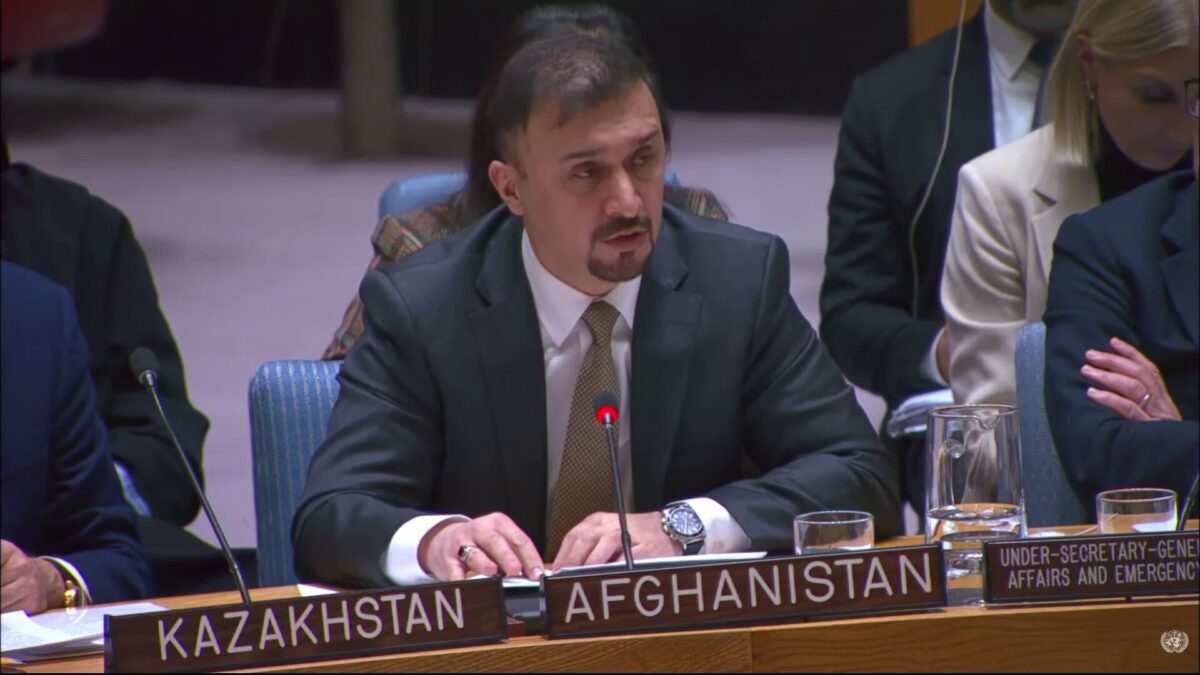
Afghanistan cannot achieve stability through “isolation, coercion or imposed authority,” the country’s chargé d’affaires to the United Nations, Naseer Ahmad Faiq, told the Security Council on Wednesday, warning that humanitarian aid alone was insufficient to sustain the country without a legitimate political framework.
Faiq said Afghanistan lacked “legitimate and accountable governance grounded in respect for national and international obligations,” and that the Taliban had failed to meet commitments they made under the 2020 Doha Agreement and endorsed by Security Council Resolution 2513. Those commitments include counterterrorism cooperation, respect for human rights and participation in a political process.
“After nearly five years, there is no political roadmap, no institutional reform, no credible intra-Afghan dialogue,” he said. “In a state of inclusion, exclusion has intensified. In a state of reconciliation, repression has deepened. In a state of legitimacy, unilateral control persists.”
He said the root cause of Afghanistan’s crisis remained political and that only an inclusive, representative government could ensure long-term stability and national unity. He urged the international community to use its leverage to encourage the Taliban to accept political dialogue with a cross-section of Afghan democratic forces to reach a settlement based on the will of the people.
Faiq endorsed the independent assessment mandated by the Security Council, saying it provided a “principled pathway” for international engagement. He said the approach required a coherent international strategy, clear political benchmarks linked to progress, the appointment of a UN special envoy and the launch of a broad-based political process reflecting Afghanistan’s diversity.
He said the Doha platform “must no longer remain symbolic or serve as a tacit endorsement of unilateral rule,” and instead should become the mechanism through which a credible political process begins, bringing together the Taliban, women, civil society and youth.
“A political process under UN supervision will mark a breakthrough in the current impasse,” he said.
Faiq also underlined the continued importance of the UN mission in Afghanistan, UNAMA, saying its role extended beyond humanitarian operations and remained essential for future political engagement.