European Union Special Envoy Gilles Bertrand, on his first visit to Afghanistan since his appointment, said Friday that only a multilateral intra‑Afghan dialogue, supported by regional and international engagement, can address the concerns of the global community and help secure enduring peace in Afghanistan.
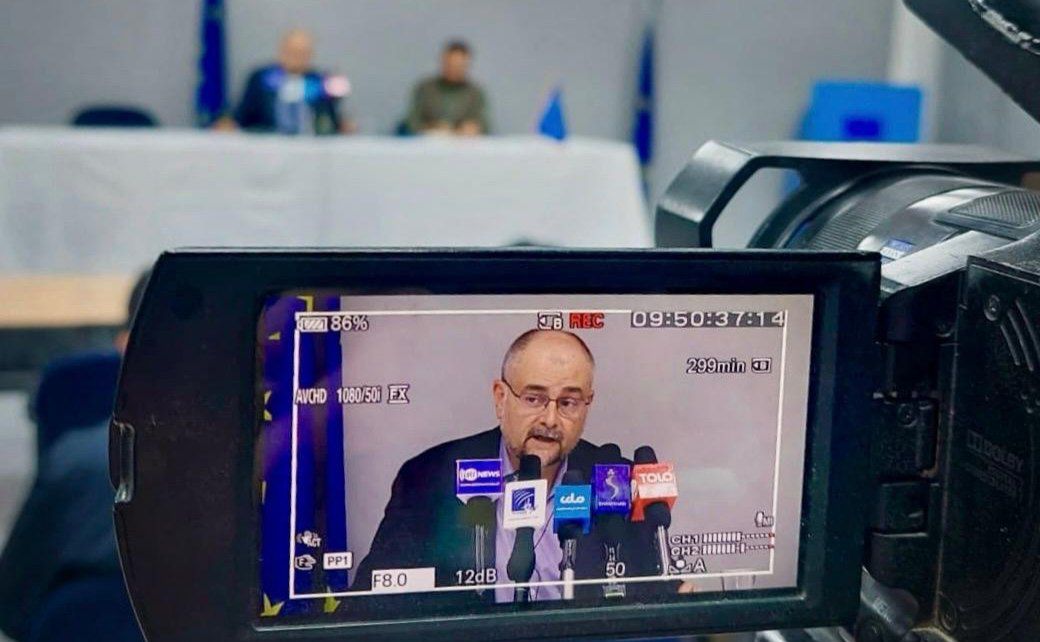
Speaking at the end of a six‑day trip to Kabul from Oct. 10 to 17, Bertrand said he met with Taliban officials, diplomats, civil society representatives and humanitarian actors to discuss urgent issues facing Afghanistan.
Bertrand pressed Taliban and Pakistani officials to resume talks over security tensions, adhere to the cease‑fire declared Oct. 15, and respect one another’s territorial integrity. He emphasized that enduring stability can only come through diplomatic engagement, not force. He endorsed the U.N.-led Doha Process as a viable route to an inclusive Afghan dialogue.
During the visit, Bertrand met with senior Taliban figures including Deputy Prime Minister Mawlawi Abdul Salam Hanafi, Ministers Abdul Kabir and Deen Mohammad Hanif, Information Minister Sher Ahmad Haqqani and Deputy Foreign Minister Mohammad Naeem Wardak. He also held discussions with the U.N., international NGOs, the diplomatic corps, civil society, journalists and business leaders—including women.
According to the statement, many Taliban interlocutors highlighted progress in reducing opium production and advancing counterterrorism measures, especially against the Islamic State Khorasan Province (ISKP). Bertrand expressed cautious recognition of those efforts, while stressing concerns about remaining cross-border militant activity.
Bertrand said he raised with Taliban officials “strong concerns” about growing restrictions on women and girls across social, economic, cultural, civil and political spheres. He criticized the decision to bar female employees from U.N. premises nationwide, calling it a negative gesture to the international community, and reaffirmed the EU’s support for press freedom.
He also highlighted how restrictions on aid providers complicate response efforts. While the EU has invested €1.8 billion in humanitarian, health, education and private sector development since 2021, Bertrand said the newly approved €83 million package faces implementation challenges. He urged the Taliban to reduce barriers that increase costs and reduce the reach of aid.
A thriving private sector, Bertrand said, is essential to Afghan prosperity. He called on the Taliban to facilitate access to microfinance for informal and women-led businesses, allow independent business associations, and craft a transparent legal and regulatory environment to attract investment. He warned that the 48‑hour communication blackout in September had hurt the economy and Afghanistan’s credibility as an investment destination.
Taliban ministers reportedly expressed interest in courting European investment across sectors, but Bertrand cautioned that companies need regulatory predictability, stable rule of law, and effective justice systems to commit resources.
Bertrand underlined that over 4 million Afghans have returned from neighboring countries in recent years, placing severe pressure on housing, services and livelihoods. He said the EU plans to expand its 2025 support for reintegration, working through UNHCR, IOM and NGOs to bolster job creation, health, education and basic assistance in return areas.
Bertrand described the EU’s posture toward Afghanistan as “principled, pragmatic and people‑centered.” He pledged to return frequently and deepen ties with all Afghans committed to a peaceful, inclusive and self-reliant future.