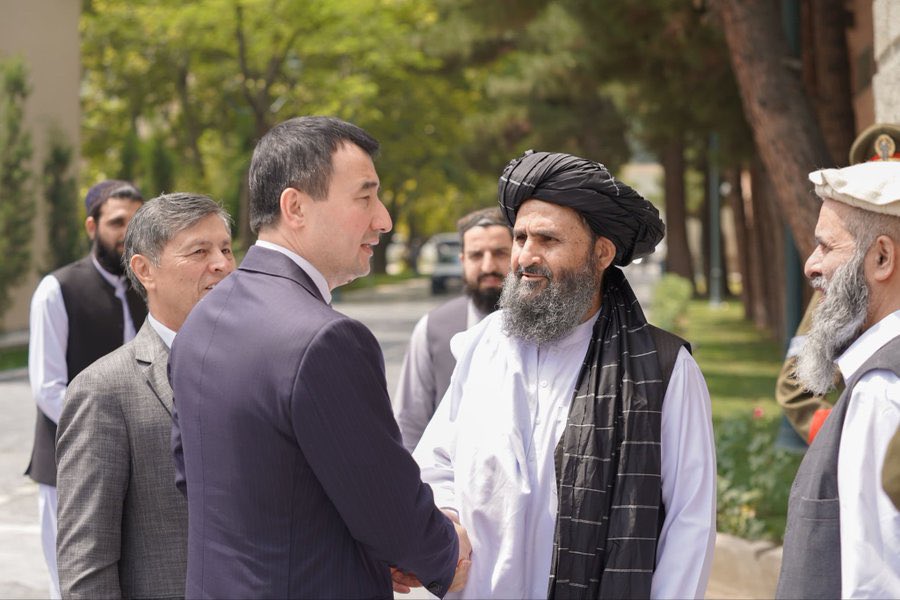
Taliban said on Sunday that Uzbekistan is seeking to accelerate the implementation of joint economic projects, following meetings in Kabul between senior Taliban officials and an Uzbek delegation led by Deputy Prime Minister Jamshid Khojayev.
According to a Taliban statement, Khojayev said Tashkent wants to speed up projects already agreed upon with Taliban and begin implementing commitments made in the areas of trade and investment.
A delegation comprising Uzbek government officials, business leaders and investors, led by Khojayev, arrived in Kabul on Saturday for talks on expanding economic, trade and investment cooperation between the two countries.
During separate meetings with Abdul Ghani Baradar, the Taliban’s deputy chief minister for economic affairs, and Mohammad Hassan Akhund, the Taliban’s chief minister, the two sides discussed strengthening economic ties, accelerating joint projects and removing barriers to trade and transit between Afghanistan and Uzbekistan, according to Taliban statements.
Khojayev said the purpose of the visit was to begin the practical implementation of previously agreed investment and trade commitments. He added that bilateral trade had reached $1.6 billion and that Uzbekistan was prepared to expedite economic projects already underway in Afghanistan.
According to the Taliban, Khojayev also announced Uzbekistan’s readiness to invest in Afghanistan’s mining sector, increase imports of Afghan meat and cotton, and establish a $50 million zinc-processing plant in the northern border town of Hairatan.
Baradar said Afghanistan and Uzbekistan should continue to build relations based on mutual trust and called for resolving outstanding issues in existing agreements, including the Toti Maidan gas extraction project, through dialogue and cooperation.
The two sides also discussed expanding cooperation in the energy, transport, agriculture, banking and trade sectors, according to the Taliban.
Uzbekistan has become one of the Taliban administration’s closest regional economic partners since the group returned to power in 2021. Although Tashkent has not formally recognized the Taliban government, it accepted a Taliban-appointed ambassador in 2024 and has continued to expand economic engagement with them.