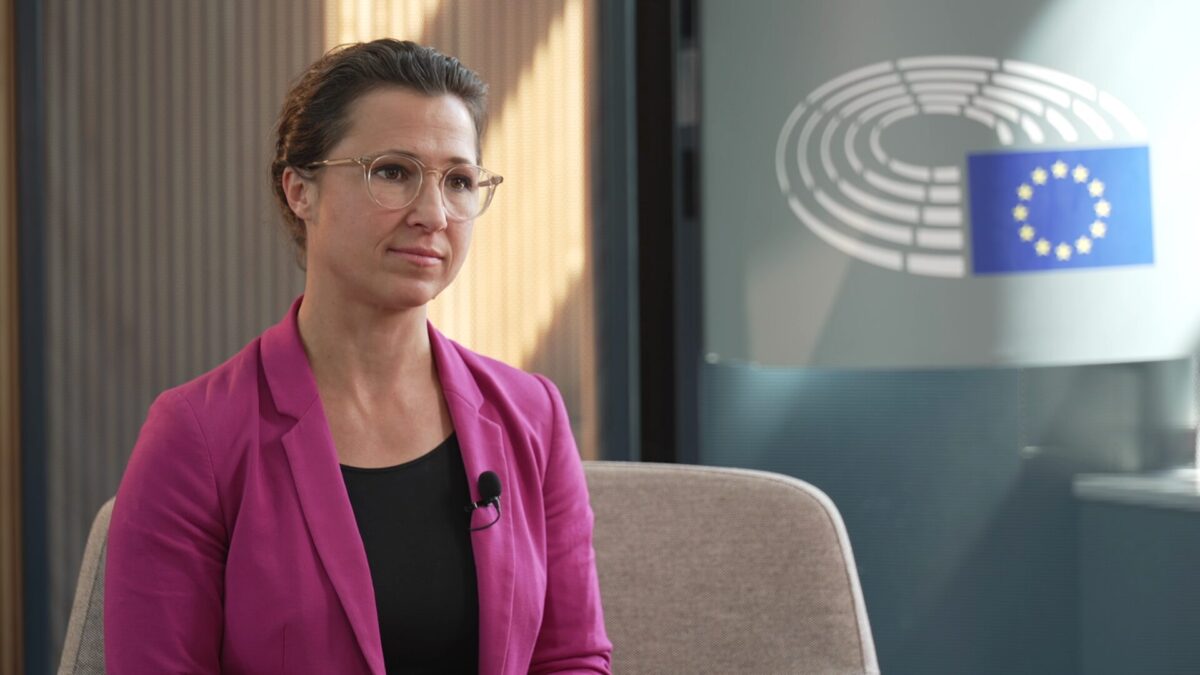
If discussions with the Taliban are truly technical, they should take place in Kabul rather than Brussels, Hannah Neumann, a member of the European Parliament, who is leading opposition to plans for talks between European officials and Taliban in the Belgian capital, said.
In an interview with Amu TV, Neumann said the Taliban’s interest in holding discussions in Brussels was driven not by migration policy but by a desire for international legitimacy.
“If you have to discuss things with the Taliban on deportation, you can do that in Kabul,” Neumann said. “Why is it that the Taliban now want to have these very same discussions in Brussels? Because they want to be invited to the capital of Europe. They want the pictures, the handshakes, everything that looks like they are back at the table.”
The European Commission has invited Taliban representatives to Brussels for discussions on migration and the return of Afghan nationals without legal status in the EU. European officials have described the planned meeting as technical and said it does not amount to recognition of Taliban rule.
The initiative has sparked criticism from rights advocates and some European lawmakers, who argue that it risks normalizing relations with a regime that remains internationally unrecognized and has imposed sweeping restrictions on women and girls.
Neumann said the invitation contradicts conditions the European Union established after the Taliban returned to power in 2021.
At the time, EU member states agreed on a set of benchmarks for engagement, including respect for human rights, meaningful access for humanitarian organizations, action against terrorism and the formation of an inclusive government.
“On human rights, we saw a backlash far worse than anyone expected,” Neumann said. “On inclusive governance, we are so far away from it. Why start an engagement now when they have moved backwards on everything?”
Germany’s example
Neumann said that Germany had already demonstrated the risks of engaging with the Taliban on deportations.
She said Berlin began contacts with Taliban in an effort to facilitate the return of Afghan nationals but ultimately gained little in return.
“In two years, about 50 Afghans were sent back to Afghanistan,” she said. “In return, two Taliban representatives are now in the consulates in Berlin and Bonn.”
According to Neumann, the Taliban have repeatedly sought diplomatic concessions in exchange for cooperation on deportations.
She said the Taliban had demanded invitations to official meetings and greater control over Afghan consular services abroad before agreeing to accept deportees.
“The Taliban basically blackmailed them,” she said.
Effort to block the visit
Neumann said lawmakers and rights advocates are pressing European institutions and Belgian authorities to stop the planned talks from taking place.
“We are trying to make all of that very complicated,” she said.
According to Neumann, 17 EU member states backed a request for the European Commission to organize discussions with Taliban representatives. The Commission has not publicly confirmed that figure.
She warned that Europe risks repeating what she described as Germany’s mistake by granting the Taliban a diplomatic platform while receiving little in return.
“I’m afraid they might run into the very same situation,” she said.
Concerns over Afghan refugees
Neumann also raised concerns about the potential impact on Afghans living in Europe.
Many Afghan refugees sought asylum because of their opposition to the Taliban, she said, arguing that giving Taliban-appointed officials access to Afghan consular services could expose sensitive information about exiles.
“Most of the Afghans are here because they were opposed to the Taliban,” she said. “Now when we give the Taliban access to the consulates, we give them access to the addresses of all these people.”
She warned that the Taliban could eventually use such access to expand what rights groups describe as transnational repression against critics living abroad.
Afghanistan still unsafe
Neumann rejected arguments that deportations can be justified on the grounds that Afghanistan has stabilized under Taliban rule.
“There is no way one could send back Afghans in general in line with the Geneva Convention because Afghanistan is not safe,” she said.
While European governments have largely limited discussions to individuals convicted of serious crimes or considered security threats, Neumann questioned whether deportation was the best solution.
People convicted of sexual offenses should remain in prison rather than be returned to Afghanistan, she argued, while those suspected of extremist activity should remain under supervision rather than disappear from the reach of European authorities.
“It simply doesn’t make sense from a security perspective,” she said.
Four years after the Taliban takeover
Neumann, who visited Afghanistan twice after the Taliban returned to power, said conditions for women and girls have deteriorated dramatically since her meetings with Taliban officials in 2022 and 2023.
She recalled being told that restrictions on girls’ education were temporary and would be lifted once authorities finalized regulations.
Instead, she said, the Taliban expanded the restrictions.
“Since then, they just walked backwards,” she said.
Girls remain barred from secondary schools and universities, while women face growing restrictions on employment and public life.
Neumann said she remains willing to visit Afghanistan again if meaningful engagement with Afghan civil society is possible, but she has been unable to obtain a visa from Taliban.
The Taliban, she said, carefully control who is allowed into the country.
“They do cherry-pick,” Neumann said. “They use that as a propaganda tool.”
For Neumann, the question is not whether the international community should engage with the Taliban, but how.
“I’m not saying we should not talk to the Taliban,” she said. “But inviting them here, giving them visas, giving them these photo opportunities in the capital of Europe—that is something very different.”