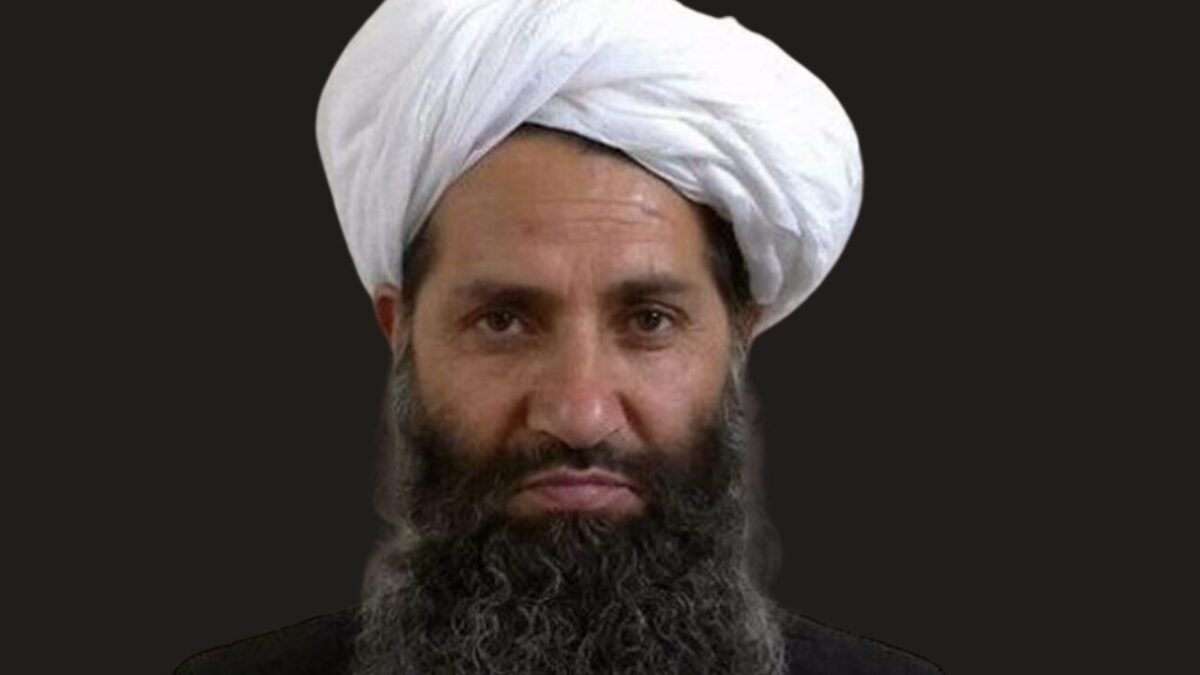
Hibatullah Akhundzada, the Taliban’s supreme leader, used his Eid al-Adha sermon on Wednesday to call on political and military opponents to abandon their resistance, return to Afghanistan and accept Taliban rule.
Speaking for about 50 minutes at Kandahar’s grand mosque, Akhundzada devoted much of his remarks to the importance of obedience to Taliban leadership, arguing that unity among Muslims depends on loyalty to a single ruler.
“Lay down your weapons. We have no issue with you,” Akhundzada said. “We forgave you before and we forgive you now. Come back. This is your country, your land and your system.”
His appeal appeared aimed at former government officials, exiled political figures and armed opposition groups that continue to reject Taliban rule nearly five years after the movement returned to power.
Akhundzada warned against political divisions and said disagreements could threaten the country’s stability. He argued that Muslims are religiously obligated to obey a ruler and said unity would be impossible without a recognized leader.
“It is obligatory for Muslims to have an emir,” he said. “If a person dies without being in obedience to the emir, his death is a death of ignorance.”
The Taliban leader has repeatedly emphasized loyalty to his authority since the Taliban’s return to power in August 2021. During that period, he has issued dozens of decrees that have reshaped Afghanistan’s society, including measures that have severely restricted the rights of women and girls.
Akhundzada also acknowledged the heavy human toll of Afghanistan’s two decades of war but defended the Taliban’s conduct during the insurgency against US-led forces and the former Afghan government.
“Afghans were killed during the war, but that was not our objective,” he said. “We told people not to stand alongside the unbelievers. Our jihad was against the unbelievers, not against you.”
His comments come despite repeated findings by the United Nations and human rights organizations documenting civilian casualties during the insurgency and reporting hundreds of cases of killings, enforced disappearances and arbitrary detentions of former Afghan security personnel since the Taliban takeover.
The UN has recorded numerous allegations of reprisals against former members of the security forces despite the Taliban’s declaration of a general amnesty in 2021.
Akhundzada also defended his decrees and directives, saying they are rooted in Islamic law and should not be subject to criticism.
Throughout the speech, he returned repeatedly to themes of obedience, cohesion and the preservation of what the Taliban describe as an Islamic system of governance.
Residents and local sources said security was exceptionally tight during the Taliban leader’s appearance in Kandahar. Large numbers of Taliban fighters, including personnel equipped with heavy weapons, were reportedly deployed around the Eidgah Mosque and surrounding areas.
Meanwhile, Eid prayers were held separately by senior Taliban leaders at Arg Palace and Sapidar Palace in Kabul, which are two neighboring buildings. Abdul Kabir, the Taliban’s minister of refugees, attended prayers at the Sapidar Palace alongside Taliban foreign minister and foreign diplomats.
The Taliban leader also reiterated his support for relations with other countries based on what he described as Islamic principles. However, the Taliban rule remains largely isolated internationally, with most countries withholding formal recognition and continuing to press the group on issues including women’s rights, political inclusion and compliance with international obligations.
The sermon came as many citizens marked Eid amid economic hardship, widespread poverty and the continuing effects of restrictions imposed since the Taliban’s return to power. Residents interviewed in Kabul and other provinces said financial difficulties and limited opportunities had overshadowed traditional holiday celebrations for many families.