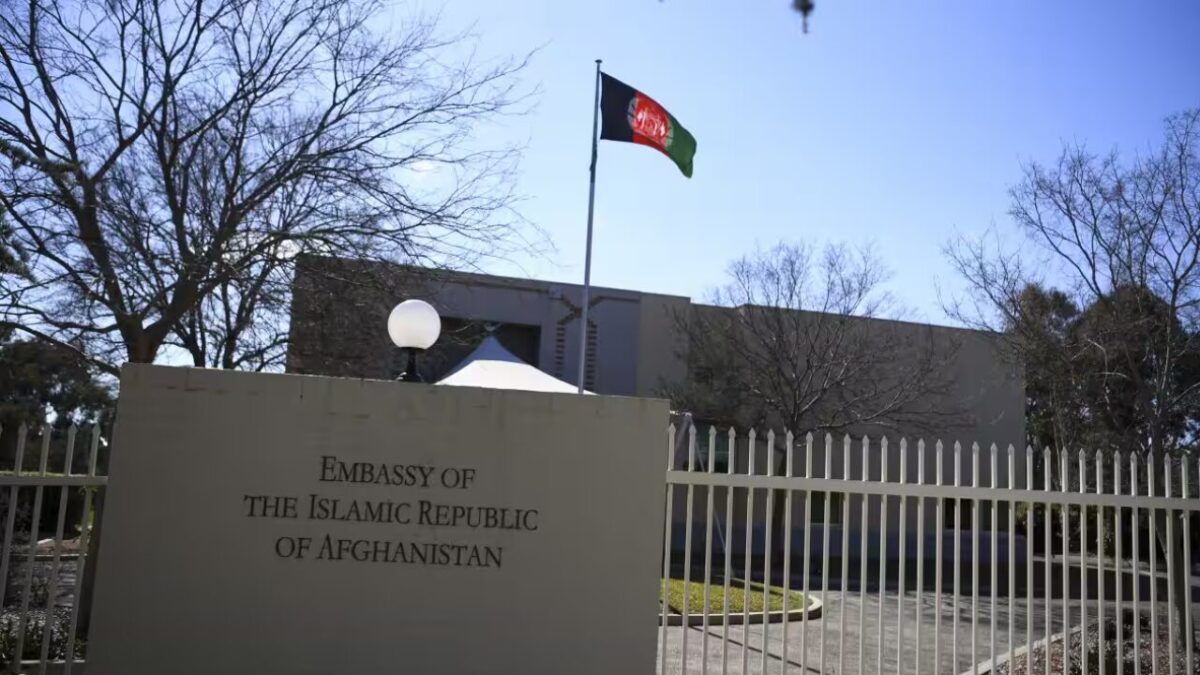
Afghanistan’s embassy in Canberra, which is held by the former government’s diplomats, will suspend operations after June 30, 2026, following consultations with the Australian government, the two sides said in a joint statement on Friday.
In the statement, the embassy and the Australian government said they stood with the people of Afghanistan and did not recognize the Taliban as the country’s legitimate representatives.
They condemned what they described as the Taliban’s “persistent systematic abuses of human rights”, particularly against women and girls and dissenting voices.
The embassy has continued to serve the Afghan-Australian community since the Taliban took Kabul in August 2021, the statement said.
Australia thanked Ambassador Wahidullah Waissi for maintaining operations during what it called a difficult period, while the embassy expressed appreciation for Australia’s humanitarian assistance and engagement with the Afghan community.
“Following consultations instigated by the Australian Government, and in the context of constraints beyond the control of the Embassy, given concerns the situation was not able to continue in perpetuity, we advise that the Embassy’s operations will be suspended after 30 June 2026,” the statement said.
The two sides said the suspension would be carried out through an “orderly and dignified transition” and would not prejudice their principled positions on Afghanistan. Australia added it would continue to respect and protect the embassy premises, property and archives after the closure, in line with international law including the Vienna Convention on Diplomatic Relations.
Australia said it had no intention of accepting a Taliban-appointed diplomat, honorary consul or other representative.
Broader diplomatic context
Since the fall of Afghanistan’s former government in August 2021, dozens of Afghanistan’s diplomatic missions abroad have operated in legal and financial limbo. Many embassies and consulates remained staffed by diplomats appointed before the Taliban takeover, relying on host-country tolerance and limited consular fees while lacking access to state funding or central coordination.
Some countries have allowed such missions to continue on a caretaker basis, while others have closed or downgraded them amid uncertainty over accreditation, staffing and funding. The Taliban have sought to replace pre-2021 diplomats with their own appointees, but most Western governments — including Australia — have refused, citing non-recognition and concerns over human rights.
Humanitarian engagement with Afghanistan has continued through international agencies, even as diplomatic relations remain frozen. Aid groups and the United Nations have repeatedly warned that restrictions on women and girls and limits on civic space complicate assistance delivery.
Australia said it would continue humanitarian support and engagement with Afghans after the Canberra embassy suspends operations.