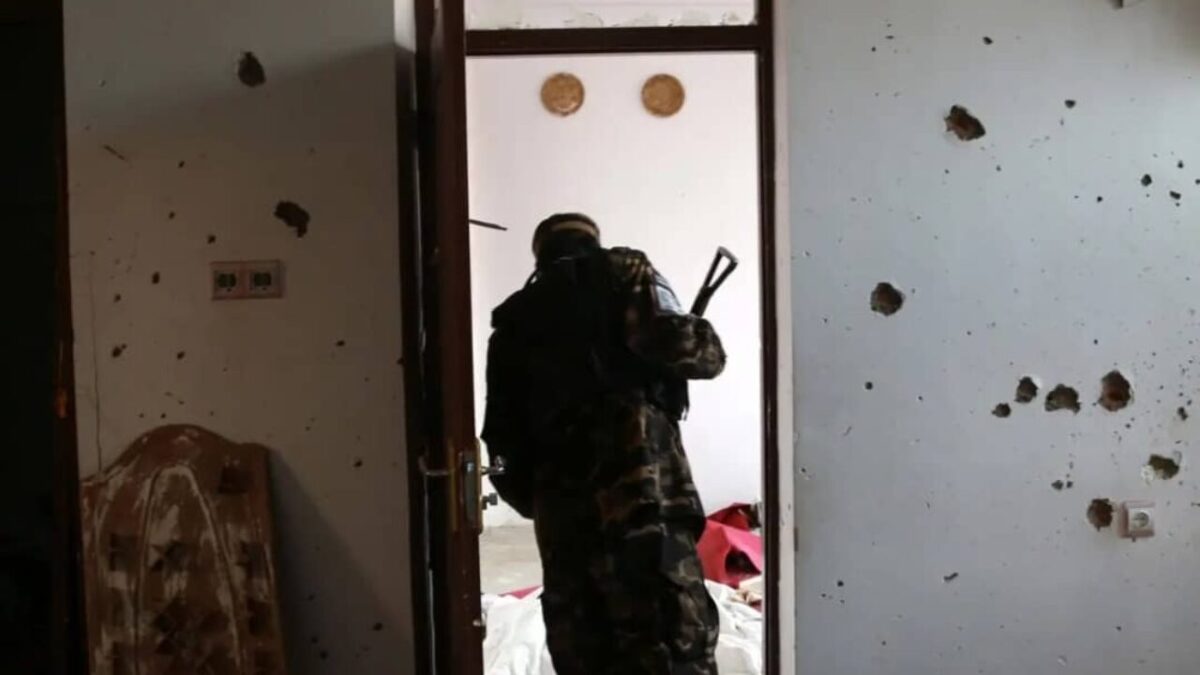
Nearly four years after reclaiming power, Taliban have provided what UN investigators describe as a “permissive environment” for a range of terrorist groups, which pose a serious threat to the security of the region.
A report to the Security Council by the UN’s Analytical Support and Sanctions Monitoring Team said the Taliban “continued to maintain a permissive environment for a range of terrorist groups, including Al-Qaida and its affiliates, posing a serious threat to the security of Central Asian and other countries.”
ISIS-Khorasan: ‘Most serious threat’
The report singled out the Islamic State’s Afghanistan affiliate, ISIL-Khorasan, or ISIS-K, as “the most serious threat, both regionally and internationally.” It estimated the group’s strength at about 2,000 fighters, scattered across northern and northeastern provinces.
Under the leadership of Sanaullah Ghafari, ISIS-K “continued to recruit both inside and outside Afghanistan, including among Central Asian States and the Russian North Caucasus, as well as disaffected fighters from other groups,” the report said. The monitors warned that in areas near the Pakistani border, ISIL-K was indoctrinating children and had “established a suicide training course for minors aged approximately 14 years old.”
Al-Qaida and Pakistani Taliban
The report said Al-Qaida remains present in Afghanistan, consisting mainly of Arab fighters who fought alongside the Taliban in the past. Its fighters are spread across six provinces — Ghazni, Helmand, Kandahar, Kunar, Uruzgan and Zabul — and maintain several training sites, “likely to be small and rudimentary,” some of which are shared with Tehrik-i-Taliban Pakistan, or TTP.
Although weakened, Al-Qaida’s ambitions remain global. According to the report, leader Sayf al-Adl tasked operatives “to reactivate cells in Iraq, the Syrian Arab Republic, Libya and Europe,” reflecting its continued intent to mount external operations.
The TTP was assessed to have about 6,000 fighters in Afghanistan and continued to receive “substantial logistical and operational support from the de facto authorities,” the report said. It noted that “the Taliban have not curtailed TTP activities and in some instances have provided tactical cooperation.” In January 2025, the TTP provided training to militants in Baluchistan, underscoring its role in regional instability.
Foreign fighters and Central Asia risks
The UN also highlighted an influx of foreign fighters, including returnees from Syria. Their presence, it said, has “significantly increased the risk of cross-border terrorist attacks,” particularly against Tajikistan, Uzbekistan and Turkmenistan.
The Eastern Turkistan Islamic Movement, also known as the Turkistan Islamic Party, was cited as especially active. The group issued a new charter in March 2025 advocating a “return to Xinjiang for jihad.” Some of its fighters, along with members of Jamaat Ansarullah of Tajikistan, the Islamic Movement of Uzbekistan and Katiba Imam al-Bukhari, “were used by the de facto authorities in law enforcement and army units for providing domestic security, in particular in north Afghanistan,” the report said.
The monitors also warned that militants were using family members, particularly women, to cross borders and maintain communication networks with external affiliates.
Broader militant landscape
The report listed a network of extremist groups active in Afghanistan, including Islamic Movement of Uzbekistan, with a presence in the north; Turkistan Islamic Party, running training sites; Jamaat Ansarullah of Tajikistan, engaged in recruitment and drills; and smaller jihadist groups from Central and South Asia.
Together, these groups benefit from the Taliban’s permissiveness and the lack of enforcement of international counterterrorism commitments, the report says.
The monitoring team concluded that the Taliban have “not taken sufficient steps to prevent Afghanistan from again becoming a launchpad for international terrorism.” Instead, it said, the regime’s policies “represent a direct threat to international peace and security.”
The Security Council echoed those concerns, warning that entrenched extremist networks in Afghanistan could destabilize the region and pose direct threats to Europe and North America.